
START HERE: Sources, Citations & Media Masterlist for Palestine
- An absurdly thorough yet always WIP resource list for Palestine by Paul Nabil Matthis.
- Supplements my ongoing series Start Here: Palestine available on TikTok and YouTube.
- Find the ⭐ favorited books in one place at Bookshop.org/Lists/Start-Here-Palestine.
- Please consider supporting Denizens Society and any other group listed here.
- 🚨 WARNING 🚨 A lot of the content on this list contains disturbing images, videos, and descriptions.
Share this list absolutely anywhere in any medium, no need to ask.
How To Use This Site
- Different types of media and sources are organized by tabs, such as Books ( on mobile), Film & Media ( on mobile), etc.
- The current tab's outline should display on the left side of your screen on desktop, or display it via the hamburger ☰ menu on mobile.
- Though the list is massive, each section has starred ⭐ favorites, which are what show up in the outline.
- All tabs have direct links, including the subtabs in the Supplement section, if you want to share them elsewhere.
- Use the search in the top-right to find entries via keyword and/or format. Enable suggestions mode if you're looking for recommendations.
- Try clicking on a section in the outline to jump to it!
⭐ SPOTLIGHT: Watermelon Pictures & Watermelon+
Watermelon Pictures is an American film production and distribution company founded in 2024 by Badie and Hamza Aliwas, with Alana Hadid serving as creative director. Its mission is to expand the representation of Palestinian liberatory media and combat the rampant dehumanization of Arabs, Muslims, and Palestinians in cinema.
- Streaming service: Watermelon+ | Watermelon Pictures
- List of films: Films | Watermelon Pictures
- Watch on YouTube: YouTube | Watermelon Pictures
- Request a screening in your area: Screening Request | Watermelon Pictures
- Press: Seeds of Change: How Palestinian-Owned Watermelon Pictures Is Creating Space for Underseen Perspectives | Variety
- Follow on Instagram: Instagram.com/WatermelonPictures
Disclaimers
-
 Free to print and share as long as it's not for commercial purposes. Released under a Creative Commons License.
 -
 The Google Doc is the printable version, and easily linked to via bit.ly/palestinelist or the QR code. As of September 13, 2026, this doc has not been updated since May 29, 2026. I am investigating options to have them both stay in-sync without me having to do it manually, mainly because Gaza encampments sometimes print it out for Rifaat libraries. Regardless, that bit.ly will live on as an archive for as long as those services and accounts function.
 -
 This website links to Bookshop.org whenever possible, an ethical alternative to Amazon that supports local, independent bookstores with every purchase. I am part of the Bookshop Affiliate program and make a small commission when a link on this site leads to a purchase. Anybody can become an affiliate, and I would enourage anyone who discusses books online to consider joining the program.
 -
 The Palestine List is part of the Tech For Palestine network. Tech for Palestine (T4P) is a 501(c)(3) nonprofit starting and scaling initiatives for Palestinian liberation. We support anyone with a meaningful idea, whether it's working against media censorship, using tech to aid protests, scaling boycotts, pushing for tech divestment, supporting Palestinian entrepreneurs, or anything else that contributes to a free Palestine.

Privacy
- This site collects no personal information or non-essential cookies.
- Static search runs locally in your browser.
- An optional "Suggest something for me" feature sends your query elsewhere through a secure API to generate a recommendation.
- This site is reverse proxied through Cloudflare to increase privacy and security.
![Palestinians pick olives during a ceremony marking the start of the olive harvesting season in Deir el-Balah in the central Gaza Strip [Said Khatib/AFP]](https://palestinelist.com/images/olive-harvest-palestine1.jpg)
Thank you for your interest in learning (and unlearning) about our world and the liberation
of oppressed peoples. None of us are free until we all are. Free Palestine.
“If thou hast Knowledge, let others light their Candle at thine.” —Thomas Fuller (1726)
Books
The Big Five (with runners-up):
⭐ The 100 Years' War on Palestine by Rashid Khalidi (2020)
A History of Settler Colonialism and Resistance, 1917–2017Drawing on a wealth of untapped archival materials and the reports of generations of family members, mayors, judges, scholars, diplomats, and journalists, this seminal work upends accepted interpretations of the colonization of Palestine. Instead of framing the conflict as a tragic clash between two peoples with claims to the same territory, Khalidi traces a hundred years of colonial war on the Palestinians, waged first by the Zionist movement and then Israel, backed by Britain and the United States, the great powers of the age. He highlights the key episodes in this colonial campaign, from the 1917 Balfour Declaration to the destruction of Palestine in 1948, from Israel’s 1982 invasion of Lebanon to the endless and futile peace process with which he himself was involved.
- Runners-up by Rashid Khalidi: Palestinian Identity (1997), The Iron Cage (2006), Brokers of Deceit (2013). An unofficial trilogy of works on Palestinian history, politics, and struggle for identity. Khalidi weaves together historical documents, personal stories, and political analysis to present a nuanced perspective on Palestinian nationalism, the obstacles to statehood, and the external influences that have shaped the Israeli-Palestinian conflict. From the late Ottoman period to the present day, these works collectively trace the evolution of Palestinian identity, the entrapments of colonial and post-colonial power dynamics, and the role of international diplomacy in the ongoing quest for peace in the Middle East.
⭐ Palestine: A Four Thousand Year History by Nur Masalha (2018)
Starting with the earliest references in Egyptian and Assyrian texts, this comprehensive work explores how Palestine and its Palestinian identity have evolved over thousands of years, from the Bronze Age to the present day. Drawing on a rich body of sources and the latest archaeological evidence, Masalha shows how Palestine's multicultural past has been distorted and mythologized by Biblical lore and Zionist propaganda, known as “hasbara.” In the process, Masalha reveals that the concept of Palestine is not a modern invention or one constructed in opposition to Israel, but rooted firmly in ancient past, beyond even Herodotus. This book represents the authoritative account of the country's history.
- Nur Masalha: The Palestine Nakba: Decolonising History, Narrating the Subaltern, Reclaiming Memory (2012).. Explores “social history from below”, subaltern narratives of memory and the formation of collective identity. Masalha argues that to write more truthfully about the Nakba is not just to practise a professional historiography but an ethical imperative. The struggles of ordinary refugees to recover and publicly assert the truth about the Nakba is a vital way of protecting their rights and keeping the hope for peace with justice alive.
⭐ The Ethnic Cleansing of Palestine by Ilan Pappé (2006)
This groundbreaking work offers a comprehensive and critical analysis of the horrific events leading up to and following the mass forced expulsion of over 750,000 Palestinian Arabs from their homeland, an event known as the “Nakba” or the Catastrophe. Between 1947 and 1949, over 500 Palestinian villages were deliberately destroyed as civilians were massacred and expelled from their homes at gunpoint. Decisively debunking the myth that the Palestinian population left of their own accord in the course of this war, Ilan Pappe offers impressive archival evidence to demonstrate that, from its very inception, a central plank in Israel’s founding ideology was the forcible removal of the indigenous population. Indispensable reading.
- For firsthand accounts of Palestinians who lived through the Nakba, read Voices of the Nakba: A Living History of Palestine (2021), a collection of stories and interviews compiled by Rosemary Sayigh and edited by Nakba Archive founder Diana Allan.
⭐ Ten Myths About Israel by Ilan Pappé (2017)
This book is directed at audiences with pre-existing notions of Palestine and the Zionist
movement. Many are not aware that they were only taught a small part of the full story, an
aggressively whitewashed version that depicts Zionism
as anything but a modern settler colonial movement. This relatively quick and accessible read
addresses the following myths:
- Palestine was an empty land
- The Jews were a people without a land
- Zionism is Judaism
- Zionism is not colonialism
- The Palestinians voluntarily left their homeland in 1948
- The June 1967 war was a war of ‘No Choice’
- Israel is the only democracy in the Middle East
- The Oslo Mythologies
- The Gaza Mythologies
- The Two-States Solution is the only way forward
- Runners up by Ilan Pappé: As a prominent “new historian” in Israel, Pappé is a prolific and well-respected author. Besides the two books in this top five, his three other most popular books are probably The Biggest Prison on Earth: A History of Gaza and the Occupied Territories, The Idea of Israel: A History of Power and Knowledge, and his collaboration with Noam Chomsky, On Palestine.
⭐ The Palestine Laboratory by Antony Loewenstein (2022)
How Israel Exports the Technology of Occupation Around the WorldIsrael’s military industrial complex uses the occupied Palestinian territories as a testing ground for weaponry and surveillance technology that they then export around the world to despots and democracies alike. Over a half century of occupation of the West Bank and Gaza has given the Israeli state invaluable experience in controlling an “enemy” population, the Palestinians. It’s here that they have perfected the architecture of control. Lowenstein shows in-depth how Palestine has become the perfect laboratory for the Israeli military-techno complex, from surveillance, home demolitions, and indefinite incarceration to the hi-tech tools that power the 'Start-up Nation'. Israel has become a global leader in spy technology and defence hardware that fuels the globe’s most brutal conflicts. As ethno-nationalism grows in the 21st century, Israel has built the ultimate model.
- Runners-up by Antony Loewenstein are Disaster Capitalism and My Israel Question: Reframing The Israel/Palestine Conflict.
Non-Fiction
Justice for Some: Law and the Question of Palestine by Noura Erakat (2019)
One Day, Everyone Will Have Always Been Against This by Omar El Akkad (2025)
Perfect Victims: And the Politics of Appeal by Mohammed El-Kurd (2025)
The Message by Ta-Nehisi Coates (2024)
Zionism During the Holocaust: The weaponisation of memory in the service of state and nation by Tony Greenstein (2022)
- A Historical Survey of Proposals to Transfer Arabs from Palestine 1895 - 1947 by Chaim Simons (1988)
- A History of Jewish-Muslim Relations: From the Origins to the Present Day by Abdelwahab Meddeb and Benjamin Stora (2014)
- A History of the Arab–Israeli Conflict - 9th Edition by Ian J. Bickerton, Carla L. Klausner (2022)
- A Land With a People: Palestinians and Jews Confront Zionism by Esther Farmer, Rosalind Pollack Petchesky and Sarah Sills (2021)
- A Problem from Hell: America and the Age of Genocide by Samantha Power (2013)
- A Quiet Revolution: The First Palestinian Intifada and Nonviolent Resistance by Mary Elizabeth King (2007)
- A Short History of Christian Zionism by Donald M. Lewis (2021)
- A State at Any Cost by Tom Segev (2019)
- A Survey of Palestine, Volume I. and II. and Supplement by J V W Shaw (1991)
- A Year on the Abyss of Genocide by Mahmoud Al-Shaer (2025)
- Against Our Better Judgment: The hidden history of how the United States was used to create Israel by Alison Weir (2014)
- All that remains: The Palestinian villages occupied and depopulated by Israel in 1948 by Walid Khalidi, Sharif S. Elmusa, Muhammad Ali Khalidi (1992)
- An Oral History of the Palestinian Nakba by Dr Nahla Abdo (Anthology Editor), Nur Masalha (Anthology Editor) (2019)
- Arabs and Israelis: Conflict and Peacemaking in the Middle East by Abdel Monem Said, Aly, Shai Feldman, Khalil Shikaki (2013)
- Are You This? or Are You This? by Madian Al Jazerah, Ellen Georgiou (2021)
- Ashkenazi Herbalism by Deatra Cohen, Adam Siegel by Deatra Cohen, Adam Siegel
- Behind the Uprising: Israelis, Jordanians, and Palestinians (Contributions in Political Science) - Melman, Yossi; Raviv, Dan by Yossi Melman, Dan Raviv
- Blaming the Victims: Spurious Scholarship and the Palestinian Question by Edward W Said, Christopher Hitchens, Ibrahim Abu-Lughod, et al. (2001)
Boycott, Divestment, Sanctions: The Global Struggle for Palestinian Rights by Omar Barghouti (2011)
The Jewish Labour Bund
The Bund: A Graphic History of Jewish Labour Resistance by Sharon Rudahl, Paul Buhle, and Michael Kluckner (2023)
- A Bundist Comments on History As It Was Being Made - Zelmanowicz, Motl by Motl Zelmanowicz
- Bundist Counterculture in Interwar Poland – Syracuse University Press by Jack Jacobs
- Here Where We Live Is Our Country: The Story of the Jewish Bund by Molly Crabapple (2026)
- Jewish Politics in Eastern Europe: The Bund at 100 by J Jacobs (2000)
- Poles, Jews, and the Politics of Nationality by The Bund and the Polish Socialist Party in Late Czarist Russia, 1892–1914, Joshua D. Zimmerman (2003)
- The Emergence Of Modern Jewish Politics by Bundism And Zionism In Eastern Europe, Zvi Gitelman (2014)
- Twenty Years with the Jewish Labor Bund by A Memoir of Interwar Poland by Bernard Goldstein (2016)
- Yiddish Revolutionaries in Migration: The Transnational History of the Jewish Labour Bund by Frank Wolff (2021)
- Camp David: Peacemaking and Politics by William B. Quant (1986)
- Checkpoint 300: Colonial Space in Palestine by Mark Griffiths (2025)
- Colonizing Palestine: The Zionist Left and the Making of the Palestinian Nakba by Areej Sabbagh-Khoury (2024)
- Comrades and Enemies: Arab and Jewish Workers in Palestine, 1906–1948 by Zachary Lockman (1996)
Deluge: Gaza and Israel from Crisis to Cataclysm by Jamie Stern-Weiner (2024)
- Drinking the Sea at Gaza: Days and Nights in a Land Under Siege by Amira Hass (1999)
Environmental Warfare in Gaza by Shourideh C. Molavi (2024)
- Ethnocracy: Land and Identity Politics in Israel/Palestine by Oren Yiftachel (2006)
- Every Moment Is a Life: Gaza in the Time of Genocide by Susan Abulhawa, Huzama Habayeb (2026)
- Except for Palestine: The Limits of Progressive Politics by Marc Lamont Hill, Mitchell Plitnick (2022)
- Expulsion of the Palestinians: The Concept of "Transfer" in Zionist Political Thought, 1882-1948 by Nur Masalha
- Fateful Triangle by Noam Chomsky, Edward Said (2014)
Freedom Is a Constant Struggle: Ferguson, Palestine, and the Foundations of a Movement by Angela Davis (2016)
- From Apartheid to Democracy: A Blueprint for Peace in Israel-Palestine by Michael Schaeffer Omer-Man, Sarah Leah Whitson (2025)
- From Coexistence to Conquest: International Law and the Origins of the Arab-Israel by Victor Kattan
- From Stones to Statehood: The Palestinian Uprising - Bennis, Phyllis by Phyllis Bennis
Gaza Unsilenced by Refaat Alareer, Laila El-Haddad (2015)
- Gaza: The Story of a Genocide by Fatima Bhutto and Sonia Faleiro (2025)
- God: An Anatomy by Francesca Stavrakopoulou (2021)
- Hamas: A Beginner's Guide (3rd edition) by Khaled Hroub (2025)
- Hasidism: A New History by David Biale, David Assaf, Benjamin Brown, Uriel Gellman, Samuel Heilman, Moshe Rosman, Gadi Sagiv, and Marcin Wodziński (2017)
- Hezbollah: A Short History by Augustus Richard Norton (2018)
- Homosexual Intifada: A Queer Palestinian Anthology by George Abraham, Hannah Moushabeck (2026)
- I Can Imagine It for Us: A Palestinian Daughter's Memoir by Mai Serhan (2025)
- Imagining Palestine: Cultures of Exile and National Identity by Tahrir Hamdi
- Imperial Perceptions of Palestine British Influence and Power in Late Ottoman Times by Lorenzo Kamel (2018)
- In the Name of Women's Rights The Rise of Femonationalism by Sara R. Farris (2017)
- Intifada: Palestine at the Crossroads by Jamal R. Nassar and Roger Heacock by Jamal R. Nassar, Roger Heacock (1990)
- Intifada: The Long Day of Rage by David Pratt (2005)
- Intifada: Zionism, imperialism and Palestinian resistance by Phil Marshall (1989)
- Israel, Egypt, and the Palestinians: From Camp David to Intifada by Ann M. Lesch, Mark Tessler (1989)
- Israel/Palestine and the Queer International by Sarah Schulman (2012)
- Jewish Socialist Movements, 1871-1917: While Messiah Tarried by Nora Levin by Nora Levin
- Jewish Socialists in the United States: The Cahan Debate, 1925-1926 by Fraser M. Ottanelli (1998)
- Jews and Palestinians in the Late Ottoman Era, 1908-1914 by Louis A Fishman (2021)
- Jews in Early Modern Poland by Gershon David Hundert (1997)
- Letters to Palestine: Writers Respond to War and Occupation by Vijay Prashad (2015)
- Love Is Resistance: 77 Tear-Out Posters for Palestine by Aya Mousawi (2025)
- Memoirs of a Palestinian Communist: The Secret Life of Najati Sidqi by Najati Sidqi (2025)
- Militarization and violence against women in conflict zones in the Middle East by Nadera Shalhoub-Kevorkian (2009)
More books specifically by or about Jews (by request)
Parting Ways: Jewishness and the Critique of Zionism by Judith Butler (2013)
Revolutionary Yiddishland: A History of Jewish Radicalism by Alain Brossat, Sylvie Klingberg, David Fernbach (2017)
The Jewelers of the Ummah: A Potential History of the Jewish Muslim World by Ariella Aïsha Azoulay (2024)
The No-State Solution: A Jewish Manifesto by Daniel Boyarin (2023)
- For Times Such as These: A Radical's Guide to the Jewish Year by Ariana Katz, Jessica Rosenberg (2024)
- Genocide Bad: Notes on Palestine, Jewish History, and Collective Liberation by Sim Kern (2025)
- On Antisemitism: Solidarity and the Struggle for Justice by Jewish Voice for Peace (2017)
- Solidarity Is the Political Version of Love: Lessons from Jewish Anti-Zionist Organizing by Rebecca Vilkomerson, Alissa Wise (2024)
- The Anti-Defamation League and the Racial State by Emmaia Gelman (2026)
- The Stars Bear Witness: Five Years in the Warsaw Ghetto by Bernard Goldstein (1947)
- Unsettled: American Jews and the Movement for Justice in Palestine by Oren Kroll-Zeldin (2024)
- Nakba and Survival: The Story of Palestinians Who Remained in Haifa and the Galilee, 1948–1956 by Adel Manna (2022)
- Nakba, 1948, and the Claims of Memory | Institute for Palestine Studies by Saleh Abd al-Jawad, edited by Sa`di and Abu-Lughod (2007)
- Nazi Billionaires: The Dark History of Germany's Wealthiest Dynasties by David de Jong by David de Jong (2023)
- Neoliberal Apartheid: Palestine/Israel and South Africa after 1994 by Andy Clarno (2017)
- Occupied by Memory: The Intifada Generation and the Palestinian State of Emergency by John Collins (2004)
- On the Pleasures of Living in Gaza: Remembering a Way of Life Now Destroyed by Mohammed Omer Almoghayer (2025)
- Once Upon a Country: A Palestinian Life by Sari Nusseibeh, Anthony David (2008)
One-State Solution
- After Zionism: One State for Israel and Palestine by Antony Loewenstein, Ahmed Moor (2024)
Decolonizing Israel, Liberating Palestine by Jeff Halper (2021)
- The One State Reality: What Is Israel/Palestine? by Michael Barnett, Nathan J Brown, Marc Lynch, et al. (2023)
- The One-State Condition Occupation and Democracy in Israel/Palestine by Ariella Azoulay, Adi Ophir (2012)
- The One-State Solution: A Breakthrough for Peace in the Israeli-Palestinian Deadlock by Virginia Tilley (2010)
- Our Palestine Question: Israel and American Jewish Dissent, 1948-1978 by Geoffrey Levin (2023)
- Palestine and Israel in the 19th and 20th Centuries, Edited By Elie Kedourie, Sylvia G. Haim by Elie Kedourie, Sylvia G. Haim
- Palestine and Marxism by Joseph Daher (2024)
- Palestine and the Decline of the Ottoman Empire: Modernization and the Path to Palestinian Statehood (Library of Ottoman Studies) by Al-Salim, Farid (2014)
- Palestine Hijacked by Thomas Suárez
- Palestine in Israeli School Books: Ideology and Propaganda in Education by Nurit Peled-Elhanan (2012)
- Palestine Is Everywhere by Skye Arundhati Thomas (2025)
- Palestine Triangle: Struggle Between the British, the Jews and the Arabs, 1935-48 by Nicholas Bethell
- Palestine: A Socialist Introduction by Sumaya Awad and Brian Bean (2020)
- Palestine: History of a Lost Nation by Karl Sabbagh (2008)
- Palestine: Peace Not Apartheid by Jimmy Carter (2007)
- Partitioning Palestine by John Strawson (2010)
- Pogroms anti jewish violence modern russian history | European history after 1450 | Cambridge University Press by John Doyle Klier and Shlomo Lambroza (2004)
- Presidential Diplomacy and Its Discontents: Jimmy Carter and the Middle East Dispute by Daniel Strieff (2015)
- Preventing Palestine: A Political History from Camp David to Oslo by Seth Anziska (2020)
- Probing the Ethics of Holocaust Culture by Wulf Kansteiner, Todd Presner, Claudio Fogu (2016)
- Rise and Kill First: The Secret History of Israel’s Targeted Assassinations by Ronen Bergman (2019)
- Socialism in Yiddish - New Politics by Hakkan Blomqvist, Translated by Blomqvist and Glasser (2021)
- Stone Men: The Palestinians Who Built Israel by Andrew Ross (2021)
- Taking the State out of the Body: A Guide to Embodied Resistance to Zionism by Eliana Rubin (2024)
- Terms of Servitude: Zionism, Silicon Valley, and Digital/Settler-Colonialism in the Palestinian Liberation Struggle by Omar Zahzah (2025)
- The Battle for Justice in Palestine by Ali Abunimah (2014)
- The Birth of Israel: Myths and Realities by Simha Flapan (1987)
- The Camp David Accords: A Testimony by Mohamed Ibrahim Kamel (1986)
- The Complicit Lens: US Media Coverage of Israel's Genocide in Gaza by Robin Andersen (2026)
- The Destruction of Palestine is the Destruction of the Earth by Andreas Malm (2025)
- The Empty Wagon: Zionism's journey from identity crisis to identity theft | Yaakov Shapiro by Yaakov Shapiro
- The Eyes of Gaza: A Diary of Resilience by Plestia Alaqad (2025)
- The First Zionist Congress: An Annotated Translation of the Proceedings Michael J. Reimer by Michael J. Reimer (2019)
- The Gaza Strip: The Political Economy of De-Development by Sara Roy (2007)
- The Genealogical Science: The Search for Jewish Origins and the Politics of Epistemology by Nadia Abu El-Haj by Nadia Abu El-Haj (2014)
- The General's Son: Journey of an Israeli in Palestine by Miko Peled
- The Hollow Half: A Memoir of Bodies and Borders by Sarah Aziza (2025)
- The Holocaust and the Nakba by Bashir Bashir and Amos Goldberg (2018)
- The Intifada: Its Impact on Israel, the Arab World, and the Superpowers | Institute for Palestine Studies by Robert O. Freedman (1991)
- The Israel Lobby and U.S. Foreign Policy by John Mearsheimer, Stephen M. Walt (2007)
- The Jews of Poland: A Social and Economic History of the Jewish Community in Poland from 1100 to 1800 by Bernard D. Weinryb (1973)
- The New Middle East by Shimon Peres by Shimon Peres
- The October War: A Retrospective by Richard B. Parker (2001)
- The Origins of Palestinian Nationalism by by Muhammad Muslih | Institute for Palestine Studies (2005)
- The Oslo Accords 1993–2013: A Critical Assessment by Mohammed Omer, Petter Bauck (2013)
- The Oslo Accords: International Law and the Israeli-Palestinian Peace Agreements by Geoffrey R. Watson (2000)
- The Oslo Peace Process: From Breakthrough to Breakdown by Petter Bauck and Mohammed Omer (2016)
- The Other Walls: The Arab-Israeli Peace Process in a Global Perspective by Harold H. Saunders (1991)
- The Palestinian Uprising: A War by Other Means - F. Robert Hunter by F. Robert Hunter
- The Peace Process: From Breakthrough to Breakdown by Afif Safieh by Afif Safieh
- The Pity of It All: A Portrait of the German-Jewish Epoch, 1743-1933 by Amos Elon (2002)
- The Population of Palestine: Population History and Statistics of the Late Ottoman Period and the Mandate by Justin McCarthy (1990)
- The Problems of Genocide: Permanent Security and the Language of Transgression by A. Dirk Moses (2021)
- The Storyteller of Jerusalem: The Life and Times of Wasif Jawhariyyeh by Wasif Jawhariyyeh, Salim Tamari
- Thirteen Days in September: The Dramatic Story of the Struggle for Peace by Lawrence Wright (2015)
- Towers of Ivory and Steel: How Israeli Universities Deny Palestinian Freedom by Robin Maya Wind (2024)
- Unfree in Palestine Registration, Documentation and Movement Restriction by Nadia Abu-Zahra, Adah Kay (2012)
- Visualizing Palestine by Jessica Anderson, Aline Batarseh, Yosra El Gazzar (2024)
- Wake Up and Reclaim Your Humanity: Essays on the Tragedy of Israel-Palestine by Richard Forer (2020)
- We Could Have Been Friends, My Father and I: A Palestinian Memoir by Raja Shehadeh (2024)
- Wishing Upon a Star: A Tale of the Holocaust and Hope | Eline Hoekstra Dresden by Eline Hoekstra Dresden
- Year Zero of the Arab-Israeli Conflict: 1929 by Hillel Cohen, Haim Watzman (2015)
- Yiddish Civilization: The Rise and Fall of a Forgotten Nation by Paul Kriwaczek (2011)
- Zionism and Anti-Semitism in Nazi German by Francis R. Nicosia (2010)
Adult Fiction
Men in the Sun by Ghassan Kanafani (1962)
- A Curious Land: Stories from Home by Susan Muaddi Darraj (2015)
- Balcony on the Moon: Coming of Age in Palestine by Ibtisam Barakat (2009)
- Discipline by Randa Abdel-Fattah (2025)
- Enter Ghost by Isabella Hammad (2024)
- Everything Comes Back to You by Jackie Khalilieh (2026)
- I Saw Ramallah by Mourid Barghouti (1997)
- In Search of Fatima: A Palestinian Story by Ghada Karmi (2002)
- Khaled and Jamila by Anan Ameri (2025)
Light in Gaza: Writings Born of Fire by Jehad Abusalim, Jennifer Bing, Mike Merryman-Lotze, Refaat Alareer (2022)
- Martyr! by Kaveh Akbar (2024)
- Minor Detail by Adania Shibli (2020)
- Palestine +100: Stories from a Century After the Nakba by Edited by Basma Ghalayini (2021)
- Palestine Minus One: Stories from the Eve of the Nakba by Basma Ghalayini (2025)
- Salt Houses by Hala Alyan (2018)
- Sharon and My Mother-in-Law: Ramallah Diaries by Suad Amiry
- The Coin by Yasmin Zaher (2024)
- The Free People's Village by Sim Kern
- The Salvage by Anbara Salam (2025)
- The Slightest Green by Sahar Mustafah (2025)
- The Woman from Tantoura: A Novel of Palestine by Radwa Ashour (2014)
- Where the Bird Disappeared by Ghassan Zaqtan (2018)
- You Exist Too Much by Zaina Arafat (2021)
Poetry
- Birthright by George Abraham
- Born Palestinian, Born Black & The Gaza Suite by Suheir Hammad
- Dear God, Dear Bones, Dear Yellow by Noor Hindi
- Diary of a Wave Outside the Sea by Dunya Mikhail (poetry and prose) (2009)
- Doves & Olives (Right of Return) by Farah Ayaad (2024)
- Enemy of the Sun: Poetry of Palestinian Resistance by Naseer Aruri, Edmund Ghareeb (2025)
- Everything Comes Next: Collected and New Poems by Naomi Shihab Nye by Naomi Shihab Nye (2022)
- His Hand Fell by Muhammed Abdulrahim Saleh (2023)
- I Remember My Name by Vacy Vlazna (2016)
- In Jerusalem and Other Poems by Tamim Al-Barghouti (2016)
- Life in a Country Album by Nathalie Handal
- Making Mirrors: Writing/Righting by Refugees by Becky Thompson and Jehan Bseiso (2019)
- My Voice Sought the Wind by Susan Abulhawa (2013)
- Nothing More To Lose by Najwan Darwish
- Quiet Orient Riot by Nathalie Khankan
- Rifqa by Mohammed el-Kurd (2021)
- Ruins and Other Poems by Samer Abu Hawwash (2025)
- So What: New and Selected Poems 1971-2005 by Taha Muhammad Ali
- Stranger by Nyla Matuk (2017)
- The Silence That Remains: Selected Poems by Ghassan Zaqtan, tr. Fady Joudah by Ghassan Zaqtan
Things You May Find Hidden in My Ear: Poems from Gaza by Mosab Abu Toha (2022)
- Thirteen Departures From the Moon by Deema K. Shehabi
- Water to Water: Gaza Renga by Marilyn Hacker, Deema K. Shehabi (2025)
- We Begin Here: Poems for Palestine and Lebanon by Kamal Boullata and Kathy Engel (2007)
- What Have You Lost? by Naomi Shihab Nye and Michael Nye (1999)
Kids Lit
- A Child's View from Gaza: Palestinian Children's Art & the Fight Against Censorship by Middle East Children’s Alliance (2012)
- A Little Piece of Ground by Elizabeth Laird
- Against Erasure: A Photographic Memory of Palestine Before the Nakba by Teresa Aranguren, Sandra Barrilaro, Mohammed El-Kurd (2024)
- Baddawi by Leila Abdelrazaq
- Code Name: Butterfly by Ahlam Bsharat
- Determined to Stay: Palestinian Youth Fight for Their Village by Jody Sokolower (2021)
Everything Grows in Jiddo's Garden by Jenan Matari, Aya Ghanameh (illustrator) (2025)
- Farah Rocks Fifth Grade by Susan Muaddi Darraj, Ruaida Mannaa (2023)
- Finding Melody Sullivan by Alice Rothchild (2023)
Gaza Writes Back: Short Stories from Young Writers in Gaza, Palestine by Refaat Alareer (2014)
- Halal Hot Dogs by Susannah Aziz, Parwinder Singh (2021)
Homeland: My Father Dreams of Palestine by Hannah Moushabeck, Reem Madooh (Illustrator) (2023)
- Jerusalem: Chronicles from the Holy City by Guy Delisle
- Mama in Congress: Rashida Tlaib's Journey to Washington by Rashida Tlaib, Miranda Paul (2022)
- Olive Harvest in Palestine: A Story of Childhood Memories by Wafa Shami (2019)
- Palestine Speaks: Narratives of Life Under Occupation by Mateo Hoke, Cate Malek (2021)
- Power Born of Dreams: My Story Is Palestine by Mohammad Sabaaneh (2021)
- Salim's Soccer Ball by Tala Fahmawi, Neveen Abu Saleem (2022)
- Sitti's Bird: A Gaza Story by Malak Mattar
- Squire by graphic novel by Nadia Shammas & Sara Alfageeh (2022)
- The Olive Tree Said to Me by N Salem (2021)
- The Shepherd's Granddaughter by Anne Laurel Carter (2008)
- The Story of Hurry by Emma Williams
These Olive Trees by Aya Ghanameh (2023)
- They Called Me a Lioness: A Palestinian Girl's Fight for Freedom by Ahed Tamimi, Dena Takruri (2023)
- Three Wishes: Palestinian and Israeli Children Speak by Deborah Ellis (2006)
- Understanding the Palestinian-Israeli Conflict: A Primer by Phyllis Bennis
- We Are Palestinian: A Celebration of Culture and Tradition by Reem Kassis, Noha Eilouti (2023)
- Young Palestinians Speak: Living Under Occupation by Anthony Robinson (2017)
Cookbooks
Falastin: A Cookbook by Sami Tamimi, Tara Wigley (2020)
- A Taste of Palestine: Menus and Memories by Aziz Shihab
- Arabiyya: Recipes from the Life of an Arab in Diaspora by Reem Assil
- Classic Palestinian Cuisine by Christiane Dabdoub Nasser
- Craving Palestine by Lamees AttarBashi
- Dine in Palestine: An Authentic Taste of Palestine in 60 Recipes from My Family to Your Table by Heifa Odeh
- The Gaza Kitchen: A Palestinian Culinary Journey by Laila El-Haddad, Maggie Schmitt
- Zaitoun: Recipes from the Palestinian Kitchen by Yasmin Khan
Other Palestine Reading Lists
All starred books on this list at Bookshop
Reading list | Decolonize Palestine
Books for Students | Teach Palestine
Free Palestine: A Verso Reading List From the River to the Sea
Free Palestine! A Reading List | HaymarketBooks.org
From the River to the Sea: Essays for a Free Palestine
- 18 Palestinian Writers to Add to Your Reading List | Boston Public Library
- 40 Books to Understand Palestine ‹ Literary Hub
- A Palestine Reading List - Words Without Borders
- A Reading List on Israel/Palestine - Washington University in St. Louis
- Books & Prints – Shop Palestine
- Books For Palestine | Bookshop
- Decolonize Palestine Reading List (100 books)
- Free Palestine - A Reading List - Pluto Press
- Israel/Gaza After October 7: Compiled Resources
- List of books by Avi Shlaim - Thriftbooks
- List of books by Edward W. Said - Thriftbooks
- List of books by Ghassan Kanafani - Thriftbooks
- List of books by Ilan Pappé - Thriftbooks
- List of books by Mahmoud Darwish - Thriftbooks
- List of books by Norman G. Finkelstein - Thriftbooks
- List of books by Nur Masalha - Thriftbooks
- List of books by Rashid Khalidi - Thriftbooks
- Our History of Popular Resistance: Palestine Reading List | Palestinian Youth Movement
- Palestine - Israel
- Palestine Book Awards | All books
- Palestine reading list
- Palestine-Israel history category | Middle East Books
- Palestine-Israel tagged "Peace Process"
- Palipunk's Palestine Masterlist
- Reading List: Palestinian Studies – UC Press
- Solidarity with Palestine - A Radical Black Feminist Mandate: A Reading List
- SOURCES FOR PALESTINE (last updated August 29th 2024)
- The Palestine Reading List - OR Books
Film & Video
Documentaries
-
⭐ The Encampments | Official Trailer | Only In Theaters March 28, 2025
-
⭐ Israelism (2023)
-
⭐ Palestine '36 (2026)
-
American Doctor (2026)
-
Land of Canaan (2026)
-
The Palestine Exception (2024)
-
Palestine Action: The Truth Behind the Ban (2026)
-
⭐ Tantura (2022)
-
⭐ Investigating war crimes in Gaza I Al Jazeera Investigations 2024
-
⭐ 5 Broken Cameras I POV PBS I Documentary 2012
-
⭐ Gaza Fights For Freedom (2019) | Full Documentary | Directed by Abby Martin
-
⭐ The Occupation of the American Mind (original 84-minute version) 2016
-
⭐ Life in Occupied PALESTINE by Anna Baltzer 2014
-
⭐ Gaza Is Our Home // Documentary by Monear Shaer 2024
- Watch for free on YouTube. When Monear Shaer first started making a slideshow about his Palestinian family, he thought he was highlighting the beauty of life in Gaza. But when the onslaught of the 2023 invasion developed, it became imperative that the true reality and first hand experience of life in his family’s homeland is shown to the world. Monear’s first feature-length documentary shows just a few of the millions of heartbreaking injustices that have been occurring over the last several decades.
- Trailer | No Other Land | Yuval Abraham, Basel Adra, Hamdan Ballal, Rachel Szor 2024
- From Ground Zero | Official Trailer HD | In Theaters NOW! 2025
- Life Is Beautiful: A Letter To Gaza | Official Trailer HD | In Theaters Nov 15 & On Digital Nov 26 2024
- The Promise | Official Trailer 2025
- To A Land Unknown | Official Trailer | Only In Theaters July 11, 2025
- Lyd | Official Trailer 2023
- How Israel Won the West | Omer Bartov 2024
- COMING AROUND (Trailer) - Frameline47 2023
- ‘The Night Won’t End’: Biden’s War on Gaza | Fault Lines | Al-Jazeera (2024)
- Where Olive Trees Weep: Official
Trailer (2024)
- Featuring Palestinian journalist and therapist Ashira Darwish, grassroots activist Ahed Tamimi, and Israeli journalist Amira Hass, and antizionist Holocaust survivor Dr. Gabor Maté.
- 1948: Creation & Catastrophe (Full documentary) (2017)
- Born in Gaza (Official Trailer) (2014)
- BYE BYE TIBERIAS Trailer | TIFF 2023
- IBRAHIM: A FATE TO DEFINE Trailer | TIFF 2019
- My Tree 🌍 Full Exclusive Documentary Premiere 🌍 English HD 2023
- Israel's Reel Extremism Zeteo (2024)
- Three Promises (2023)
- Gaza Surf Club (2016)
- Speed Sisters (2015)
- PBS: 1913 - Seeds of Conflict (2015)
- Killing Gaza (2014)
- Death in Umm al-Hiran (2024)
- RACHEL | Women Make Movies | Trailer (2010)
- Tell your tale little bird (2007)
- The Color Of Olives | Official Trailer HD 2006
- MUR [tr. “Wall”] (2004)
- A WORLD NOT OURS Trailer | Festival 2012 | Human Rights Watch 2013
- IDFA 2009 | Trailer | To Shoot an Elephant (2009)
- Arna's Children (2023)
- Two Blue Lines (2023)
- To See if I'm Smiling | OFFICIAL TRAILER | A film by Tamar Yarom (2007)
- فيلم المنام ~ محمد ملص / The Dream 1987
- Edward Said, 1986, Exile | from the
BBC series ‘Exiles’.
- Edward Said & Salman Rushdie [1986]
- Edward Said - Reflections on Exile and Other Essays
- In Search of Palestine - Edward Said's Return Home - BBC 1998
- Edward Said: 'Out of Place' | Al Jazeera World Documentary 2018
- Edward W. Said Interview (2002)
- Edward Said: The Last Interview [2003]
- Edward Said On Orientalism dir. Sut Jhally, 1998
- Interview with Edward Said with Michaël Zeeman for the Dutch TV program Leven en Werken
- The Palestinian (Al-Falastini) 1977, dir. Roy Battersby feat. Vanessa Redgrave
- Occupied Palestine (1981) directed
by David Koff
- Recently rediscovered followup to The Palestinian
- Here and Elsewhere (1976)
- Jean-Luc Godard and Anne-Marie Miéville
- The Land Speaks Arabic (2003)
- أرشيف المتحف
الفلسطيني الرقمي : "Some Palestinians" Documentary, the Experience of Palestinian Camps'
Doctor Is'af Murad, 1960-1969
- A Palestinian doctor works in the UNRWA clinic, and several Palestinian camps in Syria and southern Lebanon, before and after the 1967 Naksa.
- [AFF2022] Fadia's Tree (Trailer) (2022)
- The Settlers (inside the Jewish settlements)(2023)
- Gaza Is Our Home // Documentary by Monear Shaer (2024) (Official site)
- Stitching Palestine Trailer 2017
- Ross Kemp: Middle East - Investigating Issues in Gaza & Israel Compilation | Ross Kemp Extreme World (2018)
- Six-Day War: Censored Voices | A film by Mor Loushy (2015) (Review)
- The War Around Us (2014)
- 2017 Palestinian Film Festival Australia - From Under The Rubble - Trailer
- GAZA Trailer (Sundance 2019) - Garry Keane, Andrew McConnell Documentary
- Jenin Jenin (Full Movie) - فيلم جنين, جنين - Muhammad Bakri (English Subtitles) (2003)
- Tears of Gaza | Official Trailer | DocPlay (2010)
- 'Occupation 101' Full Movie | The Truth About the Creation of Israel | Censored on Mainstream Media! (2006)
- Death in Gaza Documentary
HQ (2004)
- the James Miller one
- Rising in Solidarity: Palestine and the Arab Revolution (2023)
- "Jaffa – The Orange’s Clockwork" | Official Trailer | OWR17 by Eyal Sivan
Mini-docs
-
⭐ Queers for Palestine & The Power of Pinkwashing Matt Bernstein (2023)
-
⭐ Resistance Climbing (2023)
- Al-Jazeera
- How Israeli Apartheid Destroyed My Hometown
- “They Could Kill Me At Any Time”: Life Under Israeli Occupation
- Palestine 1920: The Other Side of the Palestinian Story | Al Jazeera World Documentary
- Gaza: Surviving Shujayea | Al Jazeera World (2018)
- Farah: Scarred by Gaza's War | Al Jazeera World (2017)
- Defying My Disability | Al Jazeera World (2016)
-
⭐ The Holy Land Five (2016)
- Praying for Armageddon: Evangelicals, the US and the Middle East | Israel War on Gaza | Al Jazeera
- Al-Shifa Hospital: The Crimes They Tried to Bury 2024
- How a Zionist armed group helped create the state of Israel | Al Jazeera World Documentary 2024
- The Palestinian family resisting Israeli land grabs in the occupied West Bank | Witness Documentary 2024
- The man behind Gaza’s Great March of Return | Witness Documentary (2023)
- My life as a Palestinian fighter | Close Up 2023
- Starving Gaza: How Israel’s man-made famine is killing Palestinians | Fault Lines Documentary 2024
- The Occupied West Bank
- The Other Front (2023)
- Skies Above Hebron (2021)
- USS Liberty incident
- Israeli Settlers in the Occupied West Bank The Atlantic (2018)
- Between two crossings - Trailer (2018)
- Britain in Palestine 1917-1948 (2023)
- Cinema Fouad (1993) with English Subs
- Unspoken (إحكِ) (2018)
- Echo (2022)
- Enduring Roots: Over a Century of Resistance to the Jewish National Fund (JNF-KKL) (2014)
- They Do Not Exist (1974)
- Angel of Gaza (2021)
- Palestine Is Still the Issue (2002)
- Scenes of the Occupation from Gaza مشاهد من الاحتلال في غزة ( 1973 )
- Blowback: How Israel Helped Create Hamas The Intercept (2018)
- Rachel Corrie: Parents & Friend Remember U.S. Activist Crushed by Israeli Bulldozer in Rafah in 2003
- Children of Shatila (1998) - Mai Masri | #israel #palestine #gaza #lebanon #beirut
Feature Films
-
⭐ FARHA (2021)
-
⭐ Elia Suleiman
- 200 Meters - Trailer | Ajyal Film Festival 2020 (2020)
- The Teacher | Official Trailer | Only In Theaters April 11 2025
- Theeb Official Trailer 1 (2015) - Foreign Drama HD
- Inshallah a Boy | Jordan’s Oscars Entry | Official Trailer (2023)
- SIFF 2023 Trailer: A House in Jerusalem
- Wajib (2017) Trailer
- 3000 Nights | Official Trailer (2015)
-
⭐ Omar Official Trailer (2013) - Oscar Nominated Palestinian Thriller HD
- LEMON TREE OFFICIAL TRAILER (2008)
- "Salt of this Sea" trailer with English titles by Annemarie Jacir with Suheir Hammad and Saleh Bakri (2008)
- Hikayatul jawahiri thalath (1995)
[حكاية الجواهر الثلاثة] (1995)
- “The Tale of Three Jewels.” Arabic audio only, but the auto-translated captions aren’t too bad.
Shorts
-
⭐ THE PRESENT (2020)
-
⭐ Quneitra '74 / قنيطرة ٧٤ (Mohammad Malas, 1974)
- THE KEY (2024)
- Blood Like Water (2023)
- An Orange from Jaffa | Trailer
- Home Sweet Home | Short Film about Israeli's Apartheid (2022)
- Like Twenty Impossibles by Annemarie Jacir (Trailer) (2003)
- AFMI
People of the Land Collection
- Wild Plants of Palestine by Alaa Abu Asad
- Closeness to the Land by Mona Gazala
- Mariam by Dana Durr
- Under the Lemon Tree by Noor Al-Asswad
- Something from there by Rana Nazzal Hamadeh
- Sci-fi trilogy by Larissa Sansour
- A Space Exodus (2008)
- Nation Estate (2012)
- In the Future They Ate from the Finest Porcelain (2015)
TV
-
⭐ The Promise (2011)
Talks, Interviews, Video Essays
-
⭐ Debunking "Screams Before Silence," Sheryl Sandberg’s 7 October "mass rapes" film, with Ali Abunimah
-
⭐ PFLP Ghassan Kanafani, Richard Carleton interview COMPLETE Beirut (1970)
-
⭐ The splendid tapestry: How DNA reveals truths, ancient & lasting | Nathan Pearson | TEDxBoston
-
⭐ Palestine in Israeli School Books: Nurit Peled-Elhanan
-
⭐ Discriminatory Laws with Hassan Jabareen, General Director of Adalah
- How Palantir, Google & Amazon armed Israel's genocide in Gaza | Antony Loewenstein | The Big Picture
- An Israeli Daughter Confronts Her Father’s Role in the Tantura massacre from 1948 - with Yael
- Burning Conscience: Israeli Soldiers Speak Out
- Israeli Holocaust Scholar: Why Gaza Is Genocide - w/. Prof. Omer Bartov
- James Baldwin and the Politics of Holocaust Exceptionalism
- Netanyahu is Deadly Wrong | Col. Larry
Wilkerson
- “Let me preface these remarks with I never, never, ever believe Israeli figures. I've been in the government too long to know that the Israelis are patent liars. In their intelligence community, in their propaganda community, certainly, and in their leadership, they are inveterate liars. Let me say that again. They are liars. So you can't believe anything that comes out of Jerusalem. It's all propaganda if it’s during a conflict time like it is right now, and it's rarely ever true.” ––Col. Larry Wilkerson, US Army (ret.) and former Secretary of State Colin Powell's Chief of Staff (2002-05)
- Palestinian Resistance Attorney Stanley Cohen Says The West Are The REAL Terrorists
- How Hamas' Leader in Gaza Reacted to the Ceasefire 2021
- South Africa Oral Argument: Genocide in Gaza Strip (South Africa v. Israel) | Int'l Court of Justice
- Ilan Pappe: Zionism began as a Christian project
- Palestinian photographer: 'We lost more than 40 neighbours' | Israel-Hamas war
- Palestine Talks | An Anti-Zionist Roundtable with Miko Peled and Sami Al-Arian
- Humanizing Palestine | Lilia Brooker | TEDxDeerfield
- Webinar: Unrooting the Jewish National Fund Green Olive Tours 2022
- Norman Finkelstein - Israel and Palestine Roots of Conflict, Prospects for Peace (2008)
- Israel: The World's Biggest LIAR | Jennine Khalik
- Palestine Talks | Dr. Mads Gilbert on Israel’s “systematic strategy” to destroy Palestinians
- Does Israel Have a Right to EXIST? (w/ Miko Peled)
- Remembering Rachel Corrie: 20 Years Later – Virtual Conversation with Cindy & Craig Corrie
- فلسطين .. حكاية الأرض | الدحيح | Palestine .. a Tale of Land (Arabic | عربي)
- Robin D. G. Kelley: Working-Class Democracy and the Question of Palestine
- Dirk Moses: The Problems of Genocide: Israel and Palestine
- Israel once had a communist movement. Could things have been different? 2023
- How Israel uses trees to ethnically cleanse Palestine Mondoweiss 2024
- The Party's Over: Zionism Must Be Dismantled | Ghada Karmi Palestine Deep Dive 2025
- A Case for One State Solution in Israel/Palestine - Ilan Pappe and Pavel Barša | YouTube
- Israel, Palestine and the One-State Solution in the Aftermath of the War on Gaza
- Israel-Palestine: Can a one-state solution work? | The Stream
Norman Finkelstein Interviews
With thanks to Leland Wright’s List of Norman Finkelstein Interviews
- The Jimmy Dore Show - 10 October 2023: The Palestinians Had NO OTHER OPTIONS – Norman Finkelstein
- The Katie Halper Show - 16 October 2023: Norman Finkelstein on Israel's BRUTAL Assault On Gaza
- Mikhaila Peterson - 20 October 2023: Israel/Palestine: The History and What’s Real? Opposing Views with Norman Finkelstein and David Brog
- Media Education Foundation - 25 October 2023: Brief History of Israel-Palestine Conflict | Norman Finkelstein Teach-In on Gaza, Israel, and Hamas
- Live From The Table Podcast (Eli Lake) - 1 November 2023: Live From The Table Podcast: Norman Finkelstein & Eli Lake Debate - Israel Hamas Debate
- Candace Owens Podcast - 17 November 2023: Israel vs. Palestine with Norman Finkelstein
- Piers Morgan - 23 November 2023: Piers Morgan vs Norman Finkelstein On Israel and Palestine | The Full Interview
-
⭐ Marc Lamont Hill - 4 December 2023: Norman Finkelstein Discusses Israel's War on Gaza and Living Conditions for the People of Palestine
- Piers Morgan, Alan Dershowitz - 13 December 2023: Norman Finkelstein vs Alan Dershowitz On Israel-Palestine War With Piers Morgan | The Full Debate
- Eli Hassell - 10 January 2024: Eli Hassell vs Norman Finkelstein on Israel, Hamas and Harvard | The Full & Unedited Interview
- The Katie Halper Show - Jan 22, 2024: Norm Finkelstein & Mouin Rabbani BREAK DOWN Israeli Genocide Case w/Briahna Joy Gray
- Islam Channel - 25 January 2024: LIVE: Dr Norman Finkelstein on his comments on ICJ
- Robinson Erhardt - 28 January 2024: Norman Finkelstein: Hamas, Hezbollah, and Justice in the Israel-Palestine Conflict | RP#192
- India and Global Left - 10 February 2024: Norman Finkelstein: Israel, Palestine, Hamas, Palestinian Authority, Hezbollah, Houthis, Iran, US
- The Adam Friedland Show - 16 February 2024: The Adam Friedland Show - Norman Finkelstein
- Piers Morgan, Rabbi Shmuley - 20 February 2024: Israel-Hamas War: Norman Finkelstein vs Rabbi Shmuley | Full Debate
- Lex Fridman, Destiny, Benny Morris, Mouin Rabbani - 14 March 2024: Israel-Palestine Debate: Finkelstein, Destiny, M. Rabbani & Benny Morris | Lex Fridman Podcast #418
- Princeton, Chris Hedges - 28 March 2024: Norman Finkelstein and Chris Hedges discuss Israel, Gaza, Oct. 7 at Princeton
- Marc Lamont Hill - 7 April 2024: Norman Finkelstein & Marc Lamont Hill discuss Gaza, Future of Israel/Palestine, & International Law
- Piers Morgan, Alan Dershowitz Round Two - 8 April 2024: Israel-Hamas: Norman Finkelstein vs Alan Dershowitz Round 2
-
⭐ TRT World - 19 April 2024: Palestine Talks | Norman Finkelstein
- PoliticsJoe - 26 April 2024: Norman Finkelstein on Israel Palestine
- Triggernometry - 12 May 2024: Israel/Palestine: Asking The Questions No One Else Will - Norman Finkelstein
- Piers Morgan, Yishai Fleisher - 14 May 2024: “Expect Mega-Deaths” Norman Finkelstein vs Yishai Fleisher
- Riz Khan / Al Arabiya - 5 June 2024: Israel-Gaza War: Norman Finkelstein Debates The "Genocide" In Palestine | The Full Interview
- Afshin Rattansi GU - 7 June 2024: Norman Finkelstein EXPOSES October 7th Propaganda, Says Biden is Pursuing PR as Palestinians STARVE (Youtube video removed; audio available here)
- India and Global Left - 8 June 2024: Norman Finkelstein: Discussing his book "Gaza: An inquest into its martyrdom."
-
⭐ Middle East Eye - 17 June 2024: Israel, the ICC and the global structures of power | Norman Finkelstein | The Big Picture S4E12
Other Palestine Movie Lists
-
⭐ PFP Films — Palestine Film Institute
-
⭐ Films - Palestine Portal
-
⭐ Palestine Films | palestinefilms.org
-
⭐ Watermelon Pictures
-
⭐ Palestinian Stories | Netflix Official Site
-
⭐ Documentary Films | Palestine Remix | Al-Jazeera
-
⭐ Letterboxd
- Cinema of Palestine, a list of films by Arab Film & Media Institute
- Palestinian cinema archive, a list of films by Aml
- Palestine, a list of films by Laurs Kemp
- Palestine, a list of films by Windyblue
- Free Palestine, a list of films by Rawad Amer
- Palestinian Films & Filmmakers You Should Know About — afikra | عفكرة
- Films about Palestine | The Palestine Campaign
- 10 films on Palestine that everyone should watch - Dawn | Images
- 20 Arab Films Spotlighting Palestinian Stories & Struggles | Scene Now
- 15 Palestinian Films you should watch | GQ
- 30 Films for Palestine and Where to Stream Them | The Center for Global Muslim Life
- Ten Palestinian films you should watch | The New Arab
- Ten films to watch about the history of the Israel-Palestine conflict
- Films — Dutch Scholars for Palestine
- Five and a Half Movies About Palestine | Ty Burr's Watch List
- Palestinian Cinema in the Spotlight: 20 Essential Films | Projektor
- 7 Must-Watch Palestinian Films - LatinaMedia.Co
- Movies - Churches for Middle East Peace
- Full List of Palestinian Movies and TV Shows Streaming Online - Top 50 | Reelgood
- 7 Essential Films about Palestine - Pink Jinn
- Eight films to better understand the Israeli-Palestinian conflict | Euronews
- 11 films on the Palestinian question - United World International
Miscellaneous
Palestine Courses
- Curricula
Podcasts
-
⭐ The Palestine Pod
- The +972 Podcast
- The Palestine Laboratory Podcast
- This is Palestine | IMEU
- Thawra | The Dig Radio
- Sumud Pod
- The Fire These Times
- The Miko Peled Podcast
- Bad Faith Podcast
- The Red Nation Podcast
- Disillusioned | Yahav Erez
- Makdisi Street
- PreOccupationPod
- Yalla! Let's Talk
- Palestine Uncensored | Ruba Husari
- Colonial Outcasts
- Bad Hasbara: The World's Most Moral Podcast
- Labor Jawn
- Capitalism & Cocktails: The Story of Palestine, Part 1
- The Antifada Podcast | Luminary
- On the Nose | Jewish Currents
- Blood Brothers podcast | 5Pillars
- Empire | Beacons (Episodes 38-40)
News Outlets
-
⭐ +972 Magazine
-
⭐ Al-Jazeera
-
⭐ Mondoweiss
- Palestine Monitor
- Zeteo | Mehdi Hasan
- Democracy Now!
- Drop Site News
- The Electronic Intifada
- The Intercept
- Institute for Palestine Studies
- TRT World
- International Middle East Media Center
- ArabLit
- Jadaliyya
- Maan News Agency (local news)
- Silwan Information Center
- This Week in Palestine
Telegram Channels
-
⭐ Quds News Network
- Middle East Observer
- Lebanese News and Updates
- Palestinian Resistance News Network
- Shehab Agency
- Shehab Media
- The Activist Hamza Al-Masri (English)
- Activist Hamza Al-Masry (Arabic) (detailed, very uncensored)
- Palestinapremiazkoa - Activist Hamza Al-Masry | Urgent (aggregator)
- Warlife3 | Gaza News Now
- Twice Told Tales Podcast Chat
- IDF Know What's Going On
- Journalist Muhand Qashta
- Journalist Abdullah Al-Attar
- Gaza Appeals and Missing Persons
- Palestine English News Updates
- Gaza Now (English)
- Gaza Now (Arabic)
NGOs & Non-Profits
-
⭐ Palestine Children's Relief Fund (PCRF)
-
⭐ Samidoun: Palestinian Prisoner Solidarity Network
- List of Palestine-based NGOs | Arab.org
- List of Local Palestinian Organizations Responding to the Crisis in Gaza | BuildPalestine
- List of Palestine NGOs and Non-Profits | GlobalGiving
- List of Nonprofits to Support | Protect Palestine
- eSIMs
- Nabali Aid Network
- Denizens Society
- Operation Olive Branch
- UN Relief & Workds Agency (UNRWA)
- The Palestine Red Crescent Society (PRCS) (عربي)
- Doctors Without Borders | MSF response to the Israel-Gaza war
- World Central Kitchen | Feeding families impacted by the conflict in Gaza and Israel
- Save the Children | West Bank and Gaza
- Crisis in Gaza | Oxfam International
- Psychological First Aid & Support for Gaza | Hakini | Donorbox
- Palestine | Anera
- Middle East Children's Alliance
- Medical Aid for Palestinians
- United Palestinian Appeal
- Taawon (عربي)
- HEAL Palestine
- Palestine | Islamic Relief USA
- Healing Our Homeland
- Gaza Emergency fund | Open Collective
- Adalah Justice Project
Tech For Palestine Incubator Projects
-
⭐ UpScrolled - A social media platform without the shadowbans.
-
⭐ Thaura - An ethical AI companion. Try the alternative to Big Tech founded by two Syrian brothers.
-
⭐ Boycat - The ethical shopping companion app to ensure your purchases align with your values.
-
⭐ Pink Thawra - A community & consulting group supporting those building tools, spaces and stories at the intersection of Palestinian & LGBTQ+ liberation.
-
⭐ Find A Protest - Find protests and solidarity events near you. Updated daily with actions in your community.
- Watermelon Tours - A travel platform built to let people experience Palestine through the eyes of those who live there. It connects travelers directly with local guides, without agencies, scripts, or filters.
- Hexabelt - A platform designed to strengthen digital habits and awareness by protecting pro-Palestinian individuals and/or corporations against cyber threats such as phishing, impersonation, doxxing, account compromise and surveillance.
- Justice 48 - Bridges grassroots activism and legal advocacy to empower communities worldwide in the fight for Palestinian justice. We provide legal education, combat disinformation, and connect advocates to meaningful legal action through our Justice Tracker platform.
- GazaBridge Logistics - Serves as the strategic operational arm for international organizations seeking to implement high-impact initiatives within Gaza. We facilitate seamless project delivery through our comprehensive logistics and on-ground execution expertise.
- Awdeh - Operationalizing the Right of Return for over 15 million Palestinians worldwide. Through our platform, Palestinians can symbolically secure their return to ancestral villages and towns via five strategic hubs: Amman, Beirut, Larnaka, Port Said, and Jeddah.
- Luella - A free opt-out agent that removes personal information from 1,000+ data brokers, Big Tech platforms, social media companies, and interest-based advertisers. We are shrinking the data broker and surveillance economy by cutting off the personal data supply chain that fuels spam, scams, hacking, surveillance, and AI-enabled abuse.
- Tabs4Palestine - A browser extension that turns everyday browsing into donations for Palestinian initiatives. Each new tab displays a static ad, converting ad revenue into microdonations. Ads come exclusively from businesses that support the Palestinian cause, creating a positive feedback loop.
- ScholarPal - Helps Palestinian students make more informed decisions about scholarships and funding opportunities, increasing chances of acceptance. Helps students understand their options, navigate requirements, and focus their time and effort where there are the highest chances of success.
- Migrate Off Vercel - Many developers and organisations want to move off Vercel for ethical reasons, costs, or vendor lock-in. Unfortunately, this can be incredibly laborious and prone to mistakes. A few simple guides, some tools and the support of a community can be a great help.
- MPres - A Canada-based civic advocacy platform designed to streamline coordinated political action with a privacy-first approach. It empowers citizens to identify and contact their Members of Parliament in seconds, providing accessible resources for first-time advocates.
- Spark - The first price comparison platform for ethical and sustainable financial products. We map who really owns the banks, insurers and pension funds behind the brands, flag greenwashing, and give consumers somewhere to actually go when they want their money to stop funding things they oppose.
- Family Diaspora Connection Platform - A website/platform with a goal of becoming a 'Palestinian Family Builder' toolkit. The aim is to allow any family or village to easily deploy their own family heritage site, creating a decentralized network of Palestinian family history to keep heritage and connections alive despite the constant forced migration and large diaspora populations.
- Dhow - Building the first platform connecting a community of hundreds of millions of retail investors with Muslim-origin and value-aligned founders, bringing trillions of dollars into the private markets, and revolutionizing the movement of money within our community.
- MediaBiasWatch - Leveraging advertiser boycotts to influence biased media. The goal is to highlight and shame advertisers who promote bad information, influencing media content-makers to make better choices by turning credible bias detection into effective advertiser boycotts.
- Conversation-Starters-Palestine - Helps friends and family understand the Palestine anti-Genocide Movement by presenting information about the Genocide according to interests and personality traits. Answer a few questions to select the type of information you need and make conversations transformative and productive.
- Nazah - Building the ethical e-commerce marketplace for conscious consumers. We do the homework so people don't have to, screening every vendor against strict ethical and Shariah-compliant criteria to eliminate ties to unethical governments, defence industries, and BDS targets.
- Ummah - Your Digital Muslim Community - The digital ecosystem built on Islamic values, solving the fragmentation of the Muslim experience. Unifies Masjids, events, and businesses onto one platform, empowering communities with features like verified data, ethical social engagement, and powerful event management tools.
- namlah - A platform that allows you to upload your bank statements and identify any purchases that fund boycotted companies. You can keep track of your purchases, identify compliant and non-compliant companies, as well as share your personal divestment progress and achievements.
- Goldfinch - A web app that helps us shift our investments from funding violence and exploitation to building the solidarity economy we dream of. The app uses up-to-date research and a friendly UX to show us what our money is up to in the world.
- Baqi - Rounds-up your daily spending and donates that spare change to a cause you care about — such as emergency aid for Palestine. Baqi introduces a brand new donation stream for impactful non-profits, and a way for everyone to have a small but consistent daily impact.
- Zines for Palestine - A creative initiative based in Puerto Rico that harnesses the power of independent print media to educate, document, and preserve narratives of Palestinian liberation.
- A Ween Rayeh - A cutting-edge, community-driven navigation platform providing real-time intelligence on West Bank road conditions and checkpoints. Integrates AI-powered analytics with localized crowdsourced data to optimize daily commutes, enhancing safety and reducing transit uncertainty.
- HaqNow.org - A platform dedicated to collecting, organizing, and providing access to documents that improve transparency for everyone around the globe. Our advanced system automatically translates documents from over 60 languages, making both original documents and translations accessible to users worldwide.
- Mori - Awakens the silent majority in the face of the world's most urgent challenges. By removing the friction between intent and action, we use agentic AI to empower good-willed individuals and communities to move together toward meaningful systematic change, from donating to pressuring those in power and boycotting complicit companies, all made as simple as possible.
- Goodhood - Helps you find and support local pro-Palestinian businesses in your community, maximizing the power of your wallet.
- ETF - Ethical Trade Fund - A simple website to check if your ETF is holding stocks of companies listed under the U.N. report 'From economy of occupation to economy of genocide' by the Special Rapporteur on the situation of human rights in the Palestinian territories occupied since 1967.
- Zakey - Helping Palestinian tech graduates find jobs through tailored accelerated training. A global network of educational experts, techies, professionals and Palestinian supporters offering education, professional exchanges, mentorship and a chance to join the global economy.
- Israeli.Company - Listing companies and public figures supporting Israel, or Palestine.
- SourcedPress - A publication dedicated to full transparency in fact-checking. Every source document is available with annotations to guide the reader, and every fact-checking conversation is out in the open.
- Boon Digital Solutions - An ethical digital studio specializing in moving companies off Zionist tech while providing stable employment for activists.
- Gaza Tech Mentorship - Offers structured programs designed to support every stage of a student's tech journey — from guidance to graduation to career. Programs include graduation mentorship, expert consultation, workshops and events, and jobs and internships.
- Revolutionized Brands - A retail/resource/fundraiser that alters previously purchased boycott items and seeks to facilitate an inward journey of deconstruction.
- Waslaconnect.com - Empowers displaced Palestinians by offering mentorship, live soft skills training, and access to university courses.
- The Wall - A browser plugin that alerts you when you visit a website tied to Israel, and an app that scans your Android phone for apps tied to Israel.
- wtrmln.store - A platform where users can find brands connected to Palestine, featuring everything from fashion and gifts to food, home goods, and more. Wtrmln only lists brands and products made in Palestine, owned by Palestinians, or donating to the Palestinian community.
- Memories from Palestine - A platform for immersive 360 experiences from Palestine, aiming to bridge Palestinians in diaspora with the homeland through a 'Virtual Return'.
- Tribe-X - A decolonial tech initiative aimed at dismantling the exploitative systems of big tech. Through our flagship product, Kenzy, we provide privacy-first, open-source tools that empower users to reclaim control over their data, pushing for a digital future centered on equity, inclusivity, and environmental sustainability.
- Meshka.space - Provides training and participation opportunities in the Sciences Olympiad for Palestinian students (K12) to increase international participation in Palestine and improve problem-solving skills for the young generation in Palestine.
- JayWalk - An app that helps activists stay safe while attending protests.
- Apricot - Creating a model for smaller firms and non-profits to copy and create consulting companies for hiring Palestinians in tech.
- Ethics-vc - The Institute for Ethical Venture Capital (Ethics.vc) is a non-profit dedicated to redefining innovation. We research and champion best practices in ethical VC, ensuring that world-changing ideas are strategically directed toward global good and sustainable impact.
- Media-Bias-Meter - Exposing anti-Palestine media bias through language, lies by omission and disproportionate coverage and deflection. We focus on NYT and Die Welt for our first releases.
- Newscord - Large scale media comparisons and bias analysis.
- Madad for Palestine - A focused advocacy initiative promoting strategic boycotts of companies supporting the Zionist entity, harnessing Omani community awareness and collective action to strategically impact the Israeli economy. Also aims to support Palestinians and raise awareness through monthly discussions in a cultural club.
Palestine on Instagram

Antizionist Jewish Socials to Follow & Support
Organizations on Instagram
(Search org name + your city to find a local chapter!)
- @jewishvoiceforpeace - Jews organizing toward Palestinian liberation and Judaism beyond Zionism.
- @ifnotnoworg - American Jews organizing our community to end U.S. support for Israel's apartheid system and demand equality, justice, and a thriving future for all.
- @jewishantizionistnetwork - International network of Jews who are uncompromisingly committed to the liberation of Palestine and ending Zionist colonization.
- @jews4palestine_ - An archive of counter-knowledge → see, hear from, + learn about Jews for a Free Palestine. Highlighting voices for collective liberation.
- @juedischestimme - (Germany) Jüdische Organisation, die sich für Frieden und Gerechtigkeit im Nahen Osten einsetzt/Jewish org in Germany fighting for justice in middle east
- @israelismfilm - Award Winning Documentary on the Transformation of American Jews in Relation to Israel/Palestine.
- @rabbis4ceasefire - Rodfei Shalom. We are Rabbis and Rabbinical students and at this moment of great moral reckoning, we are speaking out with one voice.
- @judaismooot - Building vibrant, radically inclusive, and liberation aligned independent Jewish communities in college campuses.
- @radicaljewishcalendar - Jewish calendar with holidays, movement anniversaries, and original art.
- @jewsagainstwhitesupremacy - Internationalist Jewish anti-zionist organisation dedicated to challenging and defeating Jewish zionist institutions.
- @thejewishlaborbund - The Jewish Labor Bund is back in town. Reclaim 127 years of Jewish anti-Zionist tradition. Doikayt is Yiddish for Praxis!
- @breakingthesilenceisrael - Israeli soldiers talk about the occupied territories.
Super Awesome BFFs, Allies, Cool Kids, Comrades
Substack
-
⭐ 4 the grandchildren & the girlies [gender neutral] Rand aka officialjakegyllenhalal
- Noor’s Substack Noor al-Dayeh | queer, arab, artist, proud
- warmly, renuka Renuka | navigating the balance
- fabliha’s diary Fabliha Yeaqub | bangladeshi queer writer and community organizer
- ayandastood Ayanda | a muse-letter on creativity, spirituality, and expanding collective consciousness towards love, pleasure, and liberation
- Threadings. Ismatu Gwendolyn | viral essayist. poet in hiding.
- moonseed Hala Alyan | writing prompts. questions. meditations. letters. musings on liberation and practices of care.
- Matthew's Notebook Matthew Petti | Assistant editor at Reason Magazine
- How To Cure A Ghost Fariha Róisín | An exploration of all the ghosts that haunt me.
- The.Ink Anand Giridharadas | The Persuaders (coming soon), The True American, India Calling. MSNBC.
- Palestine Will Be Free Everything Palestine and its fight for justice.
- The Diaspora Journal Hebh Jamal | I write about the Palestinian cause and diaspora, state sanctioned violence, and Islamophobia.
- Palestine is Still the Issue Asa Winstanley | Investigative journalist and podcaster. Author of “Weaponising Anti-Semitism: How the Israel Lobby Brought Down Jeremy Corbyn.”
- Antony Loewenstein Independent journalist, best-selling author, film-maker and co-founder of Declassified Australia. His latest book is "The Palestine Laboratory: How Israel Exports. The Technology Of Occupation Around The World."
- The Racket Jonathan M. Katz | Explore the unseen connections behind world affairs, politics, disaster, and more. (*No longer on Substack, now a newsletter.*)
48 Myths About Israel | Decolonize Palestine
- Palestinians sabotaged the “peace process”
- The United Nations created Israel
- The two-state solution is the only way forward
- Had Palestinians accepted the 1947 partition plan, they would have had a state by now
- Israel has always sought peace
- Israel is a democracy
- Israel holds itself responsible for its human rights violations
- All Israelis are equal
-
⭐ Israel is not an Apartheid state
- Israel was created as penance for the Holocaust
- Palestinians used watermelons as symbols during the first Intifada
- Netanyahu [or any other Israeli politician] is/was the problem
- You can’t be antisemitic if you support Israel
- Israel lost its “soul” after the 1967 occupation
- Israel is defending itself
- The IOF is the most “moral army in the world”
- Palestinians fake Israeli atrocities, hire crisis actors (Pallywood)
-
⭐ Palestinians use human shields
- Palestinian refugees are unique
- The Palestinian Authority subsidizes “terrorism” (pay to slay)
- The Mufti helped inspire the Holocaust
- There is a media bias against Israel
-
⭐ Israel made the desert bloom
- The Gaza Strip is no longer occupied
- “From the river to the sea” is a call to genocide
- Palestinian Christians are leaving due to Palestinian Muslims and the PA
-
⭐ Anti-Zionism is Antisemitism
- There was no ethnic cleansing because the population increased
- The war of 1948 was inevitable self-defense for Israel
- Palestinians sold their land to the Zionist settlers
- Palestinians were economic migrants who moved to Palestine after Zionist induced prosperity
- The ethnic cleansing of Palestine was an accident of war
- Israel was outnumbered and outgunned in 1948 war
-
⭐ Israel (or any other state) has a right to exist
- Palestinians left their communities based on Arab orders during the Nakba
- War of 1967 was self-defense
- Zionism is not colonialism, just Jewish self-determination
-
⭐ My people were here before your people
- Only Zionists were called Palestinians during the mandate period
- The name “Palestine” was a Roman invention
- The Mandate of Palestine had a star of David on its flag
-
⭐ A land without a people for a people without a land
- Falafel, Hummus, Za’tar are Israeli
- Palestinians are Arabs that arrived in the 7th century
- The “Conflict” is ancient
- Palestinian identity is “fake”
- The Palestinian question is about religion
-
⭐ It’s just so incredibly complicated
Boycott Resources
-
⭐ BDS Movement | Boycott, Divest, Sanctions
-
⭐ Boycotts List | Ethical Consumer
-
⭐ No Thanks! boycott app
-
⭐ Boycat app
- Boycott X App
- Boycott Genocide - IHRC
- A Simple Boycott List | Boycott-Israel.org
- Boycott - CJPME - English
- Boycott List of Shame – Canadian BDS Coalition
- Browse | Israel Boycott Guide | BDS | by The Witness
- Boycott Israeli Goods & Services - Ireland Palestine Solidarity Campaign
- For the Sake of Gaza.. How and What to Boycott? | Alternative Policy Solutions Egypt
- Verified Boycott List | Masjid Al-Aqsa
- Boycott Israel - who and why? An A-Z listing - SunnahOnline.com
Apartheid Sources
-
United Nations
- ESCWA Launches Report: Israeli Practices Towards the Palestinian People and the Question of Apartheid - UN Economic and Social Commission for Western Asia (2017)
- Israel is guilty of racial discrimination, apartheid and torture in its “systematic oppression” of the Palestinian people. (UN document A/HRC/25/67) Richard Falk, emeritus professor of law at Princeton University and UN special rapporteur (2014)
- Calls on Israel to eradicate all policies and practices of “racial segregation and apartheid” affecting the Palestinian people (UN document CERD/C/ISR/CO/14-16) (2012)
- UN Committee on the Elimination of Racial Discrimination (CERD) opens an investigation into a formal complaint by Palestinian diplomats on whether Israel has breached the Convention on the Elimination of All Forms of Racial Discrimination, ratified in 1979, specifically article 3 which prohibits racial segregation and apartheid. (2019)
- “This will only confirm a one state reality characterised by a rigid two-tier system of legal and political rights, based on ethnicity and religion. This would meet the international definition of apartheid.” | OHCHR 2019
- "The plan would crystalize a 21st century apartheid, leaving in its wake the demise of the Palestinians' right to self-determination." says UN expert | OHCHR (2020)
- Israel’s 55-year occupation of Palestinian Territory is apartheid – UN human rights expert | OHCHR 2023
-
Amnesty International
-
Human Rights Watch
- New Resources on Israeli Apartheid - Palestine Solidarity Campaign
- Human Rights Groups Agree: Israel Is Practicing Apartheid - Institute for Policy Studies
- Israeli Apartheid: A Beginner's Guide by Ben White 2014
- A Decade of Dreams Down the Drain - Haaretz Com 2005
- Hafrada/Apartheid - Visualizing Palestine
- Who is talking about Israeli Apartheid? - CJPME - English
- The argument that Israel practices apartheid, explained | Vox
- Not a "vibrant democracy". This is apartheid. | B'Tselem
- Israeli apartheid factsheet | War on Want
- Over 450 global civil society groups call for UN General Assembly to investigate Israeli apartheid | BDS Movement (2020)
- A regime of Jewish supremacy from the Jordan River to the Mediterranean Sea: This is apartheid | B'Tselem (2021)
- Occupation, Colonialism, Apartheid? A re-assessment of Israel’s practices in the occupied Palestinian territories under international law | Cape Town, South Africa | May 2009
- Apartheid Laws in Israel | Together Against Apartheid
- How Israel Practices Apartheid | IMEU Policy Backgrounder
- Water For One People Only: Discriminatory Access and ‘Water-Apartheid’ in the OPT | Al-Haq
- Palestinian Prisoners and Detainees in the Face of Apartheid | Addameer
- Apartheid in the Holy Land | Desmond Tutu | The Guardian 2002
- "But we know too well that our freedom is incomplete without the freedom of the Palestinians; without the resolution of conflicts in East Timor, the Sudan and other parts of the world." Address by President Nelson Mandela at International Day of Solidarity with Palestinian People, 1997
- What Apartheid Means for Israel | Tareq Baconi | The New York Review of Books 2021
- Israel’s apartheid against Palestinians: Cruel system of domination and crime against humanity [EN/AR] - occupied Palestinian territory | ReliefWeb 2023
Greenwashing & the JNF
-
⭐Greenwashing | Decolonize Palestine
- Greenwashing Apartheid | BDS Movement
- Greenwashing by the Jewish National Fund, Israel | EJAtlas - Global Atlas of Environmental Justice
-
⭐Stop the Jewish National Fund (JNF) Campaign
- JNF Forests and Parks Projects | Stop the JNF
- The Atlas of Palestine: Land Theft by the Jewish National Fund
- Blueprint Negev – Mondoweiss
- "Enduring Roots: Over a Century of Resistance to the JNF” Documentary | IJAN
- Stop the tax-deductible status of the Jewish national fund
- Jewish National Fund works hand in glove with Israeli military | The Electronic Intifada
- A Tale of Four Parks. – Stop the JNF Campaign
- Why does the JNF still exist?
-
⭐Jewish National Fund: A century of land theft, belligerence and erasure | Middle East Eye February 2023
-
⭐How Israel is erasing the Nakba through nature May 2023
- How Israel uses trees to ethnically cleanse Palestine
- Canada revokes Jewish National
Fund's charity status for funding Israeli army
- Canadian charity used donations to fund projects linked to Israeli military | CBC News
- Jewish National Fund is taking the CRA to court over plan to revoke its charitable status | CBC News
- Canada revokes charitable status from 2 Jewish nonprofits that work in Israel
- JNF Canada to mount legal challenge after it was ‘blindsided’ by revocation of its charitable status – eJewishPhilanthropy
- Revocation of the JNF’s charitable status indicates massive shift in how Canada views the Israeli occupation – Mondoweiss
- Activists celebrate as Canada revokes Jewish National Fund's charitable status | Middle East Eye
- Canada-Based Activist And Former PFLP Official Khaled Barakat On Hizbullah TV: Revoking The Charitable Status Of The Jewish National Fund Is An Important Victory For The Resistance Following October 7, But It's Not Enough – JNF Should Be Criminalized
- Inside the Ne’eman Foundation, the Israeli military and settler funder that had its charity status stripped in Canada – Mondoweiss
- Jewish National Fund of Canada Inc. Notification of Revocation of registered charity status from the Charities Directorate of CRA - CanadianCharityLaw.ca
- JNF’s loss of charitable status justified by its conduct: Duchesney - The Hill Times
- UK:
Legal group calls on attorney general to revoke charity status of Jewish
National Fund | Middle East Eye
- British prime minister steps down as JNF patron | The Electronic Intifada
- The JNF has had a fall… | Jewish Voice for Labour
- Racist Hayek’s Abhorrent Comments – and the JNF UK | Sheffield PSC
- ICJP calls on Attorney General to revoke charity status for British-based group
- HaShomer: A British Charity Gave Over £1m to ‘Israel’s Largest Militia’ | Novara Media
- British advocacy group wants Jewish National Fund's charity status revoked for funding illegal Israeli actions
-
Factsheets
-
Personal Accounts
-
Books
- Arboreal
Scandal in Israel: Not All of the Trees Planted There Stay Planted - The New York
Times
- Israeli Tree-Planting Group Aghast After Scandal Unearthed - Los Angeles Times
- Tree planting shifts from JNF's center stage - Jewish Telegraphic Agency
- No drop-off in tree sales, JNF officials assert - New Jersey Jewish News
- JNF downplays criticism in midst of Israel tree scandal - JWeekly
- Famed Saplings Planted in Israel Lose Ground to ‘Great Tree Fraud’ – Chicago Tribune
- Zochrot - [Partial] List of destroyed Palestinian villages on which JNF sites were erected
- The Jewish National Fund: How the Land Was ‘Redeemed’ By Dan Leon
- The JNF’s Assault on the Negev
- Himnuta: JNF-owned Company Bought Land in the Territories - Haaretz.com
- Jewish National Fund in Violation of International and Domestic Law - Palestine Remembered
- A Desert Mirage: The Rising Role of US Money in Negev Development (PDF)
- Land Controlled by Jewish National Fund for Jews Only - Adalah
- JNF barred access to key UN council - The Jerusalem Post
- Internally Displaced Palestinians Challenge Israel’s Confiscation of Their Land – 2008 January-February - WRMEA
- The Jewish National Fund: A Para-State Institution in the Service of Colonialism & Apartheid (PDF)
- Israel Rejects Bill Allocating Equal Land to Jews and Arabs - Haaretz Com
- Why the JNF is too toxic for Cameron, Miliband and Clegg
- Greek BDS activists plant trees in Estee Lauder store | The Electronic Intifada
- Family of 12 faces eviction in East Jerusalem | The Electronic Intifada
- Green Zionism: uproot native trees and people, re-plant with Europe's trees and Jews
- Support the Plant-a-Tree in Palestine Delegation | IJAN
- New "Green Israel" ads on CNN greenwash sewage of occupation and apartheid | The Electronic Intifada
- Zochrot - Most JNF - KKL forests and sites are located on the ruins of Palestinian villages
- The Jewish National Fund’s list of projects in the settlements - +972 Magazine
- Palestinian Villages, Israeli Parks: How the Past Echoes in the Present | Institute for Palestine Studies
- T’ruah: U.S. Jewish Group Goes After JNF Over West Bank Donations
- Jewish National Fund Gives $530K From American Donors to West Bank Settlement
- Israel: Greenwashing Colonialism And Apartheid
- EXCLUSIVE: Iconic Jewish Charity Illegally Loaned $500K To CEO, Regulators Say
- Who Profits - The Israeli Occupation Industry - Greenwashing the Occupation
- Who Profits - The Israeli Occupation Industry - Greenwashing the Naqab
- The JNF Is Helping The Israeli Government Steal A Palestinian Family's House
- Why we’re taking on the Jewish National Fund | Corey Balsam | The Blogs
- A Situation: A Tree in Palestine
- Fact Sheet: What is the Jewish National Fund? | IMEU
- JNF: Ethnic Cleansing Disguised as Environmentalism – Israel-Palestine - WRMEA
- Israel’s Jewish National Fund is Uprooting Palestinians – Not Planting Trees - CounterPunch.org
- An Environmental Nakba: The Palestinian Environment Under Israeli Colonization • SftP Magazine
- Involvement of KKL-JNF and the Settlement Division in the Settlements - Peace Now
- Annex and Dispossess: Use of the Absentees’ Property Law to Dispossess Palestinians of their Property in East Jerusalem - Peace Now
- The JNF is no innocent charity
- Hadassah Under Fire for Enabling JNF Decision on Settlement Expansion - Haaretz.com
- Zochrot campaign highlights JNF's role in 'ongoing Nakba'
- Understanding KKL-JNF's Role in the West Bank – Israel Policy Forum
- Israel’s Jewish National Fund is Uprooting Palestinians, Not Planting Trees - Palestine Chronicle
- Jewish National Fund Pushes Forward Plan to Legalize West Bank Land Purchases - Israel News - Haaretz.com
- Palestinian villages erased by the Jewish National Fund
- “Jewish National Fund,” a Parastatal Institution Chartered to Dispossess, Dissimulate and Discriminate | Housing and Land Rights Network (PDF)
- Jerusalem Wildfires in Summer 2021, When Climate Change-Related Wildfires Expose the JNF’s Colonial Afforestation Project
- An Israeli Forest to Erase the Ruins of Palestinian Agricultural Terraces - Opinion - Haaretz.com
- Jewish National Fund Pushes Forward Plan to Legalize West Bank Land Purchases - Haaretz.com
- The Pretty Face of the Jewish National Fund's Greenwashing - Israel News - Haaretz.com
- The role of the JNF in greenwashing Israeli settler-colonialism - Spring
- Jewish National Fund Whitewashes Theft of Palestinian Lands | Haaretz Editorial
- Shut Down the JNF: A colonial conference in Boston’s wealthiest, Whitest enclave – Mondoweiss
- Clash in Seaport: Pro-Palestine protesters rally outside Jewish National Fund conference
- How Have the Forests of “Israel” Swallowed Our Unpopulated Land? - Capire
- JNF Greenwashing as a Means to Hide Ethnic Cleansing in Palestine - Politics Today
- Britannia Park - Burial and Treachery: The planting of Britannia Park (or British Park) over the ruins of seven Palestinian villages | Palestine Land Society
- COP27: The Truth Behind Israel’s Greenwashing Delegation
- Making the desert bloom? Israel's greenwashing in the Negev
- Invasive Species, Protests and Forest Fires: How Planting a Tree in Israel Became Controversial - Jewish Exponent
- Resisting greenwashing in the Naqab: Unity Intifada continues | Israel-Palestine conflict | Al Jazeera
- Greenwashing in Palestine/Israel: Settler colonialism and environmental injustice in the age of climate catastrophe - Sara Salazar Hughes, Stepha Velednitsky, Amelia Arden Green
- Zionist group uses US anti-terrorism laws to sue Palestinian activists
- Greenwashing in Palestine/Israel: Settler colonialism and environmental injustice in the age of climate catastrophe - NASA/ADS
- Israel’s Campaign Against Palestinian Olive Trees - The Yale Review Of International Studies
- Israel's Transport Budget Reveals Settlers’ Greenwashing - Israel News - Haaretz.com
- How Israel greenwashes its colonisation of the Golan Heights | Middle East Eye
- Recreating a Palestinian village 75 years after the Nakba
- The Story of Palestine’s Colonization, and Resistance, Is Embodied in the Trees | Truthout
- Forest Against the Trees | Sarah Aziza
- Interwoven struggles: The green paradox meets the Palestine paradox | Al Jazeera
- No, Israel Is Not Making the Desert Bloom
- Colonialism and Greenwashing in Occupied Palestine | IFLA!
- Green Colonialism: From Palestine to Turtle Island — Honor The Earth
- The Uprooting of Life in Gaza and the West Bank | The New Yorker
- Arab–Israeli eco-normalisation | Transnational Institute
- In the West Bank, Israeli Settlers Are Burning Palestinians’ Olive Trees
- Palestinian olive farmers hold tight to their roots amid surge in settler attacks
- Israel settlers uproot, destroy 70 ancient olive trees in the occupied west Bank
- Colorado Palestine Coalition shuts down day one of Jewish National Fund Conference — Fight Back! News
- UK-AWIS: Israel-Palestine war: UK charity is fundraising for Israeli soldiers fighting in Gaza
- Revealed: how US residents are funding illegal settlements in the West Bank | The Guardian
- How Israel Weaponizes Tree Planting to Displace Palestinians
- Yosef Weitz: Israel’s Architect of Ethnic Cleansing
More Useful Articles, Sites, & Pages
-
⭐ Start Here: The Palestine Timeline (1770-1949)
- A comprehensive anticolonial timeline, another supplemental resource for Start Here.
-
⭐ Palestine Remembered 🇵🇸
- Website dedicated to providing a comprehensive source of information about the villages and cities that were ethnically cleansed, looted, and destroyed by the Israeli army.
-
⭐ PaulNM | Beacons
- My curated Beacons page with links and resources such as fundraisers, digital tools, zines, and advocacy guides.
-
⭐ Breaking the Silence | IOF Veteran Testimonies
-
⭐ Genocide in Gaza — University Network for Human Rights May 15, 2024
-
⭐ Israeli War Crimes | Wikipedia
-
⭐ International Association of Genocide Scholars (IAGS) Resolution on the Situation in Gaza (PDF) August 31, 2025
- Israel is committing genocide in Gaza, scholars' association says | Reuters
- Israel’s Policies and Actions in Gaza ‘Meet Legal Definition of Genocide,’ Says Association of Scholars | Time
- Israel committing genocide in Gaza, world's leading experts say | BBC
- Israel committing genocide in Gaza, world’s top scholars on the crime say | The Guardian
- Israel committing genocide in Gaza, scholars group says | Al-Jazeera
- Leading genocide scholars organization says Israel is committing genocide in Gaz | PBS
- Israel Is Committing Genocide in Gaza, Scholars' Association Says | Haaretz.com ( Archived)
-
⭐ Torture and Genocide: Report of the Special Rapporteur on the situation of human rights in the Palestinian territories occupied since 1967 | OHCHR March 2026
-
⭐ Tech For Palestine
- Lets Talk One Year of Genocide Factsheet (Oct 7, 2023 - Oct 5, 2024)
- Action for Palestine Resources-Shared.docx
- SOURCES FOR PALESTINE (last updated August 29th 2024))
- Visualizing Palestine
- Opinion | I’m a Genocide Scholar. I Know It When I See It. - The New York Times July 2025
- The Story Behind the New York Times October 7 Exposé | The Intercept
- Leaked NYT Gaza Memo Tells Journalists to Avoid Words “Genocide,” “Ethnic Cleansing,” and “Occupied Territory” | The Intercept
- "Zionist Logic" by Malcolm X 1964
- PaliAnswers.com
- 1948.org.uk
- Poll: Overwhelming majority of Jewish Israelis share genocidal belief there are ‘no innocent people in Gaza’ | Mondoweiss
- Iran and the 'Axis of Resistance': A Brief History | Jadaliyya
- Israeli historian Ilan Pappe: ‘This is the last phase of Zionism’ | Israel-Palestine conflict News | Al Jazeera 2025
- Netanyahu & Forever Wars
- Why Netanyahu needs Israel's forever wars - 360
- Netanyahu Had Ceasefire Deal in April 2024 But Kept Gaza War Going to Stay in Power: NY Times | Democracy Now!
- A Calculus of Conflict: Netanyahu's Political Survival Through Extended War
- How Netanyahu Prolonged the War in Gaza to Stay in Power - The New York Times
- Israel-Hamas War Helps Netanyahu Stay in Power - Bloomberg
- Israel’s rape entitlement stems from its foundation | TRT World 2024
- The cinema of the Palestinian revolution | Sight and Sound 2014
- Studio Salud | Print Downloads
- Direct Action Zines | Sprout Distro
- Nobody Wanted to Hear Our Stories: Israeli Auschwitz Survivors Look Back - Jewish World - Haaretz.com 2015 ( Archive)
- On the Myth of Jewish Self-Hatred | Verso Books
- The first time I was called a self-hating Jew | Israel | The Guardian
- International Centre of Justice for Palestinians
- Israel destroys nature reserve, uproots 10,000 trees – Middle East Monitor
- The collected writings of Rabbi Dr. Chaim Simons
- Consortium News: Articles tagged "Palestine"
- Tony Greenstein: Zionism and the Holocaust (2006)
- Tony Greenstein's Blog
- The Killing Of Hind Rajab ← Forensic Architecture June 21, 2024
- Invention of the Mizrahim by Susan Abulhawa 2017
- Palestinians still live under apartheid in Israel, 25 years after the Oslo accord | Avi Shlaim | The Guardian
- Elbit: Cambridge University college issued legal notice over potential 'complicity' in war crimes | Middle East Eye February 2024
- Intervention — “Policing Palestine Solidarity: Moral Urban Panics and Authoritarian Specters in Germany” - Antipode Online
- FAQ | Decolonize Palestine
- Al-Shabaka | The Palestine Policy Network
- Palestine in America
- GAZA STRIP:
Famine is imminent as 1.1 million people, half of Gaza, experience catastrophic food
insecurity | IPC - Integrated Food Security Phase Classification
- IPC Global Initiative - Special Brief
- FAMINE REVIEW COMMITTEE: GAZA STRIP, MARCH 2024
- Fact Sheet the IPC Famine
- Amid uncertainty, it is possible Famine is ongoing in northern Gaza Key messages
- IPC May 2024 Report: Review of the Famine Early Warning Systems Network IPC-Compatible Analysis for the Northern Governorates of the Gaza Strip - Question of Palestine
- Written evidence submitted by Professor Asaf Siniver (MENA0053): The possibilities for a two-state solution for Israel and Palestine October 2023
- Who gets to vote in Israel’s version of democracy? +972mag | 2019
- Supreme Court Rejects Attempt to Silence Palestinian Human Rights Advocacy | Center for Constitutional Rights 2024
- Trade union solidarity | BDS Movement
- The massacre of Jews in 1929 Hebron is a microcosm of the conflict – Middle East Monitor
- Everything you need to know about Israel-Palestine | Vox
- Nakba Day: What happened in Palestine in 1948? | Al Jazeera
- Palestinian Intifada: How Israel orchestrated a bloody takeover | Al Jazeera
- Israeli Textbooks and Children’s Literature Promote Racism and Hatred Toward Palestinians and Arabs
- There are common points between the Gaza war and the Bosnian genocide | Opinions | Al Jazeera
- Arthur Balfour Was a White Supremacist and Anti-Semite
- Interview: ‘No doubt’ Netanyahu preventing hostage deal, charges ex-spokesman of Families Forum Haim Rubinstein | Times of Israel April 2024
- Israel and Palestine: a story of modern colonialism | openDemocracy
- Palestine | IDMC - Internal Displacement Monitorning Centre
- Palestine | Project World Impact
- The 1948 Deir Yassin massacre as a prequel to today’s war in Gaza – Baptist News Global
- Data on casualties | United Nations OCHA in occupied Palestinian territory
- The “Harvard Law Review” Refused to Run This Piece About Genocide in Gaza | The Nation
- Gaza: Israel’s ‘Open-Air Prison’ at 15 | Human Rights Watch
- The Geneva Conventions and the Israeli Occupation of Palestine - CJPME
- Letter to Columbia President Minouche Shafik - Boston Review | Robin D. G. Kelley
- Gaza Crisis | International Rescue Committee (IRC)
- Arab Film and Media Institute
- Filmlab Palestine
- Palestine Film Institute
- Palestine.com
- Palestinian Liberation toolkit
- OneFreeCommunity | Linktree
- Books for Palestine | Linktree
- Nina’s (Nuggets) Linktree
- All 4 Palestine | Success stories of Palestinian achievers from all over the world
- Unraveling Zionism by Jess Salomon
- ‘How Israeli Universities Deny Palestinian Freedom’: Maya Wind and Robin Kelley explore the role of higher education in occupied Palestine - The Student Life
- The Appropriation of Palestinian Culture | FFIPP Europe
- Palestine Action | Direct Action Network
- FAQ Palestine | The Slow Factory
- Librarians and Archivists with Palestine
- Stronger than words - Al Jazeera World
- How Israel Practices Apartheid | IMEU Policy Backgrounder
- The Question of Palestine | UN
- Resources on Palestinian Human Rights | Rutgers
- Peace process
- The Statehood Trap Noura Erakat and Shahd Hammouri (2025)
- Two Weeks at Camp David | Smithsonian Magazine | Bob Cullen 2003
- Camp David Accords: Jimmy Carter Reflects 25 Years Later 2003
- The Palestinian Intifada Anne Marie Baylouny (2010)
- Non-Hierarchical Revolution: Grassroots Politics in the First Palestinian Intifada
- The Two Intifadas: An Analysis of the Strategies and Tactics of the Palesinians and the Israelis Jonathan Ron (April 2006)
Music
-
Pop / Contemporary / Singer-Songwriter
- Sol | Spotify
- Elyanna | Spotify
- Maz Lovella | Spotify
- Neemz | Spotify
- Nemahsis | Spotify
- DAM | Spotify
- Bashar Murad | Spotify
- Dania | Spotify
- 47soul | Spotify
- Mohammed Assaf | Spotify
- MC Abdul | Spotify
- Llunr | Spotify
- Saint Levant | Spotify
- Lina Makoul | Instagram | Spotify
- Kamilya Jubran | Spotify
- Rim Banna | Spotify
- Kofia | Spotify
-
Traditional / Chamber
- El-Funoun | Spotify
- Gaza Youth Choir on Spotify
- Clarissa Bitar | Spotify
- Rohi Al-Khammash Wikipedia | Spotify
- Ramzi Aburedwan Wikipedia | Spotify
- Le Trio Joubran | Spotify
-
Spotify Playlists
- PALESTINIAN RESISTANCE 🇵🇸🇵🇸🇵🇸 by sansoon🫧
- Arab Vibes by EMPIRE
- المجد للمقاومة by Lisa S
- Palestine Forever by Disco Arab and Savoir Flair
- Palestinian Folk & Underground by Mouchkin404
Citations
Ancient / Prehistory
- Bar S, Kahn D, Shirley JJ (eds.). Egypt, Canaan and Israel: History, Imperialism, Ideology and Literature. Brill. 2009.
- Agranat-Tamir L, Michel M. The Genomic History of the Bronze Age Southern Levant. 2020.
- Almarri MA. The Genomic History of the Middle East. 2020.
- Arnaiz-Villena A, Martinez-Laso J. The Origin of Palestinians and Their Genetic Relatedness with Other Mediterranean Populations. 2001.
- Athas G. Setting the Record Straight: What Are We Making of the Tel Dan Inscription?. Journal of Semitic Studies. 2006.
- Baram U. Appropriating the Past: Heritage, Tourism, and Archaeology in Israel. Journal of Mediterranean Archaeology. 1999.
- Baranowski K. The Biblical Hebrew wayyiqtol and the Evidence of the Amarna Letters from Canaan. 2016.
- Ben-Yosef E, et al. A New Chronological Framework for Iron Age Copper Production at Timna (Israel). Bulletin of the American Schools of Oriental Research. 2012.
- Broshi M, Finkelstein I. The Population of Palestine in Iron Age II. 1992.
- El-Haj NA. Producing (Arti)Facts: Archaeology and Power during the British Mandate of Palestine. Israel Studies. 2002.
- Elhaik E. The Origins of Ashkenaz, Ashkenazic Jews, and Yiddish. Genome Biology and Evolution. 2016.
- Elhaik E. Diverse Genetic Origins of Medieval Steppe Nomad Conquerors – A Response to Mikheyev et al. (2019). 2020.
- Faust A, Sapir Y. The `Governor's Residency' at Tel `Eton, the United Monarchy, and the Impact of the Old-House Effect on Large-Scale Archaeological Reconstructions. Radiocarbon. 2018.
- Finkelstein I. The Archaeology of the United Monarchy: An Alternative View. Levant. 1996.
- Finkelstein I. City-States to States: Polity Dynamics in the 10th–9th Centuries B.C.E.. Near Eastern Archaeology. 2011.
- Finkelstein I. The Archaeology of the United Monarchy: An Alternative View. Levant. 2013.
- Fregel R, Méndez FL, Bokbot Y, Martín-Socas D, Camalich-Massieu MD, Santana J, et al. Ancient Genomes from North Africa Evidence Prehistoric Migrations to the Maghreb from Both the Levant and Europe. Proceedings of the National Academy of Sciences, 115(26), 6774–6779. 2018.
- Fried LS. Israel in the Persian Period: The Fifth and Fourth Centuries B.C.E. (Review). Journal of the American Oriental Society. 2021.
- Goffey A. Mercenary Molecules: Immunology and the Holy War. 2003.
- Greenberg R. Contested Sites: Archaeology and the Battle for Jerusalem. Journal of Mediterranean Archaeology. 1998.
- Greenberg R. The Politics of Archaeology in Israel. World Archaeology. 2002.
- Greenberg R. Towards an Inclusive Archaeology in Jerusalem: The Case of Silwan/The City of David. Public Archaeology. 2009.
- Greenberg R. The Archaeology of the Bronze Age Levant: From Urban Origins to the Demise of City-States, 3700–1000 BCE. Annual Review of Anthropology. 2013.
- Greenberg R. The Politics of Israeli Archaeology: Between “Nationalism” and “Science” in the Age of Neo-Liberalism. Archaeologies. 2016.
- Haber M, Nassar J, Almarri MA, Saupe T, Saag L, Griffith SJ, et al. A Genetic History of the Near East from an aDNA Time Course Sampling Eight Points in the Past 4,000 Years. The American Journal of Human Genetics, 107(1), 149–157. 2020.
- Herzog Z. Deconstructing the Walls of Jericho. Haaretz. 1999.
- Kahn D, Shirley JJ. One Step Forward, Two Steps Back: The Relations between Amenhotep III, King of Egypt and Tushratta, King of Mitanni. In: Egypt, Canaan and Israel: History, Imperialism, Ideology and Literature. 2009.
- Kaniewski D, Campo EV, Boiy T, Terral JF, Khadari B, Besnard G. Primary Domestication and Early Uses of the Emblematic Olive Tree: Palaeobotanical, Historical and Molecular Evidence from the Middle East. Biological Reviews of the Cambridge Philosophical Society, 87(4), 885–899. 2012.
- Keimer KH. Evaluating the “United Monarchy” of Israel: Unity and Identity in Text and Archaeology. 2021.
- Killebrew AE. Biblical Peoples and Ethnicity: An Archaeological Study of Egyptians, Canaanites, Philistines, and Early Israel, 1300–1100 B.C.E.. 2004.
- Knapp AB. Migration Myths and the End of the Bronze Age in the Eastern Mediterranean. 2021.
- Knott E. The Amarna Letters. In: Heilbrunn Timeline of Art History, The Metropolitan Museum of Art. 2000.
- Kohler NS. Genes as a Historical Archive: On the Applicability of Genetic Research to Sociohistorical Questions: The Debate on the Origins of Ashkenazi Jewry Revisited. 2014.
- Lehmann G. Reevaluating the Chronology of the Late Bronze and Iron Age Strata at Megiddo: A Response to Finkelstein, Höflmayer, and Adams. Bulletin of the American Schools of Oriental Research. 2016.
- Levy E. A Fresh Look at the Mekal Stele. Ägypten und Levante / Egypt and the Levant. 2018.
- Maeir AM, Davis B. Philistine Gath: The Evolving Picture from the Tell es-Safi/Gath Archaeological Project. Near Eastern Archaeology. 2017.
- Maeir AM, Hitchcock LA. Rethinking the Philistines: A 2017 Perspective. 2017.
- Maeir AM. Technological Insights on Philistine Culture: Perspectives from Tell es-Safi/Gath. 2019.
- Maeir AM. Did Trade Stop in the Early Iron Age? The Evidence from Philistia and Beyond. 2023.
- Masalha N. The Conception of Palestine from the Late Bronze Age to the Modern Period. Holy Land and Palestine Studies. 2016.
- Mazar A. The Debate over the Chronology of the Iron Age in the Southern Levant: Its History, the Current Situation, and a Suggested Resolution. Near Eastern Archaeology. 2011.
- Mikheyev, et al. Diverse Genetic Origins of Medieval Steppe Nomad Conquerors. 2019.
- Pfoh E. Rethinking the Historiographical Impulse: The History of Ancient Israel as a Problem. 2018.
- Sergi O. The Emergence of Judah as a Political Entity between Jerusalem and Benjamin. Journal of Ancient Near Eastern History. 2018.
- Skourtanioti E, Erdal YS, Frangipane M, Restelli FB, Yener KA, Pinnock F, et al. Genomic History of Neolithic to Bronze Age Anatolia, Northern Levant, and Southern Caucasus. Cell, 181(5), 1158–1175. 2020.
- Whitelam KW. The Invention of Ancient Israel: The Silencing of Palestinian History. Journal of Palestine Studies. 1998.
Nakba
- Al-Hardan A. Al-Nakbah in Arab Thought: The Transformation of a Concept. Comparative Studies of South Asia, Africa and the Middle East. 2015.
- Eghbariah R. Toward Nakba as a Legal Concept. 2024.
- Khalidi W. Plan Dalet: The Zionist Master Plan for the Conquest of Palestine. Journal of Palestine Studies. 1988.
- Khoury E. Rethinking the Nakba. Critical Inquiry. 2012.
- Manna' A. The Palestinian Nakba and its Continuous Repercussions. Israel Studies. 2013.
- Masalha N. Remembering the Palestinian Nakba: Commemoration, Oral History and Narratives of Memory. Holy Land Studies. 2008.
- Morris B. Revisiting the Palestinian Exodus of 1948. Journal of Palestine Studies. 1998.
- Nofal M. Reflections on Al-Nakba. Journal of Palestine Studies. 1998.
- Pappé I. The 1948 Ethnic Cleansing of Palestine. 2006.
- Sa'di AH. Catastrophe, Memory and Identity: Al-Nakbah as a Component of Palestinian Identity. Israel Studies. 2002.
- Sayigh R. On the Exclusion of the Palestinian Nakba from the “Trauma Genre”. Journal of Palestine Studies. 2020.
- Shlaim A. The Debate about 1948. 1995.
- Tsahor D. Postwar Nakba: A Microhistory of the Depopulation of Zakariyya, 1950. Journal of Palestine Studies. 2020.
Apartheid
- Baconi T. Israel's Apartheid: A Structure of Colonial Domination Since 1948. Journal of Palestine Studies. 2022.
- Barhoush Y, Amon JJ. Medical Apartheid in Palestine. Global Public Health. 2023.
- Dubow S. Apartheid in South Africa and Israel/Palestine: A Case of Convergent Evolution?. Palestine/Israel Review. 2024.
- Dugard J, Reynolds J. Apartheid, International Law, and the Occupied Palestinian Territory. European Journal of International Law. 2013.
- Erakat N. Whiteness as Property in Israel: Revival, Rehabilitation, and Removal. Harvard Journal on Racial & Ethnic Justice. 2015.
- Erakat N, Li D, Reynolds J. Race, Palestine, and International Law. AJIL Unbound. 2023.
- Greenstein R. Israel, Palestine, and Apartheid. Insight Turkey. 2020.
- Peteet J. The Work of Comparison: Israel/Palestine and Apartheid. Anthropological Quarterly. 2016.
- Stefano PD, Henaway M. Boycotting Apartheid From South Africa to Palestine. 2014.
- Williams J, Embrick D, Elgoharry Y, Ramirez M. Apartheid in the Twenty-first Century: Racial Capitalism and the Struggles in Palestine. Journal of Holy Land and Palestine Studies. 2024.
- Yiftachel O. “Creeping Apartheid” in Israel-Palestine. 2009.
- Yiftachel O. Deepening Apartheid: The Political Geography of Colonizing Israel/Palestine. Frontiers in Political Science. 2023.
- Zreik R. Palestine, Apartheid, and the Rights Discourse. Journal of Palestine Studies. 2004.
Pinkwashing
- Britt BR. Pinkwashed: Gay Rights, Colonial Cartographies and Racial Categories in the Pornographic Film Men of Israel. International Feminist Journal of Politics. 2015.
- Byrne R. Cyber Pinkwashing: Gay Rights under Occupation. In: The Moral Panics of Sexuality. 2013.
- Hickey G. Homonationalism and Pinkwashing: The Rebranding of Israel (2010–2019). Master's Thesis, Institute of Art, Design + Technology. 2024.
- Jackman MC, Upadhyay N. Pinkwatching Israel, Whitewashing Canada: Queer (Settler) Politics and Indigenous Colonization in Canada. WSQ: Women's Studies Quarterly. 2014.
- Lahiri S. Anti-Pinkwashing as Emerging Hope: Queering the Palestinian Liberation Movement in the Context of Institutionalised Neoliberalism. 2021.
- Milani TM, Levon E. Sexing Diversity: Linguistic Landscapes of Homonationalism. Language & Communication. 2016.
- Puar J. Citation and Censorship: The Politics of Talking About the Sexual Politics of Israel. Feminist Legal Studies. 2011.
- Puar J. Rethinking Homonationalism. International Journal of Middle East Studies. 2013.
- Puar J, Deylami S. Forum on Rahul Rao's Out of Time, Part II: Rethinking Homonationalisms. Contexto Internacional. 2023.
- Shafie G. Pinkwashing: Israel's International Strategy and Internal Agenda. Kohl: A Journal for Body and Gender Research. 2015.
Holocaust Exceptionalism
- Moses AD (ed.). Genocide and Settler Society: Frontier Violence and Stolen Indigenous Children in Australian History. Berghahn Books. 2004.
- Moses AD (ed.). Empire, Colony, Genocide: Conquest, Occupation, and Subaltern Resistance in World History. Berghahn Books. 2008.
- Fogu C, Kansteiner W, Presner T (eds.). Probing the Ethics of Holocaust Culture: The Roots of Militarism, 1866–1945. Harvard University Press. 2016.
- Moses AD, Heerten L (eds.). Postcolonial Conflict and the Question of Genocide: The Nigeria-Biafra War, 1967–1970. Routledge. 2017.
- The Catechism Debate Archive. New Fascism Syllabus blog. 2021.
- Bartov O, et al. An Open Letter on the Misuse of Holocaust Memory. 2023.
- Bartov O. Weaponizing Language: Misuses of Holocaust Memory and the Never Again Syndrome. 2024.
- Benvenuto J, Woolford A, Hinton AL. Introduction: Colonial Genocide in Indigenous North America. In: Colonial Genocide in Indigenous North America, eds. Woolford A, Benvenuto J, Hinton AL, Duke University Press. 2014.
- Blatman D. Holocaust Scholarship: Towards a Post-Uniqueness Era. Journal of Genocide Research. 2014.
- Burzlaff J. The Holocaust and Slavery? Working Towards a Comparative History of Genocide and Mass Violence. Journal of Genocide Research. 2020.
- Clifford R. Representing Genocide: The Holocaust as Paradigm?. The American Historical Review. 2018.
- Césaire A. Discourse on Colonialism. 1950.
- Dworok G, Evans RJ, Fulbrook M, Lower W, Moses AD, Olick JK, et al. Holocaust Scholarship and Politics in the Public Sphere: Reexamining the Causes, Consequences, and Controversy of the Historikerstreit and the Goldhagen Debate. Central European History. 2017.
- Edwards TS, Kelton P. Germs, Genocides, and America's Indigenous Peoples. Journal of American History. 2020.
- Fanon F. Black Skin, White Masks. 1952.
- Gordon, O'Sullivan. Colonial Paradigms of Violence: Comparative Analysis of the Holocaust, Genocide, and Mass Killing. 2022.
- Joskowicz A. Rain of Ash: Roma, Jews, and the Holocaust. Princeton University Press. 2023.
- Klävers S. Paradigm Shifts – Critical Reflections on the Historikerstreit 2.0, the Catechism-Debate, and their Precursors. Society. 2022.
- Lim JH. Postcolonial Reflections on the Mnemonic Confluence of the Holocaust, Stalinist Crimes, and Colonialism. In: Mnemonic Solidarity: Entangled Memories in the Global South, Palgrave Macmillan. 2021.
- Moses AD. Conceptual Blockages and Definitional Dilemmas in the “Racial Century”: Genocides of Indigenous Peoples and the Holocaust. Patterns of Prejudice. 2002.
- Moses AD. Modernity and the Holocaust. Australian Journal of Politics and History. 2008.
- Moses AD. Genocide and the Terror of History. Parallax. 2011.
- Moses AD. The Canadian Museum for Human Rights: The “Uniqueness of the Holocaust” and the Question of Genocide. Journal of Genocide Research. 2012.
- Moses AD. Decolonization, Self-Determination, and the Rise of Global Human Rights Politics. Cambridge University Press. 2020.
- Moses AD. The Problems of Genocide: Permanent Security and the Language of Transgression. Cambridge University Press. 2021.
- Moses AD. The German Catechism. 2021.
- Moses AD. Genocidology (CRIMES OF ATROCITY) with Dr. Dirk Moses. 2024.
- Nijim M. Genocide in Palestine: Gaza as a Case Study. The International Journal of Human Rights. 2022.
- Piccard A. Death by Boarding School: “The Last Acceptable Racism” and the United States' Genocide of Native Americans. Gonzaga Law Review. 2014.
- Samudzi Z. Paradox of Recognition: Genocide and Colonialism. Postmodern Culture. 2021.
- Samudzi Z. Looting the Archive: German Genocide and Incarcerated Skulls. Social and Health Sciences. 2021.
- Samudzi Z. Issue: Against Genocide (guest editor). 2021.
- Samudzi Z. Capturing German South West Africa: Racial Production, Land Claims, and Belonging in the Afterlife of the Herero and Nama Genocide. PhD Thesis, University of California, San Francisco. 2021.
- Samudzi Z. Interview: “The Goal is to Eliminate Gaza”. 2023.
- Samudzi Z. Haunted by Denial. Historical Studies in the Natural Sciences. 2023.
- Samudzi Z. "We are Fighting Nazis": Genocidal Fashionings of Gaza(ns) After 7 October. Journal of Genocide Research. 2024.
- Schindler M. Toward a Historicized Hermeneutics of the Shoah and Its Consequences for Human Rights. 2015.
- Segal R, Daniele L. Gaza as Twilight of Israel Exceptionalism: Holocaust and Genocide Studies from Unprecedented Crisis to Unprecedented Change. Journal of Genocide Research. 2024.
- Shaw M. Israel Charny's Attack on the Journal of Genocide Research and its Authors: A Response. 2016.
- Shaw M. Inescapably Genocidal. Journal of Genocide Research. 2024.
- Stone D. Paranoia and the Perils of Misreading. 2022.
- Sutcliffe A. Whose Feelings Matter? Holocaust Memory, Empathy, and Redemptive Anti-Antisemitism. Journal of Genocide Research. 2022.
- Ware J. Beyond Germs: Native Depopulation in North America. University of Arizona Press. 2015.
- Weiss Y. The Transfer Agreement and the Boycott Movement: A Jewish Dilemma on the Eve of the Holocaust. Yad Vashem Studies. 1998.
- Wolff N. Severing a Historical Bond: The Implications of Divorcing Human Rights from Holocaust Education. Holocaust Studies. 2019.
- Woolford A, Benvenuto J. Canada and Colonial Genocide. Journal of Genocide Research. 2015.
- Zalloua Z. Žižek on Race: Toward an Anti-Racist Future. 2020.
- Zalloua Z. Against Exceptionalism. Humanities. 2024.
1929 Western Wall Uprising
- Cohen H. Year Zero of the Arab-Israeli Conflict: 1929. Brandeis University Press. 2015.
- Gerber H. From Riots to Radicalization: 1922–36. In: Remembering and Imagining Palestine, Palgrave Macmillan. 2008.
- Greenspoon L. The Role of the Temple Mount Faithful Movement in Changing Messianic Religious Zionists' Attitude toward the Temple Mount. In: Next Year in Jerusalem: Exile and Return in Jewish History, Purdue University Press. 2019.
- Lundsten ME. Wall Politics: Zionist and Palestinian Strategies in Jerusalem, 1928. Journal of Palestine Studies. 2021.
- Ma'oz M. The Role of the Temple Mount / Al-Haram Al-Sharif in the Deterioration of Muslim–Jewish Relations. Approaching Religion. 2014.
- Mattar P. The Role of the Mufti of Jerusalem in the Political Struggle over the Western Wall, 1928–29. Middle Eastern Studies. 2006.
- Pappé I. Haj Amin and the Buraq Revolt. Jerusalem Quarterly. 2003.
- Winder A. The “Western Wall” Riots of 1929: Religious Boundaries and Communal Violence. Journal of Palestine Studies. 2012.
Other
- al-Salim F. Key to Three Crises: The Ha'avara Agreement, Jewish Immigration, and the Peel Plan of Partition of Palestine. Journal of South Asian and Middle Eastern Studies. 2013.
- Alam MS. A Land Without a People. In: Israeli Exceptionalism, Palgrave Macmillan. 2009.
- Alroey G. Journey to Early-Twentieth-Century Palestine as a Jewish Immigrant Experience. Jewish Social Studies. 2003.
- Arifuddin MT. Why Media, Women, and Children Cry in Palestine: The Case Study of the Israeli-Palestinian Conflict in May 2021. 2021.
- Barkai A. German Interests in the Haavara-Transfer Agreement 1933–1939. The Leo Baeck Institute Year Book. 1990.
- Bishara A. Reflections on October 2000: A Landmark in Jewish-Arab Relations in Israel. Journal of Palestine Studies. 2001.
- Bisharat GE. Land, Law, and Legitimacy in Israel and the Occupied Territories. American University Law Review. 1993.
- Boulos S. The “G Word,” Liberal Israeli Elites, and the Prospect of Decolonization. Journal of Genocide Research. 2025.
- Charif M. The Roots of Zionist Terrorism. 2023.
- Christophersen S. Embodied Agency: Creating Room for Maneuver through Dance in Palestine. Conflict and Society. 2022.
- Englert S. Hebrew Labor without Hebrew Workers: The Histadrut, Palestinian Workers, and the Israeli Construction Industry. 2023.
- Erakat N. Whiteness as Property in Israel: Revival, Rehabilitation, and Removal. Harvard Journal on Racial & Ethnic Justice. 2015.
- Farsakh L. The One-State Solution and the Israeli-Palestinian Conflict: Palestinian Challenges and Prospects. The Middle East Journal. 2011.
- Foster ZJ, Beška E. The Origins of the Term “Palestinian” (“Filastīnī”) in Late Ottoman Palestine, 1898–1914. 2021.
- Ghanem A, Mustafa M. The Palestinians in Israel: The Challenge of the Indigenous Group Politics in the “Jewish State”. 2011.
- Gordon A. “Nothing But a Disillusioned Love”? Hans Kohn's Break with the Zionist Movement. In: Against the Grain: Jewish Intellectuals in Hard Times, eds. Mendelsohn E, Hoffman S, Cohen RI, Berghahn Books. 2013.
- Halperin LR. Forging Beginnings: Commemorative Cultures and the Politics of the “First Aliyah”. 2020.
- Khalidi MA. Window on Zion. 2020.
- Kimmerling B. Religion, Nationalism, and Democracy in Israel. Constellations. 1999.
- Liphschitz N, Biger G. Past Distribution of Aleppo Pine (Pinus halepensis) in the Mountains of Israel (Palestine). The Holocene. 2001.
- Meyers J. A Portrait of Transition: From the Bund to Bolshevism in the Russian Revolution. Jewish Social Studies. 2019.
- Pappé I. Post-Zionist Critique on Israel and the Palestinians: Part I: The Academic Debate. Journal of Palestine Studies. 1997.
- Pappé I. Zionism as Colonialism: A Comparative View of Diluted Colonialism in Asia and Africa. South Atlantic Quarterly. 2008.
- Ram Y. Zionist Historiography and the Invention of Modern Jewish Nationhood: The Case of Ben Zion Dinur. 1995.
- Said EW. Permission to Narrate. Journal of Palestine Studies. 1984.
- Schechla JR. Israel's Para-State Institutions Operating in the United States. Al-Majdal. 2009.
- Serhan M. What Is This Palestine, Anyway?: Two Second-Generation Palestinian American Women Negotiate Roots and Routes. Journal of Palestine Studies. 2023.
- Shlaim A. The Oslo Accord. Journal of Palestine Studies. 1994.
- Shlaim A. The Rise and Fall of the Oslo Peace Process. In: International Relations of the Middle East, Oxford University Press. 2005.
- Smith RW. State Power and Genocidal Intent: On the Uses of Genocide in the Twentieth Century. In: Studies in Comparative Genocide, Palgrave Macmillan. 1999.
- Tal A. Pollution in a Promised Land: An Environmental History of Israel. University of California Press. 2002.
- Tanous O, Eghbariah R. Organized Violence and Organized Abandonment Beyond the Human: The Case of Brucellosis among Palestinians in Israel. mSystems. 2022.
- Tanous O, Asi Y, Hammoudeh W, Mills D, Wispelwey B. Structural Racism and the Health of Palestinian Citizens of Israel. Global Public Health. 2023.
- University Network for Human Rights. Genocide in Gaza: Analysis of International Law and Its Application to Israel's Military Actions Since October 7, 2023. 2024.
- Will DS. Zionist Settlement Ideology and Its Ramifications for the Palestinian People. Journal of Palestine Studies. 1982.
- Winder A. The “Western Wall” Riots of 1929: Religious Boundaries and Communal Violence. Journal of Palestine Studies. 2012.
- Yazbak M. From Poverty to Revolt: Economic Factors in the Outbreak of the 1936 Rebellion in Palestine. Middle Eastern Studies. 2000.
- Yousef A. The One State Solution: An Alternative Vision for Ending the Israeli-Palestinian Conflict. Master's Thesis, CUNY. 2012.
- Zayad L. Systematic Cultural Appropriation and the Israeli-Palestinian Conflict. 2018.
- Zuckermann G. A New Vision for “Israeli Hebrew”: Theoretical and Practical Implications of Analysing Israel's Main Language as a Semi-Engineered Semito-European Hybrid Language. Journal of Modern Jewish Studies. 2006.
Supplements
Solidarity with Palestine
-
The Red Nation | YouTube
- https://therednation.org
- Indigenous solidarity with Palestine w/ Uahikea Maile and Leanne Betasamosake Simpson (Nov 2023) (Article)
- Palestine 1492: Settler-Colonialism, Solidarity, & Resistance (Dec 2023)
- Melanie Yazzie: "We will never leave, we will never forget"(Dec 2023)
- Understanding Palestine through settler colonialism (Jan 2024)
- From Hawai'i to Palestine, occcupation is a crime w/ Mikey
- "A nightmare and a dream": Palestinians rise up w/ Ali Abunimah
- The Liberation of Palestine Represents an Alternative Path for Native Nations
-
Turtle Island (cont’d)
- Land Back from Turtle Island to Palestine - Front Porch
- Palestine’s and Turtle Island’s liberation are entwined | Opinions | Al Jazeera
- US & Palestine: Indigenous resistance to settler colonialism
- The International Indian Treaty Council Calls on Israel, the Biden Administration and the World Community to Support the Rights of the Palestinian People
- The Right of Return is Land Back: A Statement of Solidarity with Palestine
- Green Colonialism: From Palestine to Turtle Island
- How Hitler found his blueprint for a German empire by looking to the American West | Waging Nonviolence David Carroll Cochran, October 7, 2020
- Their Borders, Our World Building New Solidarities with Palestine Edited by Mahdi Sabbagh | Haymarket Books (Book)
- ‘We are all Palestinian’: 2nd Iqaluit rally calls for Gaza ceasefire
- Settler Moves to Indigeneity: From Canada to Israel - Yellowhead Institute
- The power of listening to each other’s stories | See Change
- Indigenous peoples of the world, unite! | Marusek, 2014
- Idle No More Stands in Solidarity with Palestinian People
- Palestinians stand in solidarity with the Wet’suwet’en nation | BDS Movement
- Indigenous Struggles From Turtle Island to Palestine - US Campaign for Palestinian Rights
- The Student Movement For Gaza is LANDBACK; a Struggle Against Genocide, Militarization, and Colonization - NDN COLLECTIVE
- RIGHT OF RETURN IS LANDBACK - NDN COLLECTIVE
- Statement on Palestine, Genocide, and Repression | American Indian Studies | College of Liberal Arts
- From Turtle Island to Palestine, none of us are free until we are all free. | Living Hyphen
- Internationalist Solidarity from Turtle Island to Palestine | ROAR Magazine
- Native Water Warriors Help Delay U.S. Warship, in Solidarity with Palestinians
- Inter/Nationalism:
Decolonizing Native America and Palestine by Steven Salaita (Book)
- Native and Palestinian Activism in the Age of U.S. Imperialism | Salaita, 2017 (Video)
-
Black American
- The Interconnectedness of Black and Palestinian Struggles - AAIHS
- African Americans, Palestine, and Solidarity - AAIHS
- The Thorns that Exist and Resist - MERIP
- INTERVIEW: Fatima Bernawi: The Tragedy of a People, 1978 | Black Agenda Report
- Black Palestine Solidarity - US Campaign for Palestinian Rights
- Movement for Black Lives Calls for an Immediate End to the U.S.-Backed Occupation of Palestine - M4BL
- The long history of Black and Palestinian solidarity – Liberation School
- How Palestinian and Black Liberation Is Connected | by Prince Shakur
- Angela Davis: 'Palestine is a moral litmus test for the world' | UpFront
- Black for Palestine
- Black American solidarity with Palestinians is rising and testing longstanding ties to Jewish allies
- Black and Palestinian Solidarity: Beyond Conceptions of “Natural Allyship” | Truthout
- ‘We Know Occupation’: The Long History of Black Americans’ Solidarity with Palestinians - POLITICO
- Black Power and Palestine: Transnational Countries of Color | Fischbach, 2018 (Book)
- The Roots of Black-Palestinian Solidarity - YES! Magazine
- Solidarity Statement With The People of Palestine
- Nadine Naber: Anti-Imperialism and Black-Palestinian Solidarity
- Black Christians for Palestine
- From the River to the Sea to Every Mountain Top: Solidarity as Worldmaking | Journal of Palestine Studies | University of California Press Robin D. G. Kelley 2019
-
South Africa and Pan-Africa
- Palestinian Solidarity in South Africa | Na'eem Jeenah, 2001
- South Africa's Second Anti-Apartheid Movement
- Explainer: How S. Africa, Palestinian struggles are linked
- South Africa’s historic support for Palestine | Al Jazeera Newsfeed
- Pan-African Palestine Solidarity Network
- Palestine Solidarity Campaign takes to the streets of Cape Town
- South Africa’s support for the Palestinian cause has deep roots
- Palestine Solidarity Alliance
- ‘Hold Israel accountable’: South Africans rally behind Gaza amid ICJ case
- Nelson Mandela's support for Palestinians endures with South Africa's genocide case against Israel
- Africa 4 Palestine
- Africa’s role in Palestinian liberation–an interview with Salim Vally - ROAPE
- Statement of H.E. Mr. Moussa Faki Mahamat Chairperson Of the African Union Commission, The International Day of Solidarity with The Palestinian People
- African Feminists in Solidarity with Palestine - African Feminism (AF)
- Black Liberation and Palestine Solidarity | Brenner & Quest, 2013 (Book)
-
Latine/Central/South Americas
- “Somos Sur”: Mapuche and Palestinian Chileans Stand in Solidarity with Gaza - ritimo
- Palestinians and Latin America's Indigenous Peoples - MERIP
- Solidarity with the People of Palestine - NISGUA | Nicaragua
- Making space for Palestine on this year’s Day of the Dead - El Tecolote
- Internationalist solidarity in relation to anti-colonial struggles in Palestine and Chile - Culturico
- La Peña Solidarity Statement with Palestine
- Of Borders and Limits: Comparative Indigeneity in Mexico and Palestine | Amal Eqeiq
- Letter From a Mapuche Woman to Her Palestinian Sisters | NACLA | Millán, 2023
- Why Latin America understands the struggle of the Palestinian people
- Why is Latin America so pro-Palestine?
- Latin American anthropologists pass resolution in solidarity with Palestinians | Middle East Eye
- Latin America countries hold rallies in support of Palestine
- And We Reject: Meditations on Gaza, Solidarity and Latinx Studies | Awartani, 2024
- JÓVENES MEXICANOS EXPRESAN MENSAJE DE SOLIDARIDAD AL PUEBLO PALESTINO
- United in solidarity: the mission of the Latin Palestinian Forum – Middle East Monitor
- Latin America leads the way on Palestine solidarity
- How Latin America’s Indigenous groups are showing solidarity with Palestinians in Gaza
-
First Australians
- Indigenous - Palestinian solidarity networks challenging settler colonialism in Australia - Near East Policy Forum
- Apartheid Israel’s Palestinian Genocide & Australia’s Aboriginal Genocide Compared | Countercurrents
- ‘This is massive’: hope and anger as thousands gather at Invasion Day events across Australia
- A tale of two settler colonies | Michael Brull, 2014
- Aboriginal solidarity with Palestine | Red Flag | Bullimore, 2022
- Black Australia to Palestine: solidarity in decolonial struggle – IndigenousX | Flynn & Sammak, 2021
- So Much Like Home: From Palestine To Central Australia - New Matilda | Graham, 2018
- Abolition.Feminism.Now and Free Palestine: Fighting for the rights of all oppressed peoples | McQuire, 2023
- Indigenous Australians and Palestinians: Both victims of colonial terrorism - AMUST | Vlazna, 2021
- MEDIA RELEASE: Statement in solidarity with the people of Palestine - Aboriginal Legal Service (NSW/ACT) Limited | 2024
- Radical Indigenous leaders to embrace Palestinian cause on ‘Invasion Day’ | 2024
- Australia Senator: Aboriginals, Palestinians share a reality of attempted genocide | 2023
- Australian students denounce attacks on Gaza and hypocrisy of Labor’s Voice campaign - World Socialist | 2023
- PIJ Blog : Bridging Australia with Israel-Palestine By Abigail McCall
- Council to fly Palestinian flag in gesture of solidarity - Brunswick Voice
- Indigenous Australians feel solidarity with Palestinians | Q+A | - YouTube
-
Aotearoa
- Aotearoa University Communities call for Solidarity with Palestine
- Justice for Palestine | Aotearoa New Zealand Social Work
- From Palestine to Aotearoa, Tino Rangatiratanga – Tina Ngata
- PSNA.nz
- The New Movement for Palestine in Aotearoa New Zealand
- Palestinian Youth Aotearoa
- Justice for Palestine
- Palestine Solidarity Network Aotearoa | Scoop | List of Resources
-
Haka for Palestine
- Māori Haka for Palestine, with translations @Te Otāne
- HAKA FOR PALESTINE
- Māori craft and gift Palestine a haka and make a statement of support for Palestinian liberation
- Haka at Palestine rally in Perth (Haka for Life)
- Māori perform a haka at a Pro-Palestine protest in Auckland
- MĀORI HAKA IN SUPPORT OF PALESTINE 🇳🇿🇵🇸 #palestine #auckland #newzealand #protest #united
-
Ireland
- "Solidarity of 'the Colonized'": A Critical Discourse Analysis of Sinn Féin's Connection To Palestine - Inquiries Journal
- Chris Hazzard on Ireland's solidarity with Palestine
- From Ireland to Palestine: Irish figures, activists rally for Palestine on St Patrick's Day
- A history of Ireland's support for Palestine
- Ireland and Palestine — a history of solidarity | by Gavin O’Reilly | Medium
- Irish Palestinian solidarity - Middle East Theater
- Tens of thousands demonstrate in Irish capital in support of Palestine | The Independent
- Belfast's International Wall becomes the Palestinian Wall
- 'Ireland is a Pillar of Solidarity for Palestinians': Interview with Ramzy Baroud - Palestine Chronicle
- Derry Ireland Palestine Solidarity Campaign
- Comparing the Palestinian and Irish-Catholic Struggles
- The politics of Ireland’s enduring support for Palestinians | The World from PRX
- Why does Ireland support Palestine?
- Understanding Irish - Palestinian Solidarity - No Way to Treat a Child
- History of Solidarity: Why Ireland stands out in EU as fierce defender of Palestinian rights
- ‘It’s part of our psyche’: why Ireland sides with ‘underdog’ Palestine
- This St. Patrick’s Day, Reflect on Irish-Palestinian Solidarity | The Loyola Phoenix
- Why the Irish Support Palestine – Foreign Policy
- As Israel bombs Gaza, Ireland’s enduring support of Palestine gets stronger
- One of the most pro-Palestinian nations isn't in the Middle East. It's Ireland : NPR
- The Wounds That Bind Us: Irish-Palestinian Solidarity - iIrish
- The Ireland Palestine Alliance - Sadaka
- Palestinian Ambassador to Ireland impassioned speech to packed solidarity meeting in Belfast - YouTube
-
Saami
-
Unsorted
- Solidarity with the struggle for Palestinian Liberation – Critical Resistance
- The Amazigh Revival: A Memoir of Its Birth and Progression Amrec Brahim Akhiate (2025)
- Palestine in Motion: From Honduras to New Zealand What does it mean to be a Palestinian today? Al-Jazeera Youth Interactive
- Palestine rally highlights Indigenous solidarity, calls for end to 'genocide' - The Daily Orange
- Using Indigeneity in the Struggle for Palestinian Liberation - Al-Shabaka
- Indigenous solidarity for Palestinian resistance – Workers World
- The Coordinates of Palestine Solidarity - Rampant Magazine
- Palestine Solidarity Goes Back to its Roots | Al Mayadeen English
- Solidarity between Palestinians and Indigenous Activists has Deep Roots - Palestine Chronicle
- The War in Gaza Has Galvanized the Global Indigenous Solidarity Movement | Common Dreams
- Crossings into Indigenous Palestine - Public Books | Ghanayem, 2023
- The Indigenous World 2023: Palestine - IWGIA
- indigenous solidarity | body on the line | Newman, 2009
- Indigenous Solidarity with Palestine
- Indigenous Writers in Solidarity with Palestine – IndigenousX
- Biblical myths justifying conquest of Palestine belong in dustbin of history | Joseph Massad
- The surprising bonds that link Palestinian, Black and Indigenous liberation movements
- Yes, I Said "National Liberation" | Verso Books
- Decolonial Solidarity in Palestine-Israel: Settler Colonialism and Resistance from Within by Teodora Todorova (Book)
- Global Solidarity: Palestine and Indigenous Movements - IslamiCity
- Indigenous Solidarity: Our Struggles Unite (2021)
- Walaa Alqaisiya
-
Academic Papers on Indigeneity and Solidarity
- Indigenous Internationalism Against Imprisoned Indigeneity in Australia and Palestine | Alleya & Veracini, 2024
- The Latin East Collection: Latin American, Israel, and Palestine Solidarity | 2023
- The Palestinian Diaspora and Latin American Solidarity with the Palestinian Cause Brazil as a Model | Bisharat, 2019
- Reading Irish Solidarity with Palestine through Ireland’s “Unfinished Revolution” | Browne, 2024
- Oppressive pines: Uprooting Israeli green colonialism and implanting Palestinian A’wna | Ghada Sasa, 2023
- Testing the limits of water as a human right: A comparison of First Nations in Canada and Palestinian Communities | Nichols, 2015
- From Ferguson to Gaza: How African Americans Bonded With Palestinian Activists | McGrady, 2024
- Reclaiming Palestinian Indigenous Sovereignty | Nabulsi, 2022
- Solidarity with Palestine from Diné Bikéyah | Yazzie, 2015
- Invoking the Indigenous, for and against Israel | Goldberg, 2020
- Reshaping Indigenous Identity of Palestinian People/Place | Advances in Language and Literary Studies | Al Areqi, 2018
- The Palestinians in Israel: The Challenge of the Indigenous Group Politics in the ‘Jewish State' | Ghanem & Mustafa, 2011
- THE PRESENCE OF THE ABSENCE: Indigenous Palestinian Urbanism in Israel | Blatman & Sabbagh-Khoury, 2023
- The culturalisation of indigeneity: the Palestinian-Bedouin of the Naqab and indigenous rights | Tatour, 2018
- Writing/righting Palestine studies: settler colonialism, indigenous sovereignty and resisting the ghost(s) of history | Barakat, 2017
- PRESENT ABSENTEES: The Arab school curriculum in Israel as a tool for de-educating indigenous Palestinians | Holy Land Studies | Abu-Saad, 2009
- Creating Indigenous Discourse: History, Power, and Imperialism in Academia, Palestinian Case | Habashi, 2005
- Settler-Colonialism, Memoricide and Indigenous Toponymic Memory: The Appropriation of Palestinian Place Names by the Israeli State | Journal of Holy Land and Palestine Studies | Masalha, 2015
- Decolonization: Indigeneity, Education & Society, Vol. 6, No. 1, 2017 “Palestine Lives”
Global Liberation
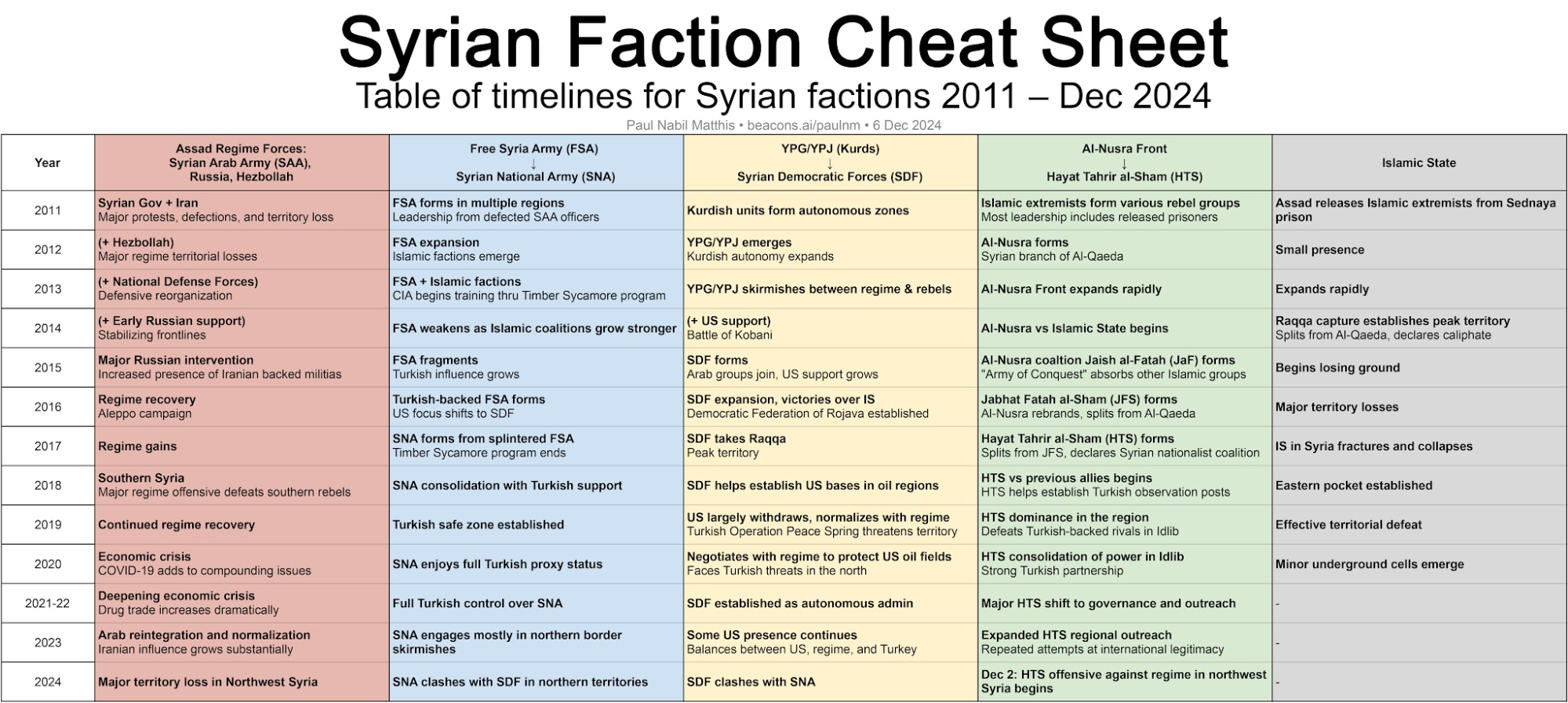
Download:
bit.ly/syrianfactions
-
Syria
-
⭐ Syrian Faction Cheat Sheet 2011 – Dec 2024
- Statement by 99 Syrian Intellectuals
- The Lost Souls of Syria | Al-Jazeera
- The Boy who started the Syrian War | Featured Documentary
- Start Here: Syria 1. It Began With Fire | Why did Syrians revolt during the Arab Spring?
- Syria | Food Assistance | U.S. Agency for International Development
- Syria | International Rescue Committee (IRC)
- Syria emergency | UNHCR
- Who's Killing Civilians In Syria?
- The Syrian Civil War - Five Books
- Syria | World Food Programme
- Whole of Syria | ReliefWeb Response
- UNICEF's Support for Syria | Middle East Crisis
- Irish Syrian Solidarity Movement
-
The White Helmets
- Mayday: How the White Helmets and James Le Mesurier got pulled into a deadly battle for truth | 26 February 2021
- This article is more than 3 years old How Syria's disinformation wars destroyed the co-founder of the White Helmets2020
- Aleppo's White Helmets: Life Under Siege - BBC News
- The White Helmets | FULL FEATURE | Netflix
-
Syria Book List
Assad or We Burn the Country: How One Family's Lust for Power Destroyed Syria by Sam Dagher (2020)
Days of Love and Rage: A Story of Ordinary People Forging a Revolution by Anand Gopal (2026)
- Syria After the Uprisings: The Political Economy of State Resilience Joseph Daher (2019)
- Burning Country - New Edition: Syrians in Revolution and War by Robin Yassin-Kassab 2018
- Syria: The Fall of the House of Assad; New Updated Edition D.W. Lesch 2013
- Defiance A Memoir of Awakening, Rebellion, and Survival in Syria Loubna Mrie (2026)
- Syria Speaks: Art and Culture from the Frontline, edited by Nawara Mahfoud, Malu Halasa, and Zaher Omareen 2014
- The Wrong End of the Telescope by Rabih Alameddine 2022
- Songs of Mihyar the Damascene by Adonis 1961, tr. 2019
- Man at the Airport: How Social Media Saved My Life - One Syrian's Story by Hassan Al Kontar 2021
- Death Is Hard Work by Khaled Khalifa 2019
- The Pianist from Syria: A Memoir by Aeham Ahmad 2021
- Sisters of the War: Two Remarkable True Stories of Survival and Hope in Syria by Rania Abouzeid 2022
- The Makers of Modern Syria: The Rise and Fall of Syrian Democracy 1918-1958 by Sami Moubayed 2018
- Cookbooks
-
Idlib
- Call for help from Idlib | Relief & Reconciliation International AISBL
- Millions in Idlib ‘counting on your support to make the violence stop’, UN relief chief tells Security Council
- Idlib | European Union Agency for Asylum
- "Targeting Life in Idlib": Syrian and Russian Strikes on Civilian Infrastructure | HRW
- Living and working in Idlib, Syria - ShelterBox
- Idlib Under Fire: Help Syrian Victims Survive | LaunchGood
- Our Work in Syria | SAMS
- Northwest Syria: Government Uses Cluster Munitions | Human Rights Watch
- Idlib - Syria Direct
- MedGlobal led a solidarity mission with the displaced civilians in Idlib, Syria
- Idlib Between September 2015 and May 2020: A Timeline | Crisis Group
- PBS FRONTLINE | Season 2021 | Episode 12 | The Jihadist
- Abu Mohammad al-Jolani Military Leader, Hayat Tahrir al-Sham
- Rania Abouzeid Journalist and Author, No Turning Back
- James Jeffrey Former U.S. Ambassador to Iraq and Turkey
- Theo Padnos Journalist, Jabhat al-Nusra Captive
- Mohamed al Salloum Brother of Executed Journalist
- Actor Profile: Hayat Tahrir al-Sham (HTS)
- The Most Notable Hay’at Tahrir al Sham Violations Since the Establishment of Jabhat al Nusra to Date SNHR | 2022 (PDF)
- SNHR’s 13th Annual Report: Most Notable Human Rights Violations in Syria in 2023
-
Chemical weapons
- A New Normal: Ongoing Chemical Weapons Attacks in Syria - Syrian American Medical Society Foundation
- The 10th Anniversary of Two Ghoutas Attack: The Largest Chemical Weapons Attack by the Syrian Regime on Syrian Citizens | ReliefWeb
- Death by Chemicals: The Syrian Government’s Widespread and Systematic Use of Chemical Weapons | HRW
- U.N. war crimes team documents further Syrian govt. use of banned chlorine | Reuters
- Timeline of Syrian Chemical Weapons Activity, 2012-2022 | Arms Control Association
- Conference Decision C-25/DEC.9: Addressing the Possession and Use of Chemical Weapons by the Syrian Arab Republic
- U.N. war crimes team documents further Syrian govt. use of banned chlorine | Reuters
- More Than 300 Chemical Attacks Launched During Syrian Civil War, Study Says : NPR
-
Congo
- Links & Free Resources — Welcome to the new Congo Reform Association
- Join The Free Congo Movement | Friends of the Congo
- Democratic Republic of Congo | International Rescue Committee (IRC)
- DR Congo - Free the Slaves
- Democratic Republic of Congo | Direct Relief
- Democratic Republic of the Congo | OCHA
- Blood Money: Why the West Wants Crisis in the Congo
-
Congo Book List
-
⭐King Leopold's Ghost: A Story of Greed, Terror, and Heroism in Colonial Africa by Adam Hochschild1998
- King Leopold's Ghost2006 documentary, narrated by Don Cheadle
-
⭐Cobalt Red: How the Blood of the Congo Powers Our Livesby Siddharth Kara (2023)
- The Congo from Leopold to Kabila Book by Georges Nzongola-Ntalaja2002
- How Dare the Sun Rise: Memoirs of a War Child by Sandra Uwiringiyimana, Abigail Pesta2018
- Broken Glass by Alain Mabanckou 2018
- The River in the Belly by Fiston Mwanza Mujila 2021
- Johnny Mad Dog by Emmanuel Dongala 2006
- Maison Rouge: Memories of a Childhood in War by Liliane Leila Juma2020
- Congo: The Epic History of a People by David Van Reybrouck2015
-
Patrice Lumumba
- The Lumumba Plot: The Secret History of the CIA and a Cold War AssassinationStuart A. Reid (2023)
- The Assassination of Lumumbaby Ludo de Witte (1999)
- May our People Triumph: Poem, Speeches & Interviewsby Patrice Lumumba, prepared by Paul Daniel Aravinth (2016)
- Patrice Lumumbaby Georges Nzongola-Ntalaja
- Death in the Congo: Murdering Patrice Lumumbaby Bruce Kuklick & Emmanuel Gerard (2015)
- Lumumba: Africa's Lost Leaderby Leo Zeilig (2008)
-
Sudan
- #SudanSyllabus.docx
- Crisis in Sudan: What is happening and how to help | International Rescue Committee
- Sudan crisis: Facts, FAQs, and how to help | World Vision
-
Middle East Research and Information Project (MERIP)
- The Struggle for Sudan | A Primer| Khalid Mustafa Medani, Spring 2024
- Sudan Archives - MERIP
- An Interview with William Carter, Sudan Country Director for the Norwegian Refugee Council - MERIP
- Sustaining Sudan’s Revolution–A Conversation with Rabab Elnaiem
- Land, Livestock and Darfur’s 'Culture Wars'
- Dispatch from Nyala, Sudan’s Second City
- Leveraging Humanitarian Aid in Wartime Sudan
- Resources and Actions to Support Sudan — Team CommUNITY
- Sudan: General Resources, Economic Development, & the Internet | Columbia University Libraries
- Water for South Sudan
-
Sudan Book List
-
⭐Darfur: A 21st Century Genocide by Gérard Prunier 2008
- The Translator: A Memoirby Daoud Hari (2009)
- Sudan's Unfinished Democracy: The Promise and Betrayal of a People's Revolutionby Willow Berridge, Alex de Waal, Justin Lynch (2022)
- Season of Migration to the Northby Tayeb Salih (2009)
- Ghost Seasonby Fatin Abbas (2023)
- River Spiritby Leila Aboulela (2023)
- Tears of the Desert: A Memoir of Survival in Darfurby Halima Bashir, Damien Lewis (2009)
- Ebola '76by Amir Tag Elsir (2017)
-
Turtle Island
-
Missing and Murdered Indigenous Women (MMIW)
- Missing and Murdered Indigenous Women (MMIW) | Native Hope
- MMIWG2S | CSVANW - Coalition to STOP Violence Against Women
- MMIW — Native Womens Wilderness
- Missing and Murdered Indigenous Women and Relatives (MMIWR) | NIWRC
- Missing and Murdered Indigenous People Crisis | Indian Affairs
- What is the MMIW Movement? - We R Native
- Missing and Murdered Indigenous Women: What is MMIW? | ICNA CSJ
- MMIW documentaries on YouTube
-
Protect the Indian Child Welfare Act (ICWA)
- Indian Child Welfare Act
- Protect ICWA – CWLA
- Indian Child Welfare Act (ICWA)| USDI Indian Affairs
- Defending the Law that Defends Our Children (Protect ICWA Campaign) - Native American Rights Fund
- Daughter of a Lost Bird | Trailer | America ReFramed
-
Land Back
- LANDBACK Movement | Speak for Wolves
- Questions about the LandBack movement, answered - High Country News
- LAND BACK! What do we mean? | 4Rs Youth Movement
- The Land Back Movement Unravels Manifest Destiny | Sierra Club
- Land Back: The Indigenous Fight to Reclaim Stolen Lands | KQED
- NDN Collective launches Second Season of LANDBACK for the People Podcast
- What is Land Back? - David Suzuki Foundation
- Here are 3 places to watch the Land Back movement unfold in 2023 | CBC Radio
- LANDBACK: A Tipi Village Takes on Healing & Homelessness
-
Iran
- COUP 53
- Iran: A Very Short IntroductionAli Ansari (2014)
- All the Shah's Men: An American Coup and the Roots of Middle East TerrorStephen Kinzer (2008)
- Iran Freedom
- Iran Reading List | Social Responsibilities Round Table
- Death of Jina Mahsa Amini | Protests, Iran, & Cause | Britannica
- Iran: Two years after ‘Woman Life Freedom’ uprising, impunity for crimes reigns supreme
- Justice and accountability: Woman, Life, Freedom protests | OHCHR
-
Uyghurs
- China’s Repression of Uyghurs in Xinjiang | Council on Foreign Relations
- Palestine and “Xinjiang” under Capitalist Rule: An Analysis from the Chinese Left by chuang | Jul 16, 2024
- Who are the Uyghurs and why is China being accused of genocide? - BBC News
- “Break Their Lineage, Break Their Roots”: China’s Crimes against Humanity Targeting Uyghurs and Other Turkic Muslims | HRW
- Don’t Look Away from China’s Atrocities Against the Uyghurs | United States Institute of Peace
- What you should know about China’s minority Uighurs
- Take Action - Uyghur Human Rights Project
- 3 things to Know About the Uyghur Crisis - The Freedom Hub
-
Uyghur Youth Initiative
- @uyghuryouth_initiative| Instagram
- @uyghuryouth| TikTok
- Resources - Xinjiang Documentation Project
- Forced Labour Lab | Sheffield Hallam University
- Uyghur Human Rights Project
- archiving detainees - Uyghur Hjelp
- United Uyghur Youth (@uniteduyghuryouth) • Instagram
- World Uyghur Congress
- Coalition to End Forced Labour in the Uyghur Region
- International Support for Uyghurs
- Campaign For Uyghurs
-
Haiti
- World Report 2024: Haiti | Human Rights Watch
- Haiti: Freedom in the World 2024 Country Report
- What Can Stop Haiti's Free Fall? | RAND
- 4 Things to Know About the #freeHaiti Movement — AmericaHates.US
- Deadly Violence in Haiti at Record High | Meetings Coverage and Press Releases UN
- The struggle to free Haiti from violence and impotent governance | The Economist
- Haiti Humanitarian Crisis - Center for Disaster Philanthropy
- Haiti crisis: Facts, FAQs, and how to help | World Vision
-
Tigray
- Free Tigray Movement
- Tigray Conflict | Human Rights Watch | HRW
- Conflict in Ethiopia | Global Conflict Tracker
- Ethiopia’s Tigray war: The short, medium and long story | BBC
- Ethiopia’s Tigray War and its Devastating Impact on Tigrayan Children’s Education | Wilson Center
-
Artsakh
- Free Artsakh • The Future Armenian
- Americans4Artsakh
- Nagorno-Karabakh: Freedom in the World 2024 Country Report
- Ethnic Armenians who fled Nagorno-Karabakh long for home, decry Azerbaijan | Al Jazeera
- Artsakh Relief | AGBU
-
Myanmar
- Myanmar — Radio Free Asia
- Human rights in Myanmar | Amnesty International
- Myanmar’s Troubled History: Coups, Military Rule, and Ethnic Conflict | Council on Foreign Relations
- Myanmar | Crisis Group
- Crisis in Myanmar: What to know and how to help | International Rescue Committee
- 5 things you need to know about Myanmar’s humanitarian crisis - European Commission
- Myanmar situation | Global Focus
Gaza Genocide Recognition List
Accurate as of May 2026, compiled by Paul Nabil Matthis. Listed below are timestamped statements from various parties asserting that there is a plausible or explicit genocide being perpetrated by Israelis against Palestinians in Gaza. The shortlink for this doc is bit.ly/itsagenocide.
Part of the START HERE: Palestine project.
International courts and UN bodies
- International Court of Justice
- Jan 2024: provisional measures ruling that South Africa's genocide claim is "plausible"
- Reaffirmed in subsequent rulings, March 2024 and May 2024
- UN Human Rights Council, Independent International Commission of Inquiry on the
Occupied Palestinian Territory
- Sept 16, 2025: explicit finding that Israel is committing genocide
- Identified four of the five Genocide Convention acts (Article II)
- Characterized by the Commission as the most authoritative UN determination on the war to date
- UN Special Committee to Investigate Israeli Practices
- Nov 14, 2024: Israeli warfare methods "consistent with the characteristics of genocide"
- UN Special Rapporteurs
- Francesca Albanese, Special Rapporteur on the Palestinian Territories
- Michael Fakhri, Right to Food
- Reem Alsalem, Violence Against Women
- Balakrishnan Rajagopal, Adequate Housing
- Pedro Arrojo-Agudo, Water and Sanitation
- May 2025: joint statement on genocide signed by roughly 20 independent experts and 4 working groups
- Office of the UN High Commissioner for Human Rights (OHCHR)
- Violations could amount to war crimes, crimes against humanity and possibly even genocide (PDF)
- Senior UN officials
- Tom Fletcher, Under-Secretary-General for Humanitarian Affairs (May 2025)
- Philippe Lazzarini, UNRWA Commissioner-General
- Intergovernmental bodies
- Organisation of Islamic Cooperation (May 2024)
- Arab League and 31 Arab/Islamic countries, joint statement (Aug 2025)
- African Union, 38th summit communiqué
Human rights and humanitarian NGOs
- Amnesty International
- Dec 5, 2024 report: investigation concluded Israel is committing genocide
- Human Rights Watch
- Dec 19, 2024 report: "extermination" and acts of genocide
- B'Tselem
- Israeli human-rights organization
- July 2025: formal genocide report
- One of the first two major Israeli organizations to use the term
- Physicians for Human Rights–Israel
- Israeli human-rights organization
- July 2025: report titled Genocide in Gaza
- One of the first two major Israeli organizations to use the term
- Médecins Sans Frontières
- July 2025: launched dedicated "Gaza genocide" page on its website
- Genocide Watch
- Dec 2024: "Genocide Emergency: Gaza and the West Bank"
- Among the earliest organizations to issue such warnings
- Lemkin Institute for Genocide Prevention
- Among the earliest, with statements going back to late 2023
- Forensic Architecture
- Architectural and visual evidence research, cited by the IAGS resolution
- DAWN (Democracy for the Arab World Now)
- Center for Constitutional Rights
- Counsel in Defense for Children International–Palestine et al v. Biden et al, Dec 2023
- European Center for Constitutional and Human Rights (ECCHR)
- Berlin-based legal advocacy NGO
- Dec 2024 statement on Gaza and the matter of genocide
- International Federation for Human Rights (FIDH)
- Dec 2023: "the unfolding genocide against the Palestinians must stop immediately"
- International Centre of Justice for Palestinians
- Palestinian human-rights organizations
- Joint May 2025 PHROC open letter
signed by:
- Al-Haq
- Al Mezan Center for Human Rights
- Adalah – The Legal Center for Arab Minority Rights in Israel
- Palestinian Centre for Human Rights
- Defence for Children International–Palestine
- Addameer Prisoner Support and Human Rights Association
- Euro-Med Human Rights Monitor (separately, since Nov 2023)
- Joint May 2025 PHROC open letter
signed by:
- Major humanitarian and faith-based NGOs
- Oxfam (Oct 2024 joint statement)
- Refugees International (Sept 2025)
- ANERA (Dec 2024 joint statement)
- Christian Aid (Aug 2025 parliamentary briefing)
- Trócaire (June 2025)
- CAFOD (Jan 2024)
- Islamic Relief Worldwide (Oct 2024)
- American Friends Service Committee (April 2024)
- Mennonite Central Committee (March 2024)
- Jewish Voice for Peace (US-based, anti-Zionist Jewish group, Oct 2023 / Jan 2024)
- Medical Aid for Palestinians (Oct 2024)
Academic associations and joint legal-academic findings
- International Association of Genocide Scholars (IAGS)
- The flagship academic body in the field
- Aug 31, 2025: resolution finding Israel's policies and actions meet the legal definition of genocide
- Passed by 86% of voting members, ninth genocide-recognition resolution in IAGS history
- IAGS President: Melanie O'Brien
- Middle East Studies Association (MESA)
- March 11, 2024 statement
- Condemned "the accelerating scale of genocidal violence" and characterized Israel's conduct as cultural genocide
- Joint legal-academic report (May 15, 2024)
- Issuing institutions: University Network for Human Rights, Boston University School of Law, Cornell Law School, University of Pretoria, Yale Law School
- Finding: "Israel has committed genocidal acts"
- NIOD Institute for War, Holocaust and Genocide Studies (Netherlands)
- Director: Martijn Eickhoff
- May 2025: characterized Israeli actions as "genocidal violence"
- Association française des anthropologues
- June 2024 editorial in Journal des Anthropologues concluding Israel is committing genocide
- British Society for Middle Eastern Studies
- Jan 2024 open letter
- International Sociological Association
- May 2025 joint statement
- Third World Approaches to International Law Review (TWAILR) public
statement
- Oct 15, 2023: Signed by more than 800 scholars warning of potential genocide
- Notable as one of the earliest mass scholarly statements
- University of Maryland / Brookings Middle East Scholar Barometer
- Jan-Feb 2025 survey, n=758
- 46% characterized Israel's campaign as "genocide", 36% as "major war crimes akin to genocide"
Genocide and Holocaust individual scholars
- Omer Bartov
- Brown University, Israeli-American
- Identified as a leading genocide specialist by the US Holocaust Memorial Museum
- Nov 2023: war crimes and crimes against humanity, but not yet genocide
- May 2024: "genocidal actions" alongside systematic war crimes and crimes against humanity
- July 2025: I'm a Genocide Scholar. I Know It When I See It, see also Democracy Now interview
- Raz Segal
- Stockton University, Holocaust and Genocide Studies
- Oct 13, 2023: called the assault "a textbook case of genocide unfolding in front of our eyes"
- The earliest high-profile call from a senior genocide-studies scholar
- Amos Goldberg
- Hebrew University of Jerusalem, Holocaust history
- April 2024: "Yes, it is genocide" (originally in Local Call / Hebrew)
- Has accused mainstream Holocaust studies of becoming an "enabling factor" of the genocide
- Daniel Blatman
- Hebrew University of Jerusalem, Holocaust history
- Joint statements with Goldberg (2025)
- Shmuel Lederman
- Open University of Israel
- Jan 2024: initially described actions as "genocidal violence" rather than genocide
- April 2024: privately concluded genocide
- Sept 2025: confirmed his earlier conclusion publicly
- A. Dirk Moses
- City College, CUNY
- Editor of the Journal of Genocide Research
- Launched the journal's "Israel-Palestine: Atrocity Crimes" forum in Jan 2024
- Martin Shaw
- Sociologist of genocide
- Nov 2023: framed states' avoidance of the term as a way of avoiding responsibility
- Has written that consensus became "overwhelming" by late 2024
- Uğur Ümit Üngör
- NIOD / University of Amsterdam
- Has framed Gaza as "subaltern genocide"
- May 2025: noted the shrinking gap between Holocaust historians and broader genocide scholars
- Melanie O'Brien
- University of Western Australia, international law
- IAGS President during the 2025 resolution
- Debórah Dwork
- Founder of the Strassler Center for Holocaust and Genocide Studies, Clark University
- Zoé Samudzi, Elyse Semerdjian, Frances Tanzer
- Strassler Center, Clark University
- Contributors to the Journal of Genocide Research forum
- Ernesto Verdeja
- University of Notre Dame, peace studies
- July 2025: "even by the most inflexible interpretation of genocide, Gaza qualifies as genocidal"
- Victoria Sanford
- Lehman College, CUNY, anthropology
- Nov 2023: submitted expert evidence in DCI-P v. Biden
- Barry Trachtenberg
- Wake Forest University, history
- Nov 2023: submitted expert evidence in DCI-P v. Biden
- Mark Levene
- British historian of genocide
- https://www.tandfonline.com/doi/full/10.1080/14623528.2025.2482297
- John Cox
- University of North Carolina, history
- Nov 2023: submitted expert evidence in DCI-P v. Biden
- Jeffrey S. Bachman
- American University
- Donald Bloxham
- British historian of genocide, University of Edinburgh
- Wrote that "much of what has transpired is eminently consistent with genocide"
- David Simon
- Yale University, Director of the Genocide Studies Program
- Sept 2025: noted the surge in scholarly use of the term
- Abdelwahab El-Affendi
- Doha Institute for Graduate Studies
- Feb 2024: described "near consensus" in genocide-studies field on the genocidal character of Israeli actions
Historians (non-genocide-studies)
- Ilan Pappé
- Jewish Israeli "New Historian"
- Israeli "genocidal impulse"
- Rashid Khalidi
- Palestinian-American historian, Columbia (emeritus)
- Enzo Traverso
- Italian historian, Cornell University
- Gaza Faces History (2024)
- Yoav Di-Capua
- Israeli historian, University of Texas at Austin
- Pervasive Israeli genocidal mindset
- Saree Makdisi
- Literary historian, UCLA
- Frames Gaza in continuity with Zionism and the 1948 expulsions
- Joseph Massad
- Columbia University, Middle Eastern studies
- Frames the genocide as colonial-demographic in purpose
- Tetsuya Sahara
- Japanese historian and political scientist
- April 2024 essay warning of "full-fledged genocide if unchecked"
- Dov Waxman
- UCLA, Israel studies
- March 2025: notable public reversal, citing the renewed offensive after the ceasefire collapse and the aid blockade
International law scholars and legal authorities
- William Schabas
- Among the leading living authorities on the Genocide Convention
- June 2024: called South Africa's case "arguably the strongest case of genocide ever brought before the ICJ"
- Luis Moreno Ocampo
- Former chief prosecutor of the International Criminal Court
- Dec 2023: characterized the siege of Gaza as a form of genocide
- Aryeh Neier
- Co-founder of Human Rights Watch
- May 2024: cited the deliberate starvation of Gaza's population
- Jonathan Sumption, Lord Sumption
- Former Justice of the UK Supreme Court
- July 2025: assessed that a court would likely regard Israel's actions as genocide
- Nimer Sultany
- SOAS, University of London
- May 2024: noted growing consensus among legal scholars
- Adil Ahmad Haque
- Rutgers Law School
- Neve Gordon
- Queen Mary University of London
- July 2024: with Perugini, framed Israel's legal arguments as instrumentalized for genocide
- Nicola Perugini
- University of Edinburgh, anthropology
- Susan Akram
- Boston University School of Law
- June 2024: described consensus across legal and Holocaust scholarship
- Conor Gearty
- London School of Economics, human rights law
- Oct 2024 lecture characterizing Israel's actions as genocidal
- Rabea Eghbariah
- Palestinian legal scholar, Harvard / Yale
- Frames the genocide as continuous with the ongoing Nakba
- Noura Erakat
- Rutgers University, legal scholar
- Mia Swart
- University of the Witwatersrand
- Wrote on the consensus emerging from South Africa's ICJ case
- Sonia Boulos
- Nebrija University (Spain), international human rights law
- Michael Mansfield KC
- Senior English barrister
- April 2025: said there is "no question" that genocide is occurring
- Craig Mokhiber
- Former senior OHCHR human rights lawyer who resigned in October 2023 over the issue
- March 2025 commentary on the breadth of consensus
Journalists and public commentators
- Gideon Levy
- Amira Hass
- Israeli journalist, Haaretz correspondent for the Occupied Palestinian Territories
- The only Israeli Jewish journalist to have lived and reported full-time from Gaza and the West Bank for three decades
- Daughter of Holocaust survivors, recipient of the 2024 Columbia Journalism Award
- Consistent reporting from Oct 2023 onward on Israeli destruction, starvation, and mass civilian death
- Mehdi Hasan
- British-American journalist, founder of Zeteo (2024), formerly MSNBC and Al Jazeera English
- Has used the term consistently and prominently from late 2023 onward
- June 2024 Haaretz interview: "If this isn't a genocide, then what is?"
- Built much of Zeteo's editorial identity around explicit use of the term ("we say the G-word, genocide")
Wikipedia Articles regarding the Gaza genocide and its recognition
- Academic and legal responses to the Gaza genocide | Wikipedia
- Gaza genocide - Wikipedia
- Gaza genocide recognition | Wikipedia
- List of humanitarian and human rights groups accusing Israel of genocide in Gaza | Wikipedia
Notes
The shift from "plausible genocide" framing (driven largely by the ICJ's January 2024 provisional measures) to explicit determinations tracks two inflection points: November 2024 (ICC arrest warrants for Netanyahu and Gallant, Amnesty's report shortly after), and mid-2025 (Bartov's NYT essay, B'Tselem and PHR-I, the IAGS resolution, the UN Commission of Inquiry's September finding). Lederman, Shaw, and Üngör have all written that scholarly consensus broadly consolidated by mid-2024 and became "overwhelming" by late 2024.
Notable holdouts among Holocaust/genocide scholars include Norman J. W. Goda, Jeffrey Herf, Benny Morris, Tal Bruttmann, Eva Illouz, Simon Schama, and Jürgen Habermas. Most of the holdouts fall somewhere on the the explicit-Zionist or critical-Zionist spectrum. Bruttmann and Habermas are the partial exceptions, with Bruttmann's objection reading more as comparative/methodological gatekeeping and Habermas's as an expression of German postwar Staatsräson rather than Zionism per se.
Apartheid Recognition List
Compiled by Paul Nabil Matthis. Listed below are courts, UN bodies, human rights organizations, scholars, and individuals who have found or asserted that Israel's rule over Palestinians (in the West Bank, Gaza, and/or historic Palestine/Israel as a whole) meets the legal definition of apartheid. This list is not exhaustive, and distinguishes present-tense legal findings from conditional or warning-framed statements (noted where relevant).
Part of the START HERE: Palestine project.
See also the peer-reviewed Apartheid citations in the Citations tab.
International courts and UN bodies
- International Court of Justice
- July 19, 2024: Advisory Opinion on the Legal Consequences arising from the Policies and Practices of Israel in the Occupied Palestinian Territory: found Israel's laws and measures "constitute a breach of Article 3" of CERD, the provision that "particularly condemns racial segregation and apartheid," citing "near-complete separation" between settlers and Palestinians in the West Bank and East Jerusalem (see also HRW's summary). The Court did not separately rule on the customary international law crime of apartheid. Its finding was specifically a breach of CERD Article 3.
- Roughly two dozen states argued in their written/oral submissions that Israel's practices meet the apartheid threshold, e.g. South Africa's written statement (full list at the ICJ's own filings page)
- UN Special Rapporteurs on the Situation of Human Rights in the Palestinian
Territories
- John Dugard, Jan 29, 2007: Report to the Human Rights Council (A/HRC/4/17), the first Special Rapporteur to conclude elements of the occupation "constitute forms of colonialism and of apartheid," and proposed the ICJ be asked for an advisory opinion on the question
- Michael Lynk, March 2022: "Israel's 55-year occupation of Palestinian Territory is apartheid": applying the three-part test from the 1973 Apartheid Convention and the Rome Statute, concluded the evidentiary standard for apartheid is met
- Francesca Albanese, Oct 2022: Report to the UN General Assembly (A/77/356), her first report as Special Rapporteur, stating Israeli policies meet the legal threshold for apartheid
- UN ESCWA (Economic and Social Commission for Western Asia)
- March 2017: "Israeli Practices towards the Palestinian People and the Question of Apartheid", authored by Richard Falk and Virginia Tilley: concluded "available evidence establishes beyond a reasonable doubt that Israel is guilty of the crime of apartheid." Ordered withdrawn from ESCWA's own site within hours of publication, prompting Executive Secretary Rima Khalaf's resignation.
- UN Committee on the Elimination of Racial Discrimination (CERD)
- Dec 12, 2019: Decision on jurisdiction in State of Palestine v. Israel, the first inter-state complaint of its kind, alleging (among other things) violation of CERD Article 3. CERD ruled it has jurisdiction to hear the case. Procedural; not yet a merits finding.
- UN General Assembly
- Nov 2024: adopted a resolution proposing to reconstitute a body modeled on the former UN Special Committee Against Apartheid, this time to monitor Israeli policy, following the ICJ opinion (analysis, resolution text, A/79/L.23)
Human rights and humanitarian NGOs
- B'Tselem
- Israeli human-rights organization
- Jan 12, 2021: "A regime of Jewish supremacy from the Jordan River to the Mediterranean Sea: This is apartheid", the first major Israeli human-rights group to formally use the term
- Human Rights Watch
- April 27, 2021: "A Threshold Crossed: Israeli Authorities and the Crimes of Apartheid and Persecution", a 213-page report concluding Israeli authorities are committing the crimes against humanity of apartheid and persecution
- Amnesty International
- Yesh Din
- Israeli human-rights organization
- July 2020: "The Occupation of the West Bank and the Crime of Apartheid: Legal Opinion", by attorney Michael Sfard
- Al-Haq, Addameer, Al Mezan, PCHR and coalition partners
- Nov 30, 2022: "Israeli Apartheid: Tool of Zionist Settler Colonialism", a joint report by eight Palestinian civil society and legal organizations
- Adalah – The Legal Center for Arab Minority Rights in Israel
- Maintains an ongoing Discriminatory Laws Database; a 2025 update reported 30 additional laws "deepening apartheid" passed since October 7, 2023
- World Council of Churches
- June 24, 2025: Central Committee statement, "A Call to End Apartheid, Occupation, and Impunity in Palestine and Israel"
- United Church of Christ
- July 2021: General Synod resolution, "Declaration for a Just Peace between Palestine and Israel", passed 462-78, explicitly naming "Israel's apartheid system of laws and legal procedures"
Academic and legal scholarly findings
- Human Sciences Research Council of South Africa
- May 2009: "Occupation, Colonialism, Apartheid? A Re-assessment of Israel's Practices in the Occupied Palestinian Territories under International Law", a 15-month study by international law scholars from South Africa, the UK, Ireland, Israel and the OPT, following up on John Dugard's 2007 UN report
- Russell Tribunal on Palestine
- Nov 5–6, 2011, Cape Town session: summary of findings: after hearing over 20 legal experts and witnesses, found Israel subjects Palestinians to "an institutionalised regime of domination amounting to apartheid"
- John Dugard, a leading international law scholar and lead author of the HSRC study above; among the earliest legal scholars to formally apply the apartheid framework to Israel/Palestine, from 2007 onward
- Richard Falk and Virginia Tilley, international law scholar (Princeton, former UN Special Rapporteur) and political scientist (Southern Illinois University); authors of the 2017 UN ESCWA report above
Governments and intergovernmental statements
No government has formally "recognized" Israel as an apartheid state the way the world once recognized apartheid South Africa. The entries below are specific, on-the-record statements by government officials or delegations, not claims of formal state recognition.
- South Africa
- Foreign Minister Naledi Pandor, July 2022: statement that Israel should be "classified as an apartheid state," reiterated in South Africa's Feb 2024 ICJ oral submission ("Israel's apartheid must end")
- Namibia
- July 2023 written statement to the ICJ: drawing on its own history under South African apartheid rule, devoted the bulk of its submission to arguing Israel's policies violate the customary international law prohibition on apartheid (see also Just Security analysis)
Notable individual voices
- Jimmy Carter, former U.S. President
- 2006 book, Palestine: Peace Not Apartheid, the most prominent use of the term by a former U.S. head of state
- Desmond Tutu, Nobel laureate and South African anti-apartheid leader
- April 29, 2002: essay "Apartheid in the Holy Land", originally published in The Guardian, describing his visit to the OPT as reminiscent of apartheid South Africa
- Michael Ben-Yair, former Attorney General of Israel (1993–96)
- Feb 10, 2022: op-ed, "With great sadness I conclude that my country is now an apartheid regime"
- Ehud Olmert, former Israeli Prime Minister
- Nov 29, 2007: interview with Haaretz warning that failure of the two-state solution would leave Israel facing "a South African-style struggle." Conditional/warning framed, not a present-tense finding.
- Ehud Barak, former Israeli Prime Minister
- Feb 2010, at the Herzliya Conference: warned that without a Palestinian state, Israel risked becoming "an apartheid state." Conditional/warning framed, not a present-tense finding.
Wikipedia Articles regarding Israeli apartheid
Notes
Two things worth flagging when reading this list. First, several entries above are explicitly conditional or warning-framed ("Israel risks becoming an apartheid state," from Olmert and Barak) rather than present-tense legal findings, and are marked as such. Second, the ICJ's 2024 opinion found a breach of CERD Article 3 (the treaty provision on racial segregation and apartheid) rather than ruling separately on the customary-law crime of apartheid, and CERD's own inter-state case against Israel remains at the jurisdictional stage rather than a concluded merits ruling. Both are significant, but distinct from a final "apartheid" verdict, and are described precisely above rather than rounded up.
Anticolonial Palestine Timeline (1770–Present)
- A comprehensive Palestine Timeline by Paul Nabil Matthis.
- Supplements my ongoing series Start Here: Palestine available on TikTok and YouTube.
- Share this absolutely anywhere in any medium, no need to ask.
- Anticolonialism entry in the International Encyclopedia of Human Geography (2020).
- Please consider supporting Denizens Society, PCRF, or any of these trusted charities.
 click for printable QR code
⭐ = Significant events in relation to Palestine. This doesn’t mean unstarred events are unimportant. For example, the Biltmore Programme is starred, but the start of World War 2 is not.
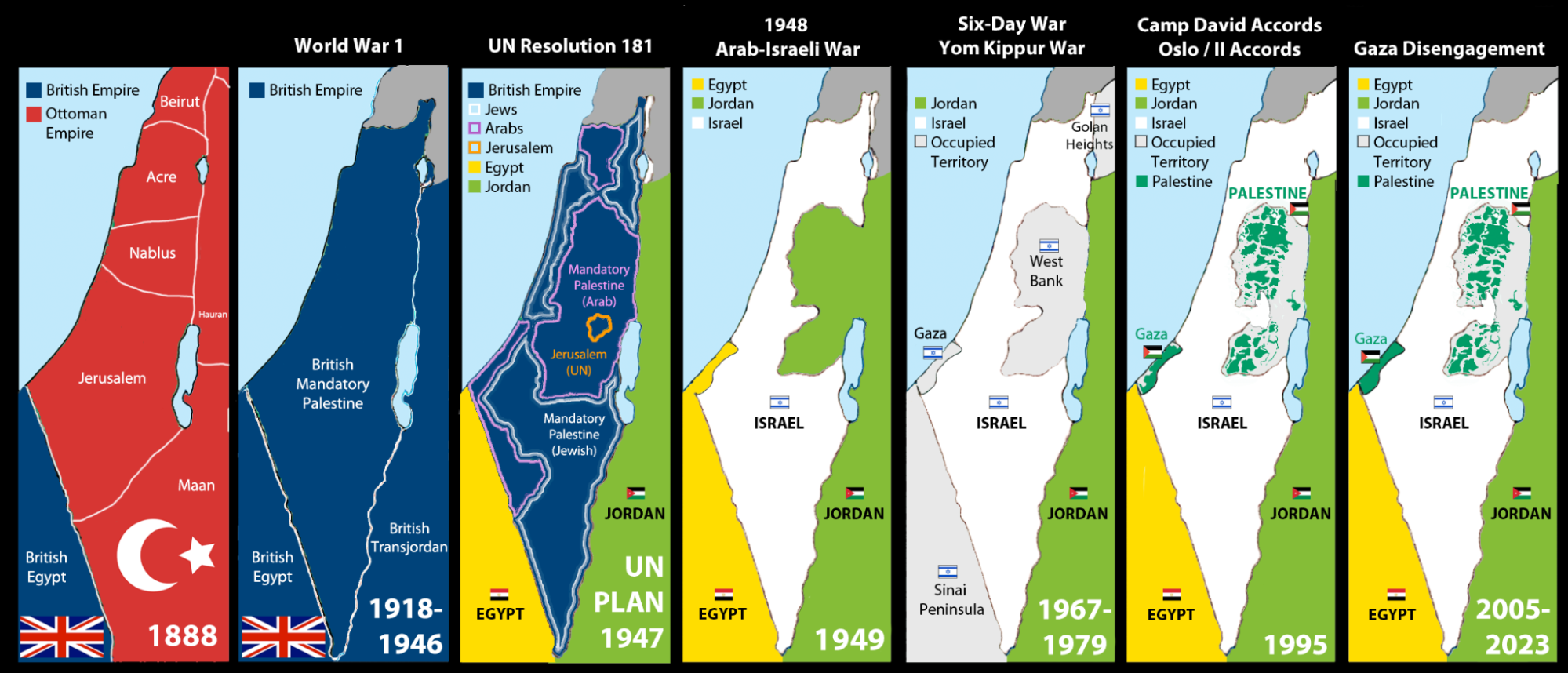
Introduction
This timeline is pieced together from some dozen sources, most of them other timelines, all of which are listed in citations at the end of this document. I’ve started it a little earlier than most, in 1770 at the rough beginning of the Haskalah, or Jewish Enlightenment, at the tail end of the European Age of Enlightenment (and then extending about a half-century afterward). In addition to focusing on Palestine in fairly excruciating detail, including many events related to the fall of the Ottoman Empire, it also includes major events in the Eastern Hemisphere that I consider broadly indicative of crumbling empire. These events include things like the so-called scramble for Africa, King Leopold’s genocide in the Congo Free State, and the Herero-Namaqua genocide that served as Germany’s trial run for the Nazi camps a few decades later. I include things like the Circassian and Armenian genocides, and such forced famines as those in Ireland, Bengal, and Ukraine. While these events may not have directly affected Palestine, they were all results of colonialist and imperialist ideologies, even in the case of the Soviet Union, which exemplified such an approach despite publicly opposing it. These death throes of empire led to the most devastating pair of wars in human history, the second of which ushered in the nation-state as the default political entity. And yet, through no fault of their own, this supposedly inherent right to self-determination was denied the indigenous Palestinians, among so many others.
According to Justin McCarthy, the population of Palestine during the first century of Ottoman rule (specifically around 1550 CE) was estimated to be approximately 300,000. This figure is derived from Ottoman tax registers (tahrir defters), which provide detailed accounts of the population and economic activities in the region. Between 1/5th and 1/4th of this population resided in the six principal towns of Jerusalem, Gaza, Safed, Nablus, Ramlah, and Hebron. The remaining population consisted predominantly of the fellahin, Arab peasant farmers, who lived in hundreds of villages of varying size. The fellahin primarily cultivated wheat and barley as their staple food crops, supplemented by leguminous pulses, olives, fruit, and vegetables. In and around most of the towns were many vineyards, orchards, and vegetable gardens.
Palestine was predominantly Muslim, but thousands of Jews and Christians lived among the population in relative peace for centuries. This demographic and economic structure persisted relatively unchanged until the mid-1800s, when improvements in agricultural techniques, public health measures, and changes in Ottoman immigration policies began to significantly alter the population dynamics of Palestine. By 1850, the population of Palestine has reached around 340,000. Approximately 300,000 of those are Muslim, 27,000 are Christian, and 13,000 are Jewish. By 1880, the Jewish population has risen to about 24,000, after which it starts to drastically increase as the Jewish national movement gains steam. There were, of course, other immigrations. In addition to Jewish settlers, other groups included Arabs from various religions and backgrounds, Druze, Circassian, and Armenian, many fleeing hardship and persecution from their own place of origin.
The Jewish immigrants, however, stood out in their intent to build a Jewish state in Palestine, their approach not to assimilate, but to isolate, to violate. Their motivation, though mostly secular, was nevertheless founded on secularized and sanitized ancient Biblical excuses. By 1885, this colonial movement had been named “Zionism” and quickly became the leading cause of tensions between the Jewish nationalist settlers and the indigenous Arab Palestinians, drastically escalating in the post-WWI collapse of the Ottoman Empire and subsequent British Mandate era. The British Empire engaged in a succession of broken promises to the Palestinians, ultimately supporting the Balfour Declaration of 1917, ignoring or walking back such promises as those of Sir Henry McMahon and policies laid out by the White Paper of 1939. All of which led to the final spectacular failure of Britain to maintain order at the end of their Mandate, the disastrous UN Partition Plan, and the subsequent violent takeover of Palestine beginning in December 1947, now called the Nakba, or “Catastrophe.”
In short, this timeline illuminates the last dying vestiges of old world empire in Palestine, the profoundly cruel treatment endured by her indigenous inhabitants, and how their struggle, though not always pretty, was always and only ever resisting colonialism, regardless of who brought it to their ancestral lands.
Late Ottoman Empire (1770–1918)
1770: Haskalah (Jewish Enlightenment) begins. The Haskalah, also called the Jewish Enlightenment, begins around 1770 in Europe, primarily in Germany and Galicia.
- Emerging in the context of the broader European Age of Enlightenment, the movement sought to modernize Jewish culture and promote integration into European society while preserving Jewish identity. Key figures such as Moses Mendelssohn contribute significantly to the movement, advocating for educational reform, cultural integration, and a rational approach to Judaism.
- The movement advocated against reclusiveness and encouraged the adoption of prevalent attire over traditional dress. It worked to diminish the authority of traditional community institutions such as rabbinic courts and boards of elders. It pursued a set of projects of cultural and moral renewal, including a revival of Hebrew for use in secular life. It strove for an optimal integration in surrounding societies, promoting the study of exogenous culture, style, and vernacular, and the adoption of modern values. Its core proponents, called the Maskilim, pursued a focus on rationalism, liberalism, and relativism.
1783: First Haskalah publication in Modern Hebrew. The periodical Ha-Me'assef (Hebrew: הַמְאַסֵּף, tr. “The Collector”) played a crucial role in spreading Enlightenment ideas among European Jewry.
1791: Jewish emancipation in France begins. Following the French Revolution and formation of France as the first European nation-state, the National Assembly of France grants equal legal status to Jews. This became part of the broader movement towards civil equality and dismantling feudal privileges that characterized the revolutionary period.
1799: Napoleon offers Palestine as a homeland to the Jews, in hopes this would weaken the Ottoman Empire’s standing there. Pretty much everyone ignores it.
1803–1815: Napoleonic Wars. A series of major conflicts led by Napoleon Bonaparte, culminating in his final defeat at the Battle of Waterloo.
1804: Haitian Revolution ends. Haiti declares independence after a successful slave rebellion, the largest and most successful uprising to ever occur in the Western Hemisphere. Along with the French Revolution, this event is generally considered to mark the decline of the Age of Enlightenment.
1814–1815: Congress of Vienna. A diplomatic conference that redrew the political map of Europe after the Napoleonic Wars, restoring monarchies and establishing a balance of power attempting to prevent future conflicts.
1826: The Auspicious Incident. Forced disbandment of the Janissary corps, an elite military group that had become increasingly powerful and unruly. Sultan Mahmud II orchestrated this event to modernize the Ottoman military and centralize power.
1830: Greek War of Independence (1821-1830) ends, leading to the establishment of an independent Greek nation-state, part of a broader wave of nationalist movements in the Ottoman Empire. Estimates of total deaths range from 100,000 to 200,000. This includes both military and civilian casualties. The conflict saw widespread atrocities, massacres, and population displacements on both sides.
1831–1833: Muhammad Ali Pasha conquers Palestine. As part of his broader campaign against the Ottoman Empire, Ali's forces, led by his son Ibrahim Pasha, invade and occupy Palestine, part of a successful military campaign in the Levant.
⭐ 1834: Palestinian Peasant Revolt
-
Ibrahim Pasha announces three polices that enrage the Palestinian population. a heavy tax increase, the forced conscription of fellahin (Arab peasant farmers) into the Egyptian army, and for fellahin to be disarmed by local notables. Along with other economic tensions, Palestinian farmers rose in revolt against these oppressive measures. This revolt is often cited as an early example of local resistance to foreign control and reflects a growing sense of regional identity among the Palestinian population during the 1800s.
-
Egyptian forced labourers, mostly from the Nile Delta, were brought in by Muhammad Ali and settled in sakināt (neighborhoods) along the coast for agriculture, which set off bad blood with the indigenous fellahin, who resented Muhammad Ali's plans and interference, prompting the wide-scale peasants' revolt.
-
Looting of Safed and other attacks on minorities occurred during the revolt. Jews and Christians were exempted from Ibrahim Pasha’s taxes and disarmament policy, which caused deep resentment and for these communities to be attacked by the uprising in several cities, including Jerusalem, Hebron, Safed, Bethlehem, and Nazareth.
1837 January 1: Galilee earthquake of 1837, known as the Safed earthquake. The Roum fault section of the Dead Sea Rift, as well as its extension south to the Sea of Galilee, were sources of the seismic event. It caused heavy damage in Northem Israel and Southem Lebanon. This earthquake was a much larger event than many earthquake catalogues indicate, most like a shallow, multiple event of magnitude greater than 7.0.
1839: Tanzimât (“Reorganization”) begins. A period of reform in the Ottoman Empire that began with the Gülhane Hatt-ı Şerif in 1839 and ended with the First Constitutional Era in 1876. The Tanzimat era began with the purpose not of radical transformation, but of modernization, desiring to consolidate the social and political foundations of the Ottoman Empire. It was characterized by various attempts to modernise the Ottoman Empire and to secure its territorial integrity against internal nationalist movements and external aggressive powers. The reforms encouraged Ottomanism among the diverse ethnic groups of the Empire and attempted to stem the rise of nationalism in the Ottoman Empire.
1840: European Intervention restores Palestine to Ottoman rule. European powers, particularly Britain and Austria, intervene in the region. The British navy bombards the coastal city of Acre, leading to the eventual withdrawal of Egyptian forces from Palestine and the restoration of Ottoman control.
1845-1852: An Gorta Mór (The Great Hunger). A potato blight devastates Ireland's crops, a staple food for the population. British colonial policies such as exporting Irish grain and livestock despite the shortages, landlordism and harsh eviction laws, and woefully inadequate relief efforts left many Irish peasants without land or means of subsistence. Forced starvation led to the deaths of approximately 1 million people and the emigration of millions more.
1850-1864: Taiping Rebellion. One of the deadliest wars in history with estimates of up to 20-30 million deaths across China. It was led by the Taiping Heavenly Kingdom against the ruling Qing Dynasty.
1856: Crimean War (1853-1856) ends. A conflict involving the Ottoman Empire, allied with Britain, France, and Sardinia, against Russia, part of the larger struggle over the decline of the Ottoman Empire and the balance of power in Europe. The Treaty of Paris reaffirmed Ottoman territorial integrity but highlighted the empire's reliance on European powers.
- The Crimean War caused an estimated 500,000 to 750,000 deaths, mostly from disease. Russian forces lost about 250,000 to 400,000, while Allied forces suffered around 250,000 to 300,000 deaths. Civilian casualties were also significant, but numbers are not available.
⭐ 1860: First Ashkenazi Jewish settlement established in Palestine
-
Sir Moses Montefiore, a prominent British Jewish philanthropist, established the first Jewish settlement outside the Old City walls of Jerusalem, known as Mishkenot Sha'ananim, often called proto-Zionist or “early Zionist piobornrs.” This initiative aimed to improve living conditions for Jews in Jerusalem and was funded by a bequest from Judah Touro, a deceased American Jewish philanthropist.
1865: The Palestine Exploration Fund established. The oldest organization created specifically for the study of the Levant, the fund helped spur evangelical tourism to the region in the late 1800s and early 1900s, which in turn generated a huge array of literature that presented Palestine as a 'Holy Land'. Sometimes called “archeology with a shovel in one hand and a Bible in the other,” findings generally portrayed local populations as a simple appendix to well-known Biblical scenarios.
1869: Sultan Abdulaziz issues a decree allowing foreigners to own lands in the Ottoman Empire, prompting an increase the Jewish immigration to Palestine.
1874 November 24: An American farmer named Joseph Glidden receives the patent for barbed wire to prevent cattle from straying outside enclosures.
1876–1878: Great Famine of India. A devastating famine in large parts of southern and western India, including the Deccan Plateau and Madras Presidency. Initially caused by a severe drought triggered by the failure of the monsoon rains, it was significantly exacerbated by British colonial policies, including high land taxes, continued export of grain despite local shortages, and woefully inadequate relief efforts. An estimated 5 to 10 million people in India died as a result.
⭐ 1876: Tanzimât ends
-
Ottoman constitution promulgated. Its reforms culminating in the introduction of the empire's first constitution, known as the Kanûn-ı Esâsî. This constitution sought to establish a more structured and representative form of governance, marking a significant shift from absolute monarchical rule to a constitutional monarchy.
-
December: The Ottoman Parliament, also called the General Assembly, forms. For the first time, representatives from various regions of the empire, including Palestine, were elected to participate in the legislative process.
1877 March 19: First Ottoman Parliament convenes in Constantinople. In the First Constitutional Era, which only lasted for two years from 1876 to 1878, the initial selection of Deputies was made by the directly elected Administrative Councils in the provinces, who acted as an electoral college for Deputies and also as local governments. There were 71 Muslim millet representatives, 44 Christians millet representatives, and 4 Jewish millet representatives.
1877-1878: Russo-Turkish War. A conflict breaks out between the Ottoman Empire and a coalition led by the Russian Empire which included Bulgaria, Romania, Serbia, and Montenegro. Fought in the Balkans and in the Caucasus in the context of emerging Balkan nationalism and Russian goals of recovering territorial losses from the Crimean War of 1853–1856. The Russian-led coalition won the war, pushing the Ottomans back all the way to the gates of Constantinople, leading to the intervention of the Western European great powers. After nearly five centuries of Ottoman rule (1396–1878), Bulgaria emerged as an autonomous state supported by Russia.
- Ottoman Sultan Abd-al Hamid II references the war, specifically the 1877 Siege of Plevna, when rejecting the initial Zionist offer to pay off Ottoman debts in return for giving them Palestine.
⭐ 1878: Petah Tikva, the first Jewish nationalist colony, established in Palestine
- While there were earlier settlements and farms established in Palestine, Petah Tikva holds the distinction of being the first nationalist settlement. Founded in 1878 by European Jewish immigrants, Petah Tikva symbolizes the beginning of organized Ashkenazi agricultural colonization.
- Prior to this, Jewish communities had existed in Palestine for centuries, primarily in urban centers like Jerusalem, Hebron, Safed, and Tiberias. However, these earlier communities were not part of the Zionist movement. Petah Tikva's establishment marked a significant shift towards the political and ideological framework that would later drive the Zionist movement and its settlement activities, often at the expense of the indigenous Palestinian population.
- There were Ashkenazi Jewish settlers in Palestine as early as the 1860s. For instance, the establishment of the Mishkenot Sha'ananim neighborhood in Jerusalem in 1860 marked the first Jewish settlement outside the Old City walls, funded by Sir Moses Montefiore. However, these early settlements were not driven by the same organized Zionist ideology that characterized later efforts. They were primarily religious communities focused on spiritual and communal life within the existing Ottoman framework.
- It was only with the establishment of Petah Tikva in 1878 that we see the emergence of a settlement aligned with the Zionist vision of agricultural colonization and national revival.
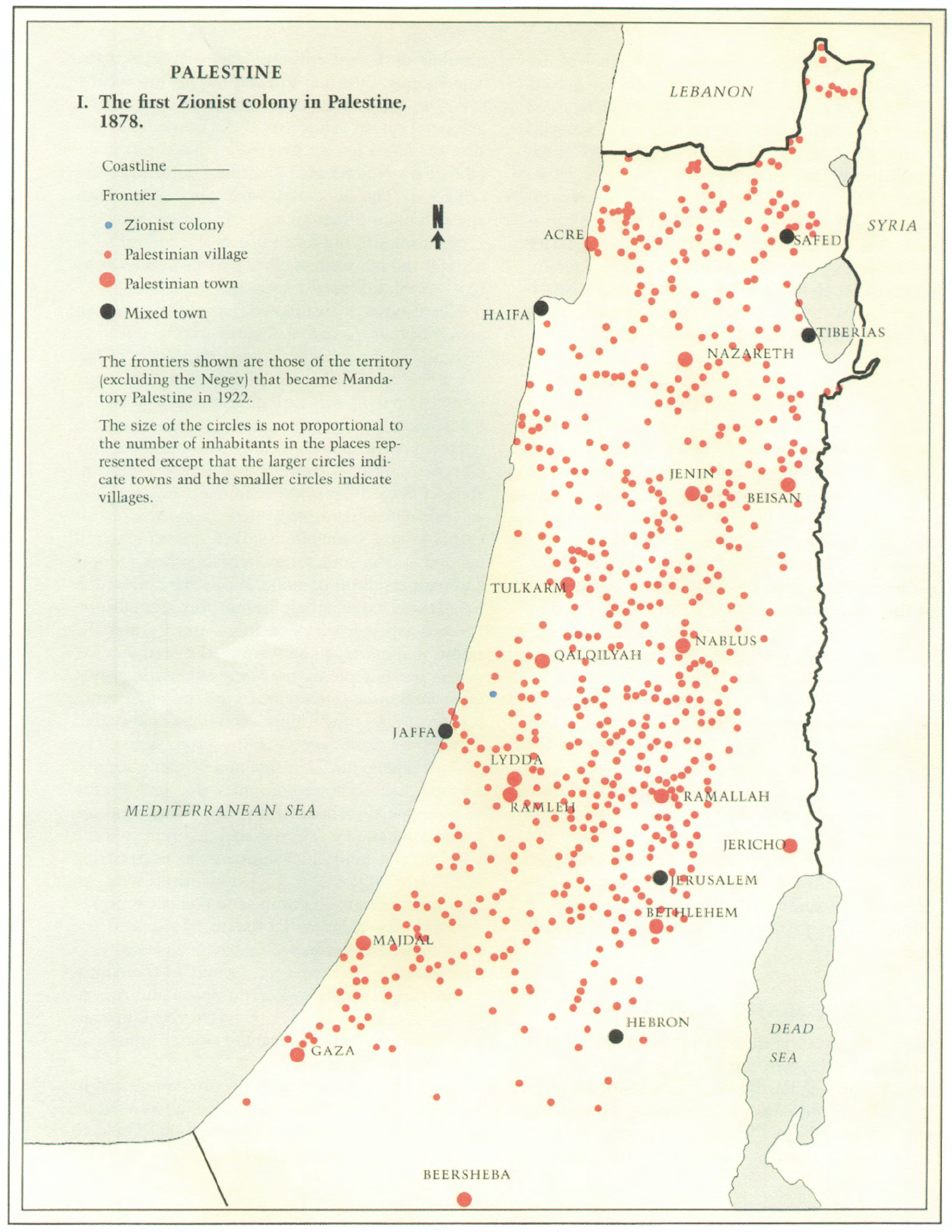
-
Eliezer Ben-Yehuda (1858-1922) emigrates to Palestine. Born Eliezer Yitzhak Perlman in Luzhki, Vilna Governorate, Russian Empire (now in Belarus). Driven by the ideals of the Haskalah, Ben-Yehuda emigrates to Ottoman Palestine, motivated by his desire to preserve Hebrew literature and a distinct Jewish nationality in the context of Zionism.
1880-1881: First Boer War. Also known as the First Anglo-Boer War, tensions between the British Empire and the Boer settlers in the Transvaal region of South Africa erupt into violence sparked by the Boers' resistance to British annexation of the Transvaal in 1877. The war concludes with the decisive victory of the Boer forces at the Battle of Majuba Hill in February 1881, leading to the Pretoria Convention and the restoration of self-government to the Transvaal under British suzerainty. This and the much larger Second Boer War (1899-1902) were primarily conflicts between white colonial powers with little regard for the rights and lives of the indigenous African populations.
1881: Haskalah ends. Jewish emancipation is widespread throughout Europe and continues to grow.
-
Eliezer Ben-Yehuda begins his Hebrew revival efforts in earnest. He believes a common spoken language was essential for the Jewish people’s national revival. He starts by implementing Hebrew in his own household.
-
Ottoman Public Debt Administration is formed. The empire's financial difficulties led to the establishment of this administration, which was controlled by European creditors. It was a significant loss of economic sovereignty and symbolized the empire's increasing dependence on European powers.
-
November: Ottoman government announces permission for foreign (non-Ottoman) Jews to settle throughout the Ottoman Empire, excluding Palestine.
- Baron Edmond de Rothschild's financial backing of Jewish agricultural colonies in Palestine underscore the seriousness of the Zionist endeavor. Local Arab leaders expressed concerns about increasing Jewish land acquisitions, and reports of these tensions reached Ottoman officials. Other than Eliezer Ben-Yehuda, several Zionist activists and thinkers had discussed the idea of a Jewish homeland in Palestine, such as Moses Hess, Leon Pinsker, Judah Leib Pinsker, Peretz Smolenskin.
1881-1884: Pogroms in the Russian Empire. Lead to increased Jewish emigration. The First Aliyah sees approximately 25,000-30,000 Jews, primarily from Eastern Europe, immigrate to Ottoman Palestine.
- A series of violent anti-Jewish pogroms sweep the Russian Empire, primarily
triggered by the assassination of Tsar Alexander II for which Jews were scapegoated.
These pogroms were characterized by widespread violence, looting,
and destruction of property, often with the tacit or explicit support of local
authorities. Here are some notable pogroms from that period:
- Elizavetgrad Pogrom (April 1881): present-day
Kropyvnytskyi, Ukraine. One of the first and most violent pogroms. Deaths
and significant property damage.
- Kiev Pogrom (April-May 1881): Considerable loss of property
and displacement.
- Odessa Pogrom (May 1881): A major port city. Significant
property damage and deaths.
- Warsaw Pogrom (December 1881): Then part of the Russian
Empire. Anti-Jewish riots led to deaths and the destruction of property.
- Balta Pogrom (April 1882): Significant pogrom in Balta,
present-day Ukraine, numerous deaths and extensive property damage.
- Nizhny Novgorod Pogrom (1884): Significant destruction of
property.
- These pogroms were part of a broader pattern of anti-Semitic violence in the Russian
Empire, which contributed to the mass emigration of Jews to Western Europe, the
United States, and Palestine. The pogroms also played a significant
role in galvanizing support for the Zionist movement, as many Jews sought a safe
haven from persecution.
- Elizavetgrad Pogrom (April 1881): present-day Kropyvnytskyi, Ukraine. One of the first and most violent pogroms. Deaths and significant property damage.
- Kiev Pogrom (April-May 1881): Considerable loss of property and displacement.
- Odessa Pogrom (May 1881): A major port city. Significant property damage and deaths.
- Warsaw Pogrom (December 1881): Then part of the Russian Empire. Anti-Jewish riots led to deaths and the destruction of property.
- Balta Pogrom (April 1882): Significant pogrom in Balta, present-day Ukraine, numerous deaths and extensive property damage.
- Nizhny Novgorod Pogrom (1884): Significant destruction of property.
1882: Leon Pinsker publishes Selbstemanzipation (“Self- or Auto-Emancipation”), a pamphlet written in German by the Russian-Polish Jewish doctor and activist Leon Pinsker. It is considered a founding document of Jewish nationalism and the Zionist vision.
-
Baron Edmond de Rothschild begins financial backing of Jewish colonization in Palestine.
-
July: Ottoman government adopts a policy allowing Jewish pilgrims and businessmen to visit Palestine but not to settle there.
-
July 31: Rishon LeZion,
one of the earliest Zionist settlements in Palestine, is established by a group of Jewish immigrants from Eastern Europe. The settlement was founded under the auspices of the Hovevei Zion movement, which sought to promote Jewish agricultural colonization in Palestine. The name means “First to Zion.” -
December: Ottoman government informs Jewish leadership in Constantinople that it views Zionist colonization in Palestine as a political problem.
⭐ 1882–1903: First Aliyah
-
Aliyah (Hebrew. עֲלִיָּה ʿălīyyā, “ascent”) is the act of Jews immigrating to Palestine. Prior to 1949, there are five numbered Aliyahs indicating waves of mass Jewish immigration, plus a period marked by illegal immigration:
- Second Aliyah (1904-1914)
- Third Aliyah (1919-1923)
- Fourth Aliyah (1924-1929)
- Fifth Aliyah (1929-1939)
- Aliyah Bet, “Illegal Aliyah” (1934-1948)
-
First Aliyah. About 35,000 Jews immigrate, mostly from the Russian Empire and Romania. They join the roughly 24,000 Jews in Palestine as of 1880. European Jewish immigrants generally look down on Palestinian Jews, who had previously constituted roughly 3% of the population of Palestine, as “uncivilized.”
-
Many more Ashkenazi agricultural settlements, including:
- Zikhron Ya'akov (1882): Originally known as Zammarin. Established by settlers from Romania with support from Baron Edmond de Rothschild.
- Rosh Pinna (1882): Originally known as al-Ja'una. Established by Romanian settlers who also benefited from Rothschild.
- Petah Tikva (re-established in 1883): Originally known as Umm Labas. Re-established after previous failures.
- Ness Ziona (1883): Originally part of Wadi Hunayn. Founded by Reuben Lehrer from Russia.
- Yesud HaMa'ala (1883): Established near al-Mutilla. Founded by Jews from Safed and Tiberias, one of the early attempts at establishing agricultural settlements in the Hula Valley.
- Gederah (1884): Part of Qatra. Established by members of the Bilu group from Russia, it became an important agricultural settlement.
- Rehovot (1890): Originally known as Daran. Founded by Polish and Russian Jews, became a center of citrus cultivation.
- Hadera (1891): Previously called al-Khayriyya. Established by Jews from Lithuania and Latvia. They faced significant challenges due to malaria but eventually thrived with Rothschild’s assistance.
- Metula (1896): Known as Um Talla. Founded by Baron Edmond de Rothschild in the northernmost region of Palestine.
1884: Hebrew Language Committee founded
-
Eliezer Ben-Yehuda (née Perlman) founds the Hebrew Language Committee (Va'ad HaLashon), which later becomes the Academy of the Hebrew Language. This institution plays a crucial role in standardizing Modern Hebrew.
-
Hermann Hirsch Schapira (later Zvi) first proposes the “Blue Box” as a means to collect monetary donations to acquire land in Palestine.
-
March: Ottoman government decides to close Palestine to foreign (non-Ottoman) Jewish businessmen but not to Jewish pilgrims.
1884–1885: Berlin Conference aka The Scramble for Africa
- European powers partition Africa, setting a precedent for the division
and colonization of lands without regard to indigenous populations. Convened to regulate
European colonization and trade in Africa during
the New Imperialism period. Participants were all major European
powers, including Britain, France, Germany, Belgium, Portugal, and Italy, among others.
No African representatives were present.
- General Act of the Berlin Conference: Established guidelines for the annexation of African territory, emphasizing the bornd for notifying other powers and demonstrating effective occupation.
- Free Trade Zones: Declared the Congo Basin and Niger River Basin open to free trade for all nations.
- Abolition of Slave Trade: Reaffirmed commitments to suppress the slave trade in Africa.
- Principle of Effective Occupation: Required colonial powers to establish authority and administration in claimed territories to legitimize their control.
- Congo Free State established as the personal possession of King Leopold II of Belgium, rather than as a Belgian colony. Leopold II convinced the international community that his interest in the Congo was humanitarian and philanthropic, aimed at ending the Arab slave trade and bringing civilization to Central Africa. However, the reality was starkly different. His primary interest was the exploitation of the region's vast natural resources, particularly copper and ivory and, later, rubber. He proceeds to impose one of the cruelest, most oppressive regimes ever created.
1885-1908: Congo Free State Genocide, one of the largest periods of targeted mass killing in history.
- The demand for rubber skyrockets due to the advent of the automobile and the bornd for rubber tires. Following the result of the Berlin Conference, King Leopold II begins a brutal regime of rubber extraction in the Congo. Local populations were coerced into collecting rubber under the threat of violence.
- Indigenous Congolese are forced to meet stringent rubber quotas. Those who failed to meet these quotas faced severe punishments, including flogging, mutilation, and execution. The Force Publique, a military force employed by Leopold II, was notorious for its brutality, including the practice of severing the hands of those who did not comply.
- The Force Publique enforces Leopold's policies through systematic violence. Villages were often burned, and hostages were taken to ensure compliance with labor demands.
- The regime's abuses included mass killings, mutilations, and other forms of physical and psychological torture. The exploitation extended to women and children, who were also subjected to forced labor and violence.
- The exploitation and violence led to a catastrophic decline in the Congolese population.
In addition to those directly killed by the colonial administration, many died from
starvation, disease, and the collapse of traditional
social structures.
- Estimates of the death toll vary widely due to the lack of precise records. Some historians suggest that up to 10 million Congolese people died as a result of Leopold's oppression. This figure represents approximately half of the population at the time.
- Leopold’s reign in Congo ended following reports of the atrocities began to reach Europe
thanks to missionaries, travelers, and activists. Individuals like E.D. Morel and Roger
Casement played crucial roles in exposing the
abuses through their writings and advocacy.
- The Congo Reform Association, founded by Morel and supported by notable figures such as Mark Twain and Arthur Conan Doyle, campaigned vigorously against the atrocities. Their efforts led to widespread international condemnation of Leopold's regime.
- The Belgian government finally took control of the Congo Free State from King Leopold II
in 1908, renaming it the Belgian Congo. While the transfer of control marked the end of
Leopold's personal rule, exploitation continued
under Belgian colonial administration, albeit with somewhat less brutality.
- The horrors that unfolded in Congo during this era were a stark warning of the carnage and exploitaition possible under imperialist European regimes with complete disregard of the welfare and lives of local inhabitants. The external imposition by Europeans on the ownership of a foreign land set a precedent of manufactured legal consent that allowed colonial powers free reign to murder and mistreat indigenous populations as they saw fit.
1885-1894: Nathan Birnbaum publishes Selbst-Emancipation! The 21-year-old Viennese Jewish intellectual names his highly influential paper after Leon Pinsker’s pamphlet.
-
⭐1890: Birnbaum coins the term “Zionism” along with “Zionist” and “Zionistic.”
-
1892: Birnbaum first conceptualizes and names “Political Zionism.”
-
1893: Birnbaum publishes a brochure entitled Die Nationale Wiedergeburt des Juedischen Volkes in seinem Lande als Mittel zur Loesung der Judenfrage (“The National Rebirth of the Jewish People in its Homeland as a Means of Solving the Jewish Question”), in which he expounds ideas very similar to those that Herzl later promotes.
⭐ 1888 May: restrictions on Jewish mass immigration loosen
-
European powers pressure the Ottoman government to allow foreign (non-Ottoman) Jews to settle in Palestine, provided they do so singly and not en masse.
- European diplomatic pressure on the Ottoman Empire culminated in a significant policy shift regarding Jewish immigration to Palestine. The exact events of that month involved negotiations and diplomatic communications between the Ottoman authorities and representatives of European powers, particularly Britain, France, and Germany. These European nations were motivated by a combination of geopolitical interests and the influence of their Jewish communities and prominent Zionist supporters.
- The outcome of these diplomatic efforts was the Ottoman government's decision to allow foreign (non-Ottoman) Jews to settle in Palestine, albeit under strict conditions. The key stipulation was that Jewish immigration had to occur on an individual basis rather than in large, organized groups. This policy aimed to mitigate the potential political and social disruptions that large-scale Zionist colonization might cause.
1890: Eliezer Ben-Yehuda publishes the first volume of his Modern Hebrew dictionary. "A Complete Dictionary of Ancient and Modern Hebrew" was a cornerstone in the revival of Hebrew, transforming it from a liturgical and scholarly language into a functional, everyday vernacular.
⭐ 1891: Jewish Colonization Association (JCA) founded by Baron Maurice de Hirsch
- At this point, it is primarily focused on establishing Jewish agricultural colonies
in Argentina and Brazil.
-
Ottoman Sultan Abd-al Hamid II expresses fears that granting Ottoman nationality to Jewish immigrants in Palestine “may result in the creation of a Jewish Government in Jerusalem.”
1892: Palestine Railways established. The Jaffa-Jerusalem Railway opens, becoming the first railway line in Palestine. It connects the port city of Jaffa with Jerusalem, significantly improving transportation and commerce. Palestine Railways would continue to expand and operate until the Nakba in 1948, at which point it was seized by Zionist forces and renamed Israeli Railways.
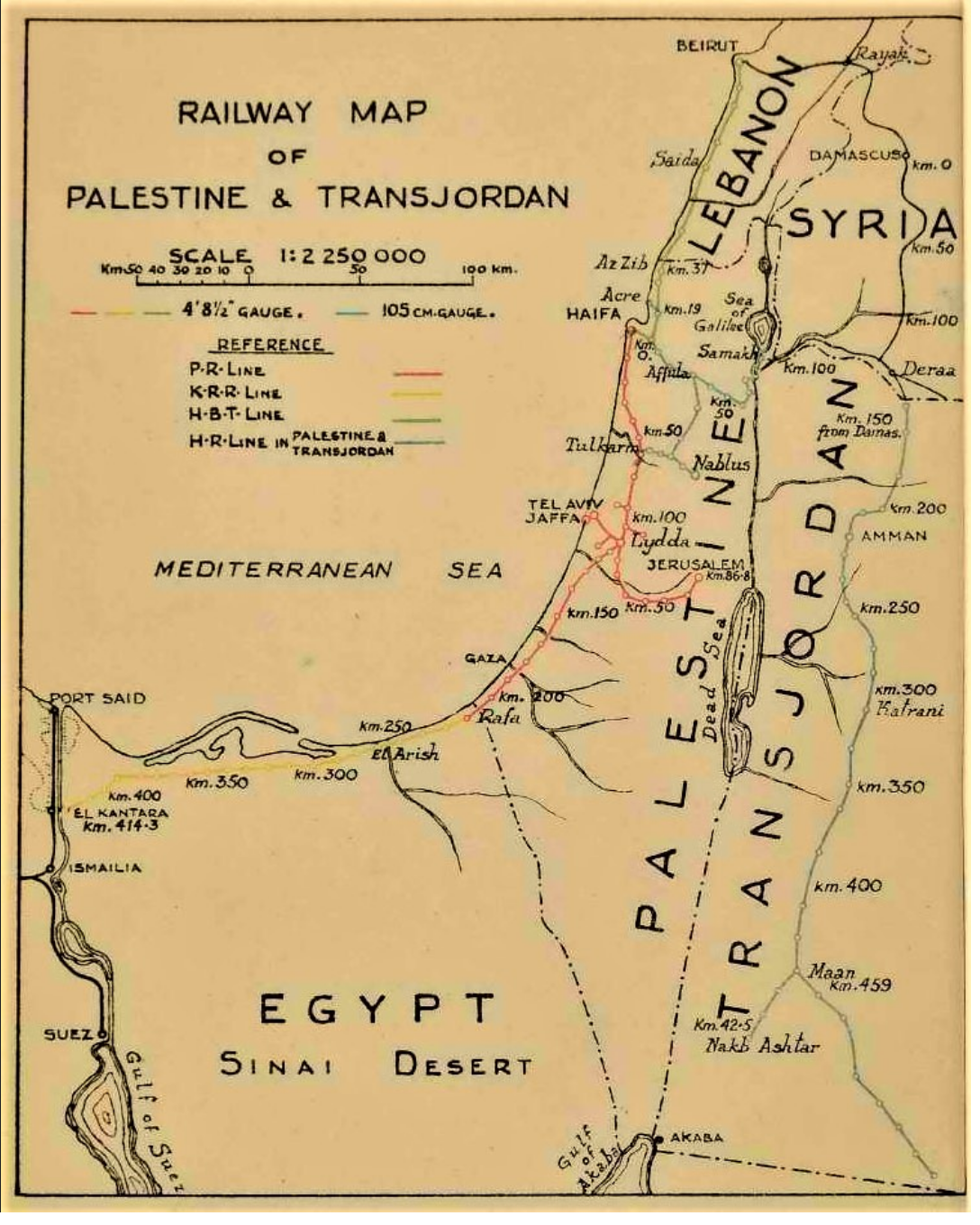
-
November: Ottoman government forbids the sale of state land to foreign (non-Ottoman) Jews in Palestine.
-
Prominent Zionist Max Nordau publishes his book Degeneration ("Entartung ") examining of what he perceived as the moral and cultural decay of contemporary European society. He vehemently attacked modernist movements in art and literature, such as Symbolism and Impressionism, arguing that they were symptomatic of a broader societal decline characterized by irrationality and moral corruption. Drawing on pseudoscientific language, he diagnosed modernist artists and writers with various forms of psychopathology and suggested their works were products of diseased minds. The degenerate man was pathetic, impotent, and full of despair.
- Nordau's conservative, reactionary ideology has been associated with eugenicists such as Francis Galton and Cesare Lombroso, and informed the openly eugenic ideology of Nordau’s intellectual successor, Arthur Ruppin (1876–1943).
1893 April: European powers pressure the Ottoman government to permit Jews legally resident in Palestine to buy land provided they establish no colonies on it.
⭐ 1894–1906: The Dreyfus Affair
- The wrongful conviction of French Jewish army officer Alfred Dreyfus for treason.
The affair shines a light on antisemitism in Europe and strongly influences Theodor
Herzl.
-
1894–1895: Alfred Dreyfus, a Jewish captain in the French Army, was wrongfully accused and convicted of passing military secrets to Germany. The evidence against him was flimsy and largely fabricated, yet he was sentenced to life imprisonment on Devil's Island.
-
The affair exposed deep-seated antisemitism within French society and its institutions. The wrongful conviction was fueled by widespread prejudice against Jews, and the case became a focal point for antisemitic sentiment.
-
The case divided French society into two camps. the Dreyfusards, who advocated for Dreyfus's innocence and justice, and the anti-Dreyfusards, who supported his conviction.
-
Theodor Herzl, an Austrian Jewish journalist who covered the trial, is profoundly affected by the his coverage of the trial. Witnessing the virulent antisemitism in France, Herzl became convinced that assimilation would not protect Jews from persecution.
-
1898: The famous writer Emile Zola published an open letter titled "J 'Accuse...!" in the newspaper L'Aurore, accusing the French military and government of an antisemitic cover-up. Zola 's intervention brought international attention to the case and intensified the demand for justice.
-
1906: Dreyfus was eventually exonerated after years of legal battles and public pressure.
1894–1897: Hamidian massacres. Also called the Armenian massacres, estimated casualties range from 100,000 to 300,000, resulting in 50,000 orphaned children. The massacres are named after Sultan Abd al-Hamid II, who, in his efforts to maintain the imperial domain of the declining Ottoman Empire, reasserted pan-Islamism as a state ideology. Although the massacres were aimed mainly at the Armenians, in some cases they turned into indiscriminate anti-Christian pogroms, including the Diyarbekir massacres, where according to some sources up to 25,000 Assyrians were also killed.
1895: First early version of a concentration camp is propososed by Spanish general Arsenio Martínez Campos in Cuba, which he called reconcentración. His idea was to isolate rebels by relocating rural inhabitants into Spanish-held cities behind a new invention, “barbed wire.” In the end, he himself refuses to implement it, calling his enemy too noble to subject them to such treatement.
⭐ 1896 February 14: Publication of "Der Judenstaat" (“The Jewish State”)
-
Disturbed by his journalistic coverage of the Dreyfus Affair, Theodor Herzl by releasing a roughly 80-page pamphlet advocating for the creation of a Jewish nation-state
-
JCA Operations Begin in Palestine.
- Originally focused on facilitating Jewish agricultural settlements in Argentina and Brazil, the Jewish Colonization Association extended its efforts to Palestine to support the nascent Zionist movement. The association provided financial aid, agricultural training, and infrastructure development to enhance the productivity and sustainability of Jewish settlements.
- Notable contributions included support for colonies like Metula and Rehovot. Despite facing challenges such as local resistance, harsh agricultural conditions, and political obstacles from the Ottoman authorities, the JCA's work was pivotal in laying the groundwork for future Jewish statehood and aligning with the broader goals of the Zionist movement.
-
⭐ June: Proposal to the Ottomans
-
Herzl meets with a well-connected friend, Jewish journalist and Ottoman spy Philipp Michael de Newlinski to propose a charter for Jewish colonization in exchange for financial aid to the Ottoman Empire. Through Newlinski, they first meet with Grand Vizier Halil Rifat Pasha, then Sultan Abdul Hamid II himself, both of whom reject Herzl's proposal outright. Abdul Hamid II says:
- “If Mr. Herzl is as much your friend as you are mine, then advise him not to take another step in this matter. I cannot sell even a foot of land, for it does not belong to me, but to my people. My people have won this empire by fighting for it with their blood and have fertilized it with their blood. We will again cover it with our blood before we allow it to be wrested away from us. The men of two of my regiments from Syria and Palestine let themselves be killed one by one at Plevna. Not one of them yielded; they all gave their lives on that battlefield. The Turkish Empire belongs not to me, but to the Turkish people. I cannot give away any part of it. Let the Jews save their billions. When my Empire is partitioned, they may get Palestine for nothing. But only our corpse will be divided. I will not agree to vivisection.” The Complete Diaries of Theodor Herzl Vol. 1 pg. 378
-
- In Cuba, General Valeriano Weyler replaces Martínez Campos and begins implementing reconcentración. Within a year, tens of thousands are dead or dying in the camps from horrific conditions. An estimated 150,000 die in total.
⭐ 1897: First Zionist Congress and the Jewish Labor Bund
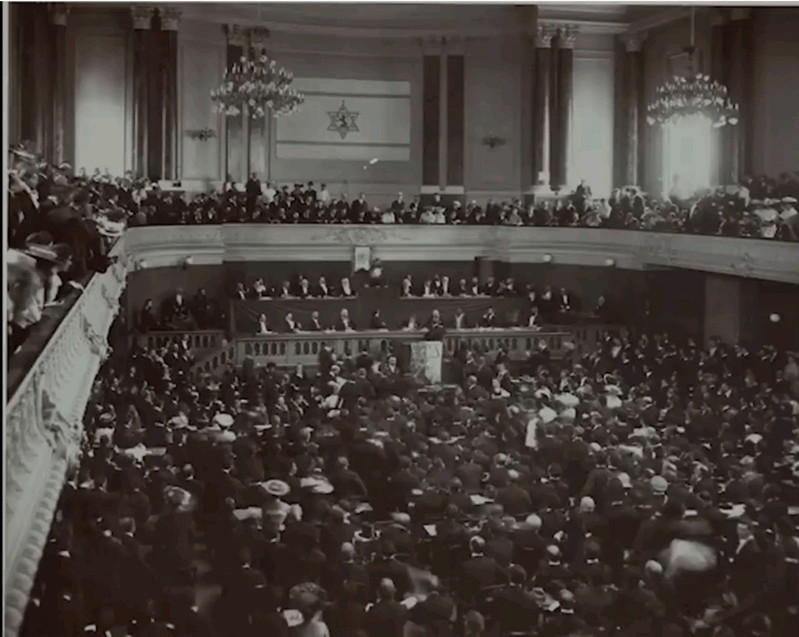
-
August 29–31: The First Zionist Congress is held in Basel, Switzerland, with Theodor Herzl acting as chairperson. The Congress was attended by some 200 participants who formulated the Zionist platform, known as the "Basel programme", and established the Zionist Organization (ZO).
- In contrast with the older Hibbat Zion movement, the ZO took a clear stance in favour of Zionism as a political endeavor, stating in its programme that, “Zionism seeks to establish a home in Palestine for the Jewish people, secured under public law.”
- Hermann Hirsch Schapira, later Zvi, proposes the formation of a Jewish national fund, widely considered to be the first seeds of the Jewish National Fund formed four years later.
- Afterward, Herzl wrote in his diary, “Were I to sum up the Basel Congress in a word - which I shall guard against pronouncing publicly - it would be this: At Basel I founded the Jewish State.”
-
October 7: The Jewish Labor Bund is founded. Two months later, the Jewish Labor Bund is founded in Vilnius, Lithuania. Officially known as the General Jewish Labour Bund in Lithuania, Poland, and Russia, it emerges primarily in response to the socio-economic conditions and political challenges faced by Jewish workers in the Russian Empire. It is dedicated to addressing the unique bonds of the Jewish proletariat.
- The Bund's ideology was rooted in the principles of socialism and Jewish cultural autonomy. It advocated for the rights of Jewish workers and aimed to improve their living and working conditions through class struggle and solidarity with the broader labor movement. Unlike the Zionist movement, which sought the establishment of a Jewish state in Palestine, the Bund emphasized the importance of fighting for Jewish rights and cultural preservation wherever Jews already lived. This stance was encapsulated in their Yiddish slogan: דאָרטען, וואו מיר לעבן, דאָרט איז אונדזער לאַנד! (“Dort, wo mir leben, dort is unser land!”) or: “There, where we live, there is our country!”.
- The Bund was a staunch advocate for the use of Yiddish as the language of the Jewish working class, promoting Yiddish culture and education. It opposed both assimilationist tendencies and the Zionist project, arguing that the solution to anti-Semitism and social injustice lay in the struggle for socialist transformation and equality within the existing societies.
- The Bund continues to play a significant role in various revolutionary movements, including the Russian Revolution of 1905, and remains a major force in Jewish political life in Eastern Europe. Despite the immense losses suffered during World War II, the Bund's legacy persists, influencing post-war Jewish socialist movements and continuing to advocate for Jewish cultural and political rights in the diaspora to the present day.
-
Muhammad Tahir al-Husseini heads a commission appointed to scrutinize Zionist land-acquisition methods.
- Muhammad Tahir al-Husseini, the Grand Mufti of Jerusalem from 1865 to 1908, played a significant role in scrutinizing Zionist land acquisition methods in Palestine. As the leader of the Muslim community in Jerusalem and a prominent religious and political figure, al-Husseini was deeply concerned about the increasing purchase of land by Zionist settlers, which threatened the socio-economic fabric and demographic balance of the region.
- In response to these concerns, a commission headed by al-Husseini was appointed to investigate and monitor the methods used by Zionist organizations to acquire land. This commission aimed to protect the interests of the indigenous Palestinian Arab population and to ensure that land transactions were conducted fairly and transparently, reflecting the growing tensions between the Zionist movement and the Palestinian Arabs in the early 1900s.
-
Ottoman Sultan Abd-al Hamid II initiates a policy of sending members of his own palace staff to govern the province of Jerusalem in response to the First Zionist Congress.
- Ottoman Sultan Abdülhamid II, who reigned from 1876 to 1909, responded to the increasing activities of the Zionist movement, particularly following the First Zionist Congress in 1897, by tightening his control over the province of Jerusalem. Recognizing the potential threat posed by Zionist land acquisitions and settlement activities to the stability of the Ottoman Empire, Abdülhamid II initiated a policy of appointing trusted members of his own palace staff to govern the province.
- This move aimed to ensure that the central government maintained a firm grip on the region and could effectively monitor and regulate Zionist activities. By placing loyal and reliable officials in key administrative positions, Abdülhamid II sought to safeguard the interests of the indigenous Palestinian population and prevent any large-scale demographic or political shifts that could undermine Ottoman authority.
-
Greco-Ottoman War. Pan-Islamism, an ideology advocating for the unity and solidarity of Muslims under a single Islamic political entity, gained considerable traction in the late 19th and early 20th centuries. This movement was particularly invigorated by the Ottoman Empire's efforts to position itself as the defender of the Muslim world. The Greco-Ottoman War of 1897, which resulted in a relatively favorable outcome for the Ottomans, served as a catalyst for this sentiment.
- Although the war was short and ended with a mixed outcome, many Muslims perceived the Ottoman Empire's resilience against Greece, a Christian European nation, as a symbolic victory for the Muslim world. This perception reinforced the idea that the Ottoman Sultan, who also held the title of Caliph, was the protector of Islam.
- The war spurred a sense of solidarity among Muslims across different regions. Celebrations and expressions of support for the Ottoman victory were widespread, indicating the resonance of Pan-Islamic sentiments. This unity was not merely symbolic but also manifested in various forms of resistance against European colonial powers.
- Following the war, there were numerous uprisings, lockouts, and protests in Muslim-majority regions against European colonial rule. These acts of defiance were often inspired by the notion of a united Muslim front, as promoted by Pan-Islamist ideology. For example, in British India, the Khilafat Movement (1919–22) later emerged, advocating for the preservation of the Ottoman Caliphate and opposing British imperialism.
- Newspapers and journals in the Muslim world played a crucial role in propagating Pan-Islamist ideas. They reported on the Ottoman victory and framed it as a triumph for all Muslims, while also criticizing European colonial practices. Intellectuals and activists used these platforms to argue for greater unity and resistance against colonial powers, further spreading Pan-Islamist ideology.
- The success of Pan-Islamism in galvanizing Muslim support for the Ottoman Empire had a lasting impact on various national movements. It provided a framework for anti-colonial resistance and influenced the political discourse in many Muslim-majority regions. While Pan-Islamism did not achieve its ultimate goal of unifying all Muslims under a single political entity, it significantly contributed to the rise of nationalist movements that sought to challenge European colonial rule and assert Muslim identity and autonomy.
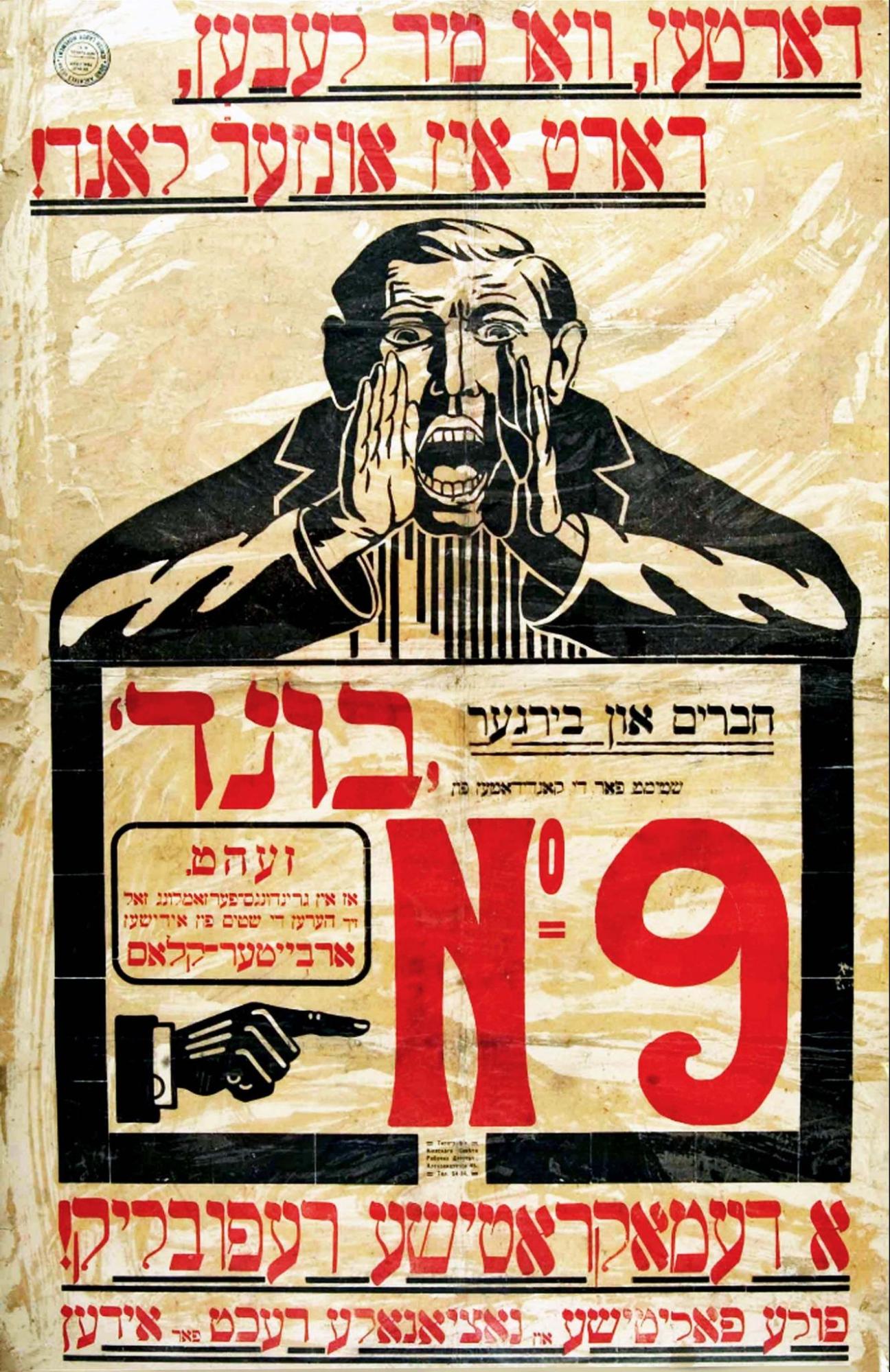
⭐ 1898: the modern Palestinian national identity begins to emerge
-
The Cairo journal warns of Zionism aims as part of a growing nationalist consciousness in Palestine and a general distrust of colonialism throughout the Ottoman Empire. The Arabic press, particularly the Cairo-based journal Al-Manar, played a crucial role in raising awareness about the Zionist movement's intentions in Palestine. In the early 20th century, Al-Manar issued warnings that Zionism sought to take possession of Palestine, reflecting growing concerns among the Arab intelligentsia about the implications of Jewish immigration and land acquisition. The journal's editor, Rashid Rida, was particularly vocal in cautioning that Zionist ambitions extended beyond mere settlement and aimed at establishing a Jewish state, which would inevitably lead to the displacement and marginalization of the indigenous Arab population. This sentiment resonated widely among the Arab public and contributed to the burgeoning nationalist movements in the region.
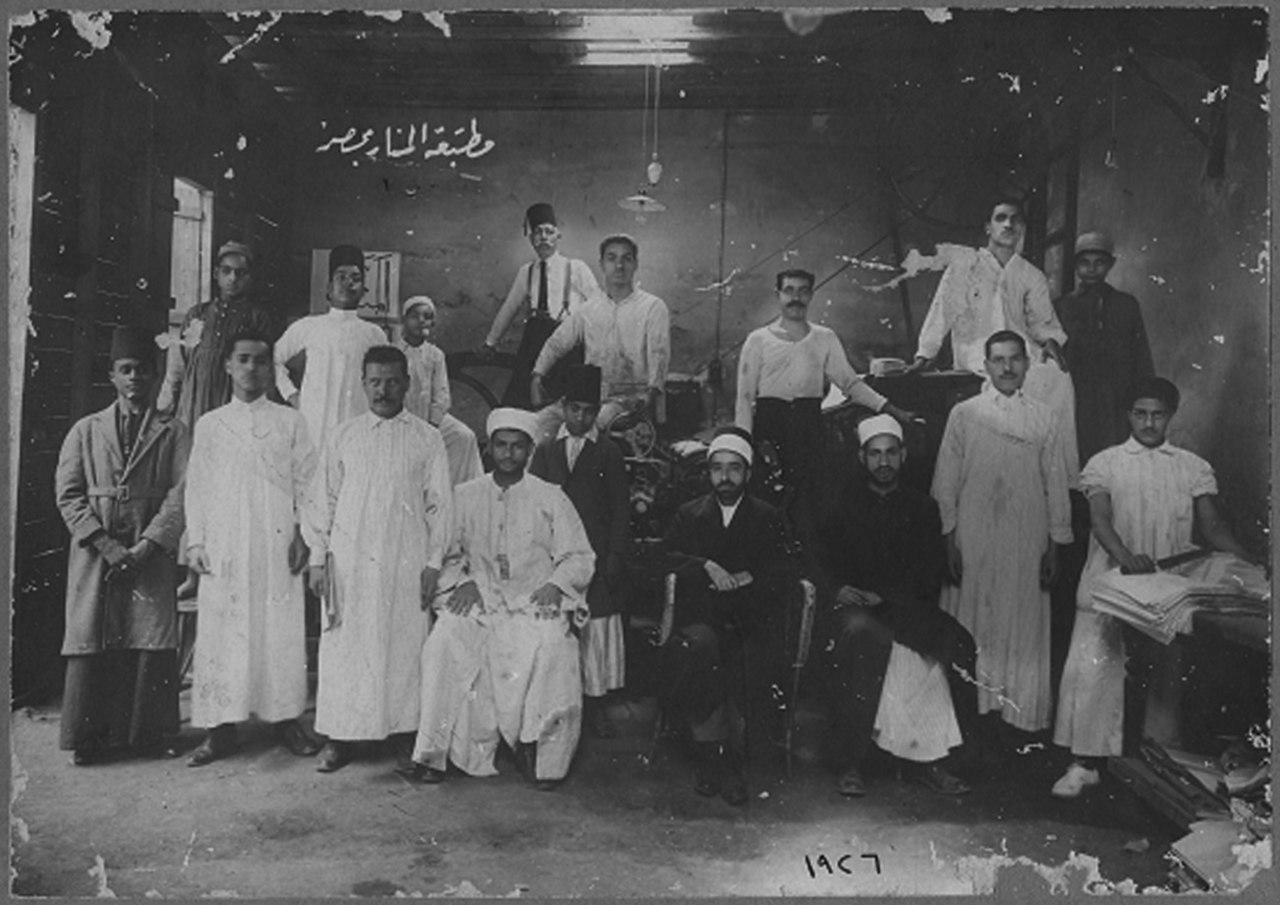
-
Nazarene Khalīl Baydas translates “A Description of the Holy Land” from Russian to Arabic, claiming, “the Arabic geography books on the topic were insufficient,” and “the people of Palestine needed a geography book about their country.” He describes the book as “a description of the land of Palestine” and refers to the people of Palestine as Palestinians in multiple places. (Source)
-
Kaiser Wilhelm II visits Palestine. This underscored Germany's interest in the Ottoman Empire and the broader Middle East. It was a part of Germany's strategy to strengthen its influence in the region and to establish itself as a protector of Christian interests in the Holy Land.
- The visit included a meeting with Theodor Herzl, the founder of the Zionist movement. This meeting was crucial as it signaled a form of recognition and potential support from a major European power for the Zionist cause. Although Wilhelm II's support was more symbolic than practical, it nevertheless provided a morale boost to the Zionist movement.
- Wilhelm II's visit was also framed as a pilgrimage, which had significant religious symbolism. It highlighted the shared Christian heritage and interests in Jerusalem, further complicating the religious and political dynamics of the region.
- For the Ottoman Empire, the visit was an opportunity to showcase its control over Jerusalem and to strengthen its diplomatic ties with Germany. The Ottomans hoped to leverage this relationship to counterbalance the influence of other European powers in the region.
-
August: Max Nordau introduces "Muskeljudentum" (Muscular Judaism) at the Second Zionist Congress, which he is now head of. Inspired by eugenicist advocates for the physical and mental rejuvenation of the Jewish people through athleticism and physical fitness. Its aim was to counter stereotypes of Jewish weakness and instead promote the concept of a strong, masculine “New Jew.” Nordau’s works would later be directly referenced by prominent white supremacist eugenicist Lothrop Stoddard.
-
October: Albert Antebi, JCA representative in Jerusalem, observes that the First Zionist Congress has adversely affected relations between Palestinians and Jewish immigrants.
-
March 19: Herzl sends a letter to the Palestinian mayor of Jerusalem hinting that, if Zionists are not welcome in Palestine, they will go elsewhere.
1899-1902: Second Boer War. Also known as the South African War and vernacularly known as simply the Boer War. Begins in October 1899 as a result of escalating tensions over British imperial ambitions and Boer independence in the Transvaal and Orange Free State and marked by significant battles and guerrilla warfare.
-
Involved the British use of concentration camps, where thousands of Boer women and children, as well as some Black Africans, were interned under appalling conditions, leading to high mortality rates due to disease and malnutrition.
-
Ends in May 1902 with the Treaty of Vereeniging, which resulted in the annexation of both Boer republics into the British Empire. This laid the groundwork for the future Union of South Africa in 1910, a state that would continue to enforce racial segregation and disenfranchisement of Black South Africans. The legacy of these wars and the policies enacted during and after them contributed to the systemic racial inequalities that persisted throughout the 20th century.
1900 June: Ottoman government sends a commission of inquiry to Palestine to study the implications of Zionist mass immigration and land acquisition.
-
The JCA takes over responsibility for colonies supported by Baron de Rothschild.
1901: Keren Kayemeth (Jewish National Fund) founded as a land-acquisition organ of the WZO, with the central tenet that all land acquired by the JNF in Palestine must be inalienably Jewish, with exclusively Jewish labor to be employed on it.
-
The Jewish Labor Bund officially rejects Zionism through a formal resolution during its Fourth Congress held in Białystok, modern-day Poland. Calling it a misguided solution to Jewish persecution. the Bund asserted that Jewish liberation should be achieved through the struggle for socialism and workers' rights within their current countries of residence. They believed that Zionism diverted Jewish workers from the broader class struggle and promoted a bourgeois nationalist agenda, thus undermining efforts to achieve cultural autonomy and improve social and economic conditions everywhere.
-
January: Ottoman restrictions on Zionist immigration to and land acquisition in the Jerusalem district take effect.
-
May: Administrative Council of Jerusalem strongly objects to JCA's attempts at acquiring land in the Jerusalem district.
- May 19: Herzl's Interview with Sultan Abdul Hamid II. Herzl again proposes a plan to consolidate the Ottoman Debt in exchange for a charter for Jewish colonization, now with the backing of Zionist Organization, but again is refused. In the following year, he makes several further attempts to convince the Ottomans of the Zionists' loyalty fail, but they (correctly) take his Der Judenstaat and the stated goals of the Zionist Congress to heart.
-
July: Palestinian peasants in the region of Tiberias express alarm at the extent of Zionist land acquisition.
-
Ottoman government allows foreign (non-Ottoman) Jews to buy land in northern Palestine under pressure from European powers.
1902 January: Al-Manar warns that Zionism seeks national sovereignty in Palestine.
-
February: JCA representative Antebi observes that “the ill will of the local population coincides with the creation of Zionism.”
- July: The Ottomans reject Herzl for a final time in his lifetime, tell him, “...the purchase of Palestine thus becomes a political question, and not one of swelling our exchequer.”
-
Herzl meets with the Colonial Office in London asking the British to promote Jewish colonization in Sinai—part of Britain’s Egyptian protectorate. Herzl next sends a representative to negotiate with the British-controlled Egyptian government in Cairo. The Egyptians offer to encourage and sponsor Jewish immigration so long as the new arrivals adopt Ottoman citizenship, which Egyptians retained under the British Protectorate. Herzl rejects the offer of equality and insists on a capitulation under which the Jews would enjoy foreign citizenship—which the Egyptian foreign minister, Boutros Ghali, the grandfather of UN Secretary-General Boutros Boutros-Ghali, rejects.
1903: The Uganda Scheme is proposed by the British government as a temporary refuge for Jews facing persecution in Eastern Europe. The idea was met with significant controversy and debate within the Zionist movement, ultimately being rejected at the Seventh Zionist Congress in 1905.
-
October: During passage through the port of Alexandria on his way back to Europe, an already ailing Herzl attends a “dreadfully boring” lecture by the world’s leading authority on irrigation. He turns his attention to the audience:
-
“What interested me most was the striking number of intelligent-looking young Egyptians who packed the hall. They are the coming masters. It is a wonder the English don’t see this. They think they are going to deal with the fellahin [Arab peasant farmers] forever.” This blindness of the British, he remarked, would “make them lose their colonies later.”
-
-
December: Anglo-Palestine Company (APC), a subsidiary of JCA, established in Palestine to finance Zionist colonization.
-
Jewish population in Palestine reaches approximately 50,000.
1904–1908: Herero and Namaqua Genocide. Carried out by German colonial forces in German South West Africa (modern-day Namibia), this represents one of the earliest instances of modern, 20th-century genocide. It is especially brutal, involving more modernized methods of mass killing and early versions of German concentration camps.
-
January: The Herero people revolt against oppressive colonial rule, and violence quickly escalates. Under the command of General Lothar von Trotha, the German military adopt a policy of extermination and collective punishment.
-
October 19:04. "Extermination Order" issued by von Trotha declaring that all Herero, whether armed or unarmed, were to be killed. The Herero were driven into the Omaheke Desert, where many perished from starvation and dehydration.
-
1905: The Nama people also rise in rebellion but face a similarly brutal response.
-
Concentration camps established in which captured Herero and Namaqua were subjected to forced labor, starvation, and disease. By the end of the campaign, an estimated 65,000 Herero (approximately 80% of the Herero population) and at least 10,000 Nama (around 50% of the Namaqua population) had perished.
- These camps were prototypes for what the Nazi regime would later use against Jews during World War II and the Holocaust.
1904 July: Death of Theodor Herzl. Following his death, the leadership of the Zionist movement transitions to a collective leadership, with Max Nordau continuing as a prominent figure.
-
August-September: Trouble in Tiberias. Tensions flare between Zionist colonists and Palestinian farmers in the Tiberias region. In its attempts to settle its substantial debts, the Ottoman Empire sold off land owned by absentee landlords to European investors, including Zionist organizations. This often resulted in the displacement of Palestinian tenant farmers who had cultivated the lands for generations, due to the Zionist settler policy of Jewish-only labor. New restrictions were also imposed on Palestinian agricultural practices which further led to economic strife, leading to growing resentment, open hostility, and in some cases violent clashes with Jewish colonial settlers.
⭐ 1904–1914: Second Aliyah
-
The second wave of Jewish immigration to Palestine driven largely by the aftermath of pogroms in Eastern Europe and the socio-political upheavals in the Russian Empire. Approximately 35,000-40,000 Jews, primarily from Russia and Poland, arrive. This wave of immigration was characterized by the establishment of agricultural settlements and collective farms (kibbutzim), as well as the promotion of Hebrew as a spoken language. The settlers were ideologically motivated by the promise of establishing a Jewish nation-state.
1905: The Aliens Act passed in Britain
-
January: Publication of "Le Reveil de la Nation Arabe" by Naguib Azoury.
- Le réveil de la nation arabe dans l’Asie turque—or, more commonly, Le réveil de la nation arabe (The Awakening of the Arab Nation) is Azoury's most significant work, termed “a minor classic in Arab nationalist literature.” Le réveil included a comprehensive discussion of the relationships between the Ottoman Empire and the world powers. Azoury openly urged the Arab provinces to sever their ties with the Ottoman Empire.
- In addition to the text's nationalistic nature, Le réveil decried Zionist aspirations in Palestine. Azoury envisaged “that Zionist and Arab nationalist aspirations were likely to come seriously into conflict,” writing that "two important phenomena are emerging at this moment in Asiatic Turkey. They are the awakening of the Arab Nation and the latent effort by Jews to reconstitute on a very large scale the ancient Kingdom of Israel... They are destined to fight each other continually until one of them wins.”
-
The Aliens Act of 1905 was a British law passed during the tenure of the Conservative government led by Prime Minister Arthur Balfour. It was aimed at restricting immigration, particularly targeting Eastern European Jews fleeing persecution.
- Driven by growing antisemitic sentiments and concerns over job competition and social stability, the Act allowed for the exclusion of immigrants deemed "undesirable" based on criteria like poverty and illness. It marked a significant shift from Britain's previously liberal immigration policies, reflecting broader European trends of nativism and xenophobia, and significantly reduced Jewish immigration to the UK.
-
David Wolffsohn becomes president of the World Zionist Organization at the Seventh Zionist Congress. The far right-wing leader Max Nordau remains an influential figure within the movement.
-
Russian Revolution (1905–1907). The Bund plays a significant role in this conflict, advocating for workers’ rights and Jewish cultural autonomy.
1906: Israel Shochat establishes a local branch of Poale Zion. Along with the somewhat mythologized historical figure Michael Halperin, Shochat establishes a small branch of Poale Zion in Palestine, numbering about 60 members.
-
During a House of Commons debate, Lord Balfour argues that the disenfranchisement of the blacks in South Africa was not immoral, saying, “We have to face the facts. Men are not born equal, the white and black races are not born with equal capacities: they are born with different capacities which education cannot and will not change.”
1907: Bar-Giora marks the beginning of organized Jewish militancy in Palestine.
-
Sejera established. Manya Wilbushewitz Shochat, along with her husband Israel Shochat, help establish Sejera (also known as Ilaniya), considered a notable precursor to the kibbutz movement, although it is not classified as a kibbutz in the same sense as Degania Alef. Shochat traveled to Europe and the United States to gain financial support for the socialist farming collectives.
-
April: Prominent Zionist leader Chaim Weizmann visits Palestine for the first time
-
August: Report issued by the Ottoman governor of Jerusalem on Zionist evasion of Ottoman immigration and land-transfer regulations.
-
⭐ September 28: Bar-Giora founded
-
by Israel Shochat based on his experiences with underground militias during the Tzarist pogroms.
- Yitzhak Ben-Zvi (born Izaak Shimshelevich) arrives in Palestine from Poltava, Ukraine, who had been on the run from the Russian secret police for about a year due to his work with Poale Zion there. Shochat and Ben-Zvi travel together to the 8th World Zionist Congress in The Hague, and upon their return establish the first incarnation of Bar-Giora.
- They gather a group in Ben-Zvi's Jaffa apartment that also includes Manya Shochat, Alexander Zeid, Mendel Portugali, Israel Giladi, Yehezkel Hankin, Yehezkel Nissanov and Moshe Givoni. Swearing themselves to secrecy on pain of death, they pledge their allegiance to Israel Shochat. The name was chosen after Simon Bar-Giora, a leaders of the Jewish Revolt against the Romans. As a motto, they choose a line from Yaakov Cohen's poem, Habiryonim: “In fire and blood did Judea fall; in blood and fire Judea shall rise.”
- Their stated objective was to create an underground army, preparing for armed insurrection and the creation of a Jewish state. Their tactics were to act as a command cell and organise groups that could be manipulated towards the ultimate objective. They focused on replacing Arab guards in the remote colonies in Upper Galilee and set up their own outposts. A team of shepherds undertook a detailed survey of the land.
-
- October: Shochat leads an expanded group to Sejera leaving Ben-Zvi in Jaffa as their man inside Poale Zion.
1908: Palestinian deputies elected from Jerusalem, Jaffa, Nablus, and Acre to the Ottoman Parliament in Constantinople.
-
Palestinian journal al-Karmil founded. In Haifa, the Palestinian antizionist weekly newspaper is published by Najib Nassar, a prominent Arab Christian journalist and vehement advocate for Palestinian nationalism.
-
March 16: Clash between Zionist immigrants and Palestinians in Jaffa results in one Palestinian dead and 13 Jews wounded.
-
July 24: The Young Turks Revolution begins in Constantinople.
- The "Young Turks" Revolution, also known as the Young Turk Revolution, began on July 24, 1908, in Constantinople (modern-day Istanbul). This revolution was led by the Committee of Union and Progress (CUP), a reformist group within the Ottoman Empire seeking to restore the 1876 constitution and re-establish parliamentary governance. The revolution was a response to the autocratic rule of Sultan Abdülhamid II, whose regime was marked by repression and centralization.
- The success of the revolution led to the reinstatement of the Ottoman constitution and the opening of the Ottoman Parliament, marking a significant shift towards modernization and political reform within the empire. It also aimed to address the empire's internal weaknesses and external threats by promoting a sense of Ottomanism to unify the diverse ethnic and religious groups under a single national identity. The revolution also set the stage for future conflicts and power struggles, both within the CUP and between different ethnic groups in the empire.
-
The successful Young Turks uprising and subsequent reinstatement of the Ottoman constitution results in sweeping reforms that include increased political freedom and drastic loosening of censorship across the empire, including in Palestine and Egypt. The period sees a significant rise in the publication of newspapers, journals, and other forms of media, contributing to a flourishing of political and intellectual activity, especially around building nationalist identities and resisting European colonial endeavors.
-
On Zionist Isolationism
- ‘It would be simplistic to attribute solely to the “isolationist process” the episodes of violence that, in an increasingly systematic way, marred the relationship between Arab-Palestinians and Jews, not least because some of them — including the clashes that occurred in Jaffa in March 1908, in Zarnuqa in 1913 and in Tel Hai in March 1920 — predated the Mandate phase. And yet, these earlier clashes as well were themselves connected, in different ways, to the “isolationist process”. It is enough to mention that in 1907 — a few months before the Jaffa clashes — the Eighth Zionist Congress created a “Palestine Office” (“Agricultural Colonisation Department”) in Jaffa, under the direction of Arthur Ruppin, whose objective, in his own words, was “the creation of a Jewish milieu and of a closed Jewish economy, in which producers, consumers and middlemen shall all be Jewish.” It is, therefore, hardly surprising what Mark LeVine has written in relation to Tel Aviv, which was established two years later (1909) and, since 1950, has included the Jaffa municipality: “For Tel Aviv’s founders,” he noted, “the attempt to separate physically as well as ideologically and espistemologically their new neighborhood from Jaffa and its existing Arab and Jewish quarters was a primary concern.”’ ––Prof. Lorenzo Kamel, Middle East Monitor, 2021
⭐ 1909: Issues with Zionism raised with Ottoman Parliament
-
April 9: Adana massacre. A massacre of Armenian Christians by Ottoman Muslims in the city of Adana (modern-day Turkey) amidst the Ottoman countercoup of 1909 expanded to a series of anti-Armenian pogroms throughout the province. Around 20,000 to 25,000 people were killed in Adana and surrounding towns, mostly Armenians. It was reported that about 1,300 Assyrians were also killed during the massacres. Unlike the earlier Hamidian massacres, the events were not organized by the central government, but instead instigated by local officials, intellectuals, and Islamic clerics, including Committee of Union and Progress (CUP) supporters.
-
April 11: Tel Aviv founded. With significant help from the Jewish National Fund, 66 Jewish settlers from the non-agrarian Ahuzat Bayit society purchase about 30 acres of land 2 miles north of the ancient port city of Jaffa. They participated in a lottery on the sand dunes to divide the land to build their homes.
-
Arthur Ruppin, the head of the Zionist Organization office in Palestine and disciple of Max Nordau, creates a collective farm on the banks of the Kinneret (Sea of Galilee) on land whose purchase he had arranged. Despite some success, the original group dispersed after a year.
-
February-April: Renewed tensions and clashes between Zionist colonists and Palestinian farmers near Nazareth.
-
⭐ April 12: Hashomer (the Guardian) founded
-
by Yitzhak Ben-Zvi (born Izaak Shimshelevich) and Israel Schochat.
-
Along with Israel Giladi, Mendel Portugali, and Alexander Zeid, the Bar-Giora leadership decide at a meeting in Mes'ha, now Kfar Tavor, to disband their organization and create a larger one modeled on Cossack and Bedouin martial tactics. Even at its height in the late 1910s, it likely never surpasses 100 members.
-
-
June: Zionist issue raised for the first time in the Ottoman Parliament by a Palestinian deputy from Jaffa.
-
July: Five members of the Ottoman Parliament, including a Palestinian deputy from Jerusalem, meet with British Zionist leader Sir Francis Montefiore in London to voice their concern about the political objectives of Zionism.
1910: First Lasting Kibbutz
-
Arabic Newspapers. In Beirut, Damascus, and Haifa express opposition to Zionist land acquisition in Palestine.
-
June: Deputies in the Ottoman Parliament from Arab provinces request assurances from the Ottoman minister of interior against Zionist land-acquisition policies in Palestine.
-
⭐ October: Degania Alef established.
-
The first lasting kibbutz, also called “kvutza” (smaller commune), is generally considered the first true settlement in the kibbutz movement.
- October 28: A group known as the “Hadera Commune” arrived at Umm Juni located on the Kinneret and agree to lease the land from Arthur Ruppin and the Jewish National Fund. According to the Degania website, the new workers wrote, “On the 25th of Tishrei 5671 [October 28th 1910], we have arrived, ten men and two women, to receive the inventory from the ‘labor conquest group’. We have proceeded to establish an independent settlement of Jewish workers in the national homeland – a Commune.”
- The group changed the name of the settlement from Umm Juni to Degania, from the Hebrew word dagan, meaning grain. The first year was a success and surpassed the previous experiments at collective farming. Within a few years, the model established at Degania was replicated and the kibbutz movement spread among other Jewish settlers in Palestine.
-
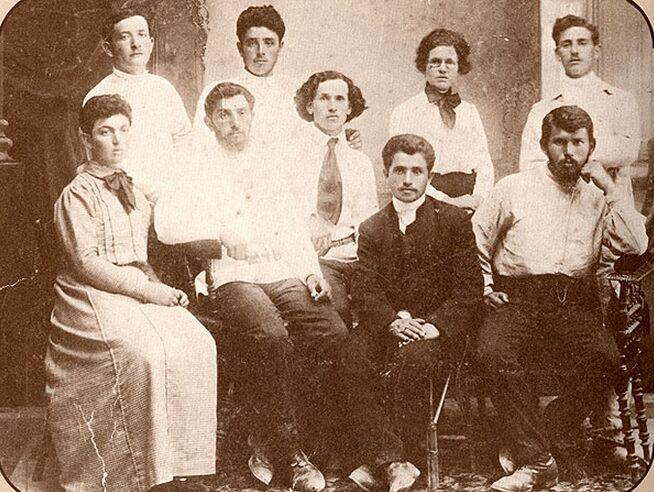
1911: Palestinian Identity
-
⭐ January: Filastin newspaper founded.
- This Arabic-language newspaper was established in Jaffa, Palestine, by Issa El-Issa and his cousin Yusef El-Issa. It referred to its readers as “Palestinians.” The paper became a significant platform for Palestinian nationalist thought and played a crucial role in articulating the concerns and aspirations of the Palestinian Arab community during the early 1900s. It frequently addressed Zionist immigration and land purchases, British colonial policies, and the struggle for Palestinian self-determination. Filastin is considered one of the most influential publications in Palestinian history.
-
January-February: European powers pressure the Ottoman government to allow Zionist land acquisition in Palestine.
-
March-April: Arab deputies from Jerusalem, Beirut, and Damascus lobby in the Ottoman Parliament for legislation against Zionist mass immigration to Palestine.
-
April: In a telegram to Constantinople, 150 Palestinians from Jaffa demand measures against Zionist mass immigration and land acquisition.
-
May 16: Two Jerusalem deputies open the first full-scale debate in the Ottoman Parliament on Zionism, charging that the Zionist aim is to create a Jewish state in Palestine.
-
Najib Nassar, a Palestinian journalist, publishes the first book in Arabic on Zionism, entitled "Zionism: Its History, Objective and Importance."
-
Italo-Turkish War. Italy invades the Ottoman territories of Tripolitania, Fezzan, and Cyrenaica (modern-day Libya). The conflict exposed the military weaknesses of the Ottoman Empire and led to the loss of these territories.
1912: Palestinian deputies elected from Jerusalem, Gaza, Nablus, and Acre to the Ottoman Parliament.
-
January: European powers renew pressure on the Ottoman government to facilitate Zionist land acquisition in Palestine.
-
Balkan Wars. The First and Second Balkan Wars significantly weakened the Ottoman Empire. The empire lost most of its European territories, which further destabilized the region and strained Ottoman resources.
1913: “The Zionists will gain mastery over our country village by village, town by town.”
-
⭐ January: An article in Filastin by ‘Arif al-‘Arif titled “Ila mutasarrifina al-jadid.
-
As-sahyuniyuna wa Abu Shusha” (To our New Mutasarrif: the Zionists and Abu Shusha) includes the quote, “If this state of affairs continues… then the Zionists will gain mastery over our country village by village, town by town; tomorrow the whole of Jerusalem will be sold, and then Palestine in its entirety.”
- The rise of Arab nationalism in the early 1900s marked a significant shift in the political landscape of the Arab provinces within the Ottoman Empire, including Palestine. Intellectuals and activists began to advocate for greater autonomy or outright independence, driven by a combination of factors such as the decline of the Ottoman Empire, the impact of Western colonialism, and the influence of nationalist ideas circulating globally.
- In Palestine, the burgeoning Arab nationalist movement was fueled by concerns over Zionist immigration and land acquisition, which threatened the demographic and socio-political fabric of the region. Palestinian intellectuals and leaders called for the preservation of identity and the protection of their homeland from foreign encroachments. This period saw the formation of various political organizations and the publication of nationalist literature, which played a crucial role in mobilizing public opinion and laying the groundwork for future resistance against both Ottoman centralization and later British colonial rule.
-
World War I (1914–1918)
World War I, at the time called the Great War, quickly becomes one of the deadliest, most technologically advanced conflicts in history. The Ottoman Empire, which controls Palestine, aligns with the Central Powers against Britain and its allies.
- The First World War began in the summer of 1914, shortly after the assassination of Austria’s Archduke, Franz Ferdinand, and lasted more than four years. It left more than 20 million soldiers dead and 21 million more wounded. Understanding the causes of World War I are equally as important as understanding the conflict’s devastating effects. Though the assassination of Archduke Ferdinand was the direct catalyst leading to the declaration of war, there were many other factors that also played a role in leading up to WWI.
-
Six Causes of WWI
- European Expansionism: European nations, particularly Britain and France, expanded their empires globally, leading to heightened tensions with other powers like Germany, Austria-Hungary, and the Ottoman Empire.
- Serbian Nationalism: Serbian nationalism sought independence from Austria-Hungary and the Ottoman Empire. The assassination of Archduke Franz Ferdinand by a Bosnian Serb nationalist in 1914 directly triggered the war.
- Assassination of Franz Ferdinand: On June 28, 1914, Archduke Franz Ferdinand of Austria was assassinated by Gavrilo Princip. This event led Austria-Hungary to declare war on Serbia, with Germany's support, and prompted Russia to defend Serbia, sparking the war.
- Conflicting Alliances: Pre-war alliances, such as the Triple Entente (France, Britain, Russia) and the Central Powers (Germany, Austria-Hungary, Ottoman Empire), created a web of mutual defense obligations.
- Blank Check Assurance: Germany's unconditional support to Austria-Hungary following the assassination of Franz Ferdinand, known as the "blank check assurance," emboldened Austria-Hungary to act aggressively against Serbia, contributing to the war's outbreak.
- German Millenarianism (Spirit of 1914): Germany's belief in a transformative war to secure its place as a leading power was supported by public nationalism. Initial successes fueled this spirit, but it quickly waned as the war dragged on, leading to significant national demoralization.
-
The First Modern War. Although this title is sometimes given to other conflicts like the American Civil War, World War I marks a pivotal moment in modern warfare in the extensive use of newly developed martial technologies.
- Artillery like the Lewis Gun, Vickers Machine Gun, and the German MG 08 rendered traditional infantry tactics devastatingly lethal.
- Heavy artillery like the French 75mm Field Gun and Germany's Big Bertha inflicted unprecedented destruction.
- Newly developed chemical weapons like chlorine gas, phosgene gas, and mustard gas caused prolonged suffering and death.
- Tanks in particular change the face of modern warfare. Models like the British Mark I, the German A7V, and the French Renault FT could break through entrenched positions and barbed wire defenses.
- Fighter planes emerged like the Fokker Dr.I and Sopwith Camel, while heavy bombers like the Handley Page Type O and Gotha G.IV targeted civilian areas.
1914: Ottoman Empire allies with Germany
-
August 2: The Ottoman Empire signs a secret alliance with Germany, committing to join the Central Powers in the event of war.
-
October 29: The Ottoman Empire enters World War I after the Ottoman navy, including German ships under Ottoman flag, bombards Russian ports in the Black Sea.
-
November 2: Russia declares war on the Ottoman Empire.
-
November 5: Britain and France declare war on the Ottoman Empire.
-
Greek Genocide (1914–1922) begins. The Ottoman Empire's systematic persecution results in the deaths of hundreds of thousands of ethnic Greeks through massacre, forced marches, and starvation.
-
Assyrian Genocide (1914–1923) begins. Alongside the Armenians and Greeks, Assyrians were targeted by the Ottoman Empire during World War I, with hundreds of thousands killed.
1915: Britain offers the Arabs an independent state
-
⭐January: British cabinet member Herbert Samuel calls for the British annexation of Palestine in memorandum “The Future of Palestine”
-
April 25: The Gallipoli Campaign begins as Allied forces land on the Gallipoli Peninsula, aiming to secure the Dardanelles Strait and capture Constantinople (Istanbul). The campaign results in heavy casualties on both sides.
- The Australian and New Zealand Army Corps (ANZAC) was formed in 1915 and is most famously known for its role in the Gallipoli Campaign during World War I. The campaign began on April 25, 1915, a date now commemorated annually as ANZAC Day in both Australia and New Zealand.
-
April 24: Armenian Genocide begins, with mass arrests of Armenian intellectuals and leaders in Constantinople, marking the start of widespread deportations and massacres.
-
The Ottoman Empire systematically exterminates around 1.5 million Armenians through violence, forced marches, and starvation.
-
-
July 14: Correspondence between Sharif Hussein of Mecca and Sir Henry McMahon, British high commissioner in Egypt, begins.
-
August 6–21: The Battle of Sari Bair, part of the Gallipoli Campaign, sees intense fighting but ultimately fails to break the Ottoman defenses.
-
August 15: Jemal Pasha, Ottoman military governor, hangs 11 Arab nationalists in Beirut as part of the broader repression of Arab nationalist movements during WWI.
-
⭐October: Sir Henry McMahon promises an independent Arab state
-
The British High Commissioner in Egypt promises Sharif Hussein of Mecca an independent Arab state if Arabs would rise against the Turks. The offer is accepted.
-
-
December 20: The Allies begin to evacuate their forces from Gallipoli, marking the end of the campaign.
1916: Sykes-Picot
-
January 9: The final evacuation of Allied troops from Gallipoli is completed.
-
January 30: Hussein-McMahon correspondence concludes; Arabs understand it as ensuring postwar independence and unity of Arab provinces of the Ottoman Empire, including Palestine.
-
February 21: The Ottoman Empire faces the Russian offensive in the Caucasus, leading to significant territorial losses.
-
March 9: The Siege of Kut begins, with British forces besieged by the Ottomans in the town of Kut-al-Amara in Mesopotamia (modern-day Iraq).
-
April 29: British forces surrender at Kut, resulting in a major Ottoman victory and the capture of around 13,000 British and Indian troops.
-
May 6: Jemal Pasha hangs 21 Arab leaders and intellectuals, including two Palestinians, in Beirut and Damascus. This date is commemorated as Martyrs' Day in Lebanon and Syria, honoring those who were executed for their nationalist activities and opposition to Ottoman rule.
-
⭐ May 16: The Sykes-Picot Agreement is signed between Britain and France
-
Secretly divides Ottoman territories in the Middle East into spheres of influence.
- The Sykes-Picot Agreement, formally known as the Asia Minor Agreement, was a secret treaty negotiated between the United Kingdom and France with the assent of the Russian Empire.
- Named after its principal negotiators, Sir Mark Sykes of Britain and François Georges-Picot of France, the agreement aimed to divide the Ottoman Empire's territories in the Middle East into spheres of influence and control following the anticipated defeat of the Ottomans in World War I.
- Terms:
- France would gain control over modern-day Lebanon, Syria, and parts of southeastern Turkey
- Britain would control areas corresponding to modern-day Iraq, Jordan, and parts of Palestine.
- An international administration for Palestine, reflecting its strategic and religious significance.
- The Sykes-Picot Agreement is often criticized for its arbitrary borders, drawn without regard to the ethnic, religious, or cultural complexities of the region, and for sowing the seeds of future conflicts.
- Its eventual disclosure by the Bolsheviks in 1917, following the Russian Revolution, caused outrage and a sense of betrayal among Arab leaders who had been promised independence in exchange for their support against the Ottomans.
-
-
June: The Great Arab Revolt begins. An armed uprising by the Hashemite-led Arabs of the Hejaz against the Ottoman Empire amidst the Middle Eastern theatre of World War I.
- On the basis of the McMahon–Hussein Correspondence, exchanged between Henry McMahon of the United Kingdom and Hussein bin Ali of the Kingdom of Hejaz, the rebellion against the ruling Turks was officially initiated at Mecca on 10 June 1916. The primary goal of the Arab rebels was to establish an independent and unified Arab state stretching from Aleppo to Aden, which the British government had promised to recognize.
- The Sharifian Army, led by Hussein and the Hashemites with backing from the British military's Egyptian Expeditionary Force, successfully fought and expelled the Ottoman military presence from much of the Hejaz and Transjordan. By 1918, the rebels had captured Damascus and proclaimed the Arab Kingdom of Syria, a short-lived monarchy that was led by Hussein's son Faisal I.
- Having covertly signed the Sykes–Picot Agreement with the French Third Republic, the British reneged on their promise to support the Arabs' establishment of a singular Arab state. Instead, the Arab-majority Ottoman territories of the Middle East were broken up into a number of League of Nations mandates, jointly controlled by the British and the French.
1917: Balfour Declaration
-
Russian Revolution of 1917. The Jewish Labor Bund again supports a Russian Revolution (1917-1923), aligning itself with the broader socialist movement that sought to overthrow the Tsarist regime and establish a more egalitarian society. The Bund is effectively integrated into the emerging Soviet political landscape, advocating for the rights and cultural autonomy of Jewish workers.
-
The Bund's opposition to Zionism remained steadfast; it argued that the solution to Jewish oppression lay not in the establishment of a separate Jewish state but in the fight for social and political equality within the countries where Jews resided. The Bund promoted Yiddish culture and the concept of Doykeit (“hereness”) and emphasized the importance of preserving Jewish identity while participating in the broader socialist struggle.
-
-
March 11: British forces capture Baghdad, a significant blow to Ottoman control in Mesopotamia.
-
⭐ November 2: Balfour Declaration issued
-
Lord Arthur Balfour, British Foreign Secretary, issues the Balfour Declaration, a statement by the British government expressing support for the establishment of a "national home for the Jewish people" in Palestine.
-
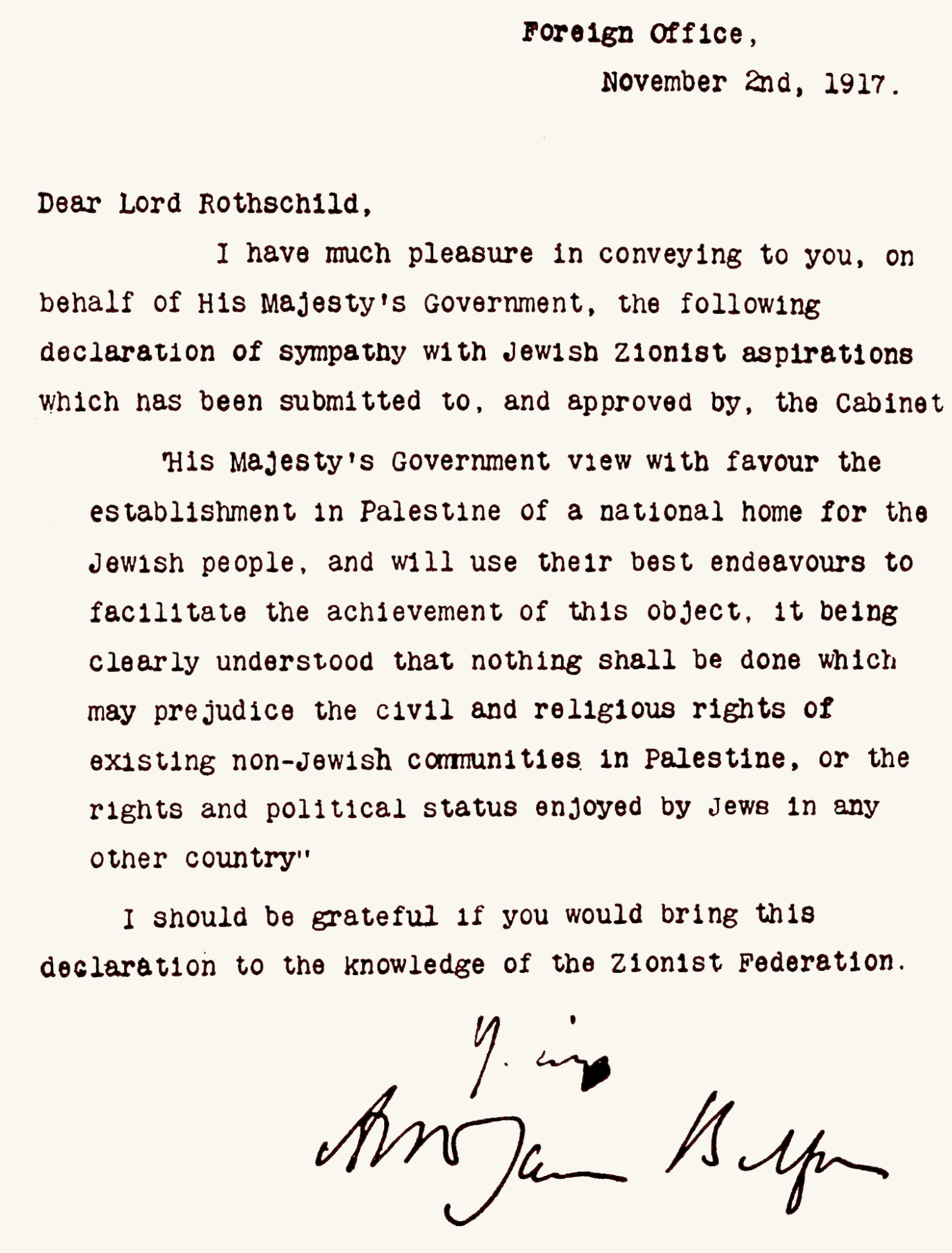
- The declaration took the form of a letter addressed to Lord Rothschild, a leader of the
British Jewish community and financier of Zionism. The text of the declaration was brief
but had a lasting and devastating effect on the
future of Palestine.
- The declaration was motivated by a combination of factors, including British strategic interests in gaining Jewish support during World War I, as well as the influence of Zionist lobbying efforts. The Balfour Declaration had profound and far-reaching consequences, as it laid the groundwork for increased Jewish immigration to Palestine and heightened tensions between Jewish and Arab communities. The ambiguous language and lack of clarity regarding the political status and boundaries of the proposed "national home" contributed to the complexity and contentiousness of the region's subsequent history. The declaration remains a pivotal document in the history of the Israeli-Palestinian conflict, symbolizing both the aspirations of the Zionist movement and the grievances of the Palestinian people.
- Sir Edward Montagu, the only Jewish member of the British Cabinet, strongly opposed the declaration.
-
December 9: Surrender of Ottoman forces in Jerusalem to Allied forces under General Sir Edmund Allenby.
1918: World War I ends
-
September 19–25: The Battle of Megiddo, part of the British-led Sinai and Palestine Campaign, results in a decisive Allied victory and the collapse of Ottoman defenses in Palestine. The whole of Palestine is occupied by Allied forces under General Allenby.
-
October 30: The Armistice of Mudros is signed, effectively ending hostilities between the Ottoman Empire and the Allies. The armistice leads to the occupation of key Ottoman territories by Allied forces.
-
November 13: Allied forces enter Constantinople, marking the beginning of the occupation of the Ottoman capital.
-
Britain and France proclaim former Ottoman subjects would determine their own futures, but conflicting plans emerged.
-
The Jewish population in Palestine is approximately 56,000.
Interwar Period (1919–1938)
⭐ Third Aliyah (1919–1923)
- 40,000 Jews, mainly from Eastern Europe arrived in the wake of World War I. The British occupation of Palestine and the establishment of the British Mandate created the conditions for the implementation of the promises contained in the Balfour Declaration. Many of the Jewish immigrants were ideologically driven pioneers, known as halutzim, trained in agriculture and capable of establishing self-sustaining economies. The Jezreel Valley and the Hefer Plain marshes were drained and converted to agricultural use. Additional national institutions arose such as the Histadrut (General Labor Federation); an elected assembly; national council; and the Haganah, the forerunner of the Israel Defense Forces.
⭐ 1919: Paris Peace Conference, King-Crane Commission
-
January: Emir Feisal presents a memorandum to the Paris Peace Conference, outlining the case for independence of Arab countries.
-
January 5: Nazi Party founded in Germany, characterized by a centralist, nationalist, authoritarian structure. Its platform was based on militaristic, racial, and vehemently antisemitic policies.
-
June 28: Treaty of Versailles marks the official end of World War I. Negotiated primarily by the Allied Powers—France, the United Kingdom, and the United States—without significant input from Germany, the treaty imposed harsh penalties on Germany. Key provisions included the loss of German territories, substantial reparations payments, military restrictions, and the acceptance of full responsibility for the war through the "war guilt" clause. The treaty aimed to prevent future conflicts, but instead fostered economic hardship and political instability in Germany, contributing to the rise of extremism, the Nazi party, and, eventually, World War II.
-
⭐ Paris Peace Conference begins
-
Chaim Weizmann states his dream to make Palestine “as Jewish as England is English.”
-
On President Wilson’s insistence during the Paris Peace Conference in 1919, a commission is appointed to ascertain the wishes of the indigenous populations.
- The Commission began as an outgrowth of the 1919 Paris Peace Conference. It visited areas of Palestine, Syria, Lebanon, and Anatolia, surveyed local public opinion, and assessed its view on the best course of action for the region. Originally meant to be led by French, British, Italian and American representatives, it ended as an investigation conducted solely by the United States government after the other countries withdrew to avoid the risk of being "confronted by recommendations from their own appointed delegates which might conflict with their policies". With the withdrawal of other allied nations, the commission lost any real credibility.
- The British Foreign Secretary, Lord Curzon, warns that the term “national home” really meant “a Jewish State” in which the Arabs would be second-class citizens. He declares, “I think the entire concept wrong.”
- Balfour himself acknowledged what was being done and noted, “that so far as Palestine is concerned, the [Allied] Powers have made no statement of fact which is not admittedly wrong, and no declaration of policy … which they have not intended to violate”.
-
-
August: King-Crane Commission submitted. The United States dispatches the King-Crane Commission to conduct an in-depth investigation into the future of Palestine and the wider Middle East. Led by Henry King and Charles Crane, the inquiry aimed to gather the perspectives of local populations on the post-WWI political landscape. The commission’s findings were of overwhelming opposition to Zionist aspirations among native Palestinians.
- The Commission recommended an American Mandate over Syria, including Palestine. In assessing the wishes of the indigenous population of Palestine regarding the Jewish immigration there, the Commission called for “serious modification of the extreme Zionist programme for Palestine of unlimited immigration of Jews” . The Commission declared that this programme, aiming “… finally to making Palestine distinctly a Jewish State [would be] a serious injustice”.
- Dealing with the Zionist claim “that they have a ‘right’ to Palestine, based on their occupation of two thousand years”, the Commission remarked that this claim “can hardly be seriously considered”.
- The Commission submitted its report to the Paris Peace Conference in August, its work being undercut from the beginning by France and the United Kingdom's pact, the Sykes–Picot Agreement, and its inherent colonialist designs. In short, by the time the commussion was finished, the Peace Conference had already concluded the area's fate
-
November 9: Germany is now governed by the Weimar Republic. With Kaiser Wilhelm II abdicated, many Germans are dissatisfied with the new situation and long for a return to Empire. Many people also believed that the ruling social democrats were to blame for losing the war.
-
Nathan Birnbaum, who coined the term Zionism in 1885, is by now Orthodox and a staunch antizionist, remaining so until his death in 1937. He writes:
- “And is it at all possible that we, who regard Judaism as our one and only treasure, should ever be able to compete with such expert demagogues and loud self-advertisers as they [the Zionists]? It is surely not necessary that we should. We are, after all, still the mountains and they the grain, and all we need to do is to gather all our forces in a world organization of religious Jews, and it will follow of itself, and without the application of any great political cunning on our part, that we shall have it in our power to prevent what must needs be prevented and to carry out what we have to carry out. But there is no need first to create this world organization of religious Jews. It is already in existence. The world knows its name, it is Agudas Yisroel [The Union of Israel].”
-
Lord Balfour, on the other hand, in his introduction to Nahum Sokolow's History of Zionism, writes that the Zionist movement would “mitigate the age-long miseries created for Western civilization by the presence in its midst of a Body [the Jews] which it too long regarded as alien and even hostile, but which it was equally unable to expel or to absorb.”
-
Palestine Restoration Fund established as a financial mechanism to support the Zionist project of establishing a Jewish nation-state in Palestine.
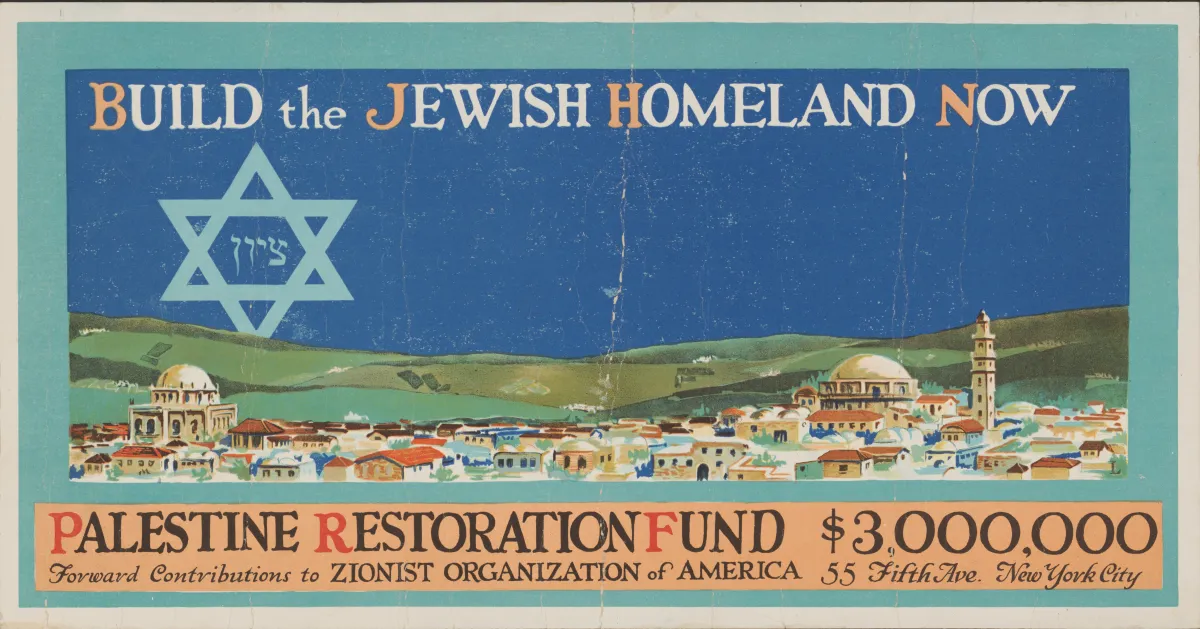
⭐ 1920: British Mandate Palestine begins
- The League of Nations officially grants Britain the mandate over Palestine. The mandate system was intended to prepare territories for self-governance, but British policies, including immigration quotas favoring Jewish immigrants, create significant tensions between the Jewish and Arab populations. Britain walks back the promises of Sir Henry McMahon, and a Jewish settler named David Green, eventually Ben-Gurion, helps form the Jewish paramilitary group Haganah.
-
The Covenant of the League of Nations required that the wishes of the communities affected be a principal consideration in the selection of the Mandatory. This, however, was ignored in the case of Palestine.
-
Arab-Jewish tensions reach a boiling point, leading to riots in Jerusalem and other parts of Palestine. The violence was fueled by competing nationalist aspirations and grievances over land and political control.
- April: Nebi Musa Riots: Arab riots erupted in Jerusalem during the Nebi Musa festival, leading to the deaths of five Jews and four Arabs. This violence led to more organized Jewish paramilitary groups, heavily contributing to the formation of the Haganah.
-
February 20: German National Socialist Workers' Party (NSDAP) founded in Munich. The partiy is miniscule, but a talented orator named Adolf Hitler quickly attracts more members. Its platform is based almost entirely on ultra-nationalism and antisemitism.
-
⭐ June 15: Jewish paramilitary group Haganah formed
-
The formation of the Haganah (Hebrew: הגנה, Defense) was announced as an extension of Hashomer (a Jewish paramilitary group formed in 1909). The purpose was ostensibly to defend Jewish settlements against Arab attacks. The paramilitary group was under the control of the Jewish Agency, the official governmental body in charge of Palestine's Jewish community during the British mandate era.
- Haganah issues its "constitution" in mid-June declaring itself to be a secret military formation whose object is to protect the Jewish community in Palestine, the Yishuv.
- The Haganah was linked to the Jewish Labor Unions, “the Histadrut” (PDF), and trained its members in the use of firearms in the Zionist Kibbutzes and settlements, before some of them enlisted in the British police force in Palestine.
- The gang also struck deals to buy weapons from outside Palestine which it then smuggled into the country, and manufactured some weapons in small workshops founded in these kibbutzes and settlements.
-
-
⭐ British walks back promises regarding Palestine
-
The British government argues that Palestine was excluded from the promises made by Sir Henry McMahon to Sharif Hussein during World War I. This position exacerbated Arab distrust towards British intentions and policies.
-
-
Chaim Weizmann elected President of the World Zionist Organization (WZO), a position he held for several terms.
- Weizmann was a Britain-based Russian Zionist leader and chemist whose contributions to the British war effort during World War I made him well-connected to the upper echelons of the British government. Weizmann lobbied hard for more than two years with British former Prime Minister David Lloyd-George and former Foreign Minister Arthur Balfour to publicly commit Britain to Jewish state-buliding in Palestine.
-
August 10: The Treaty of Sèvres is signed, officially partitioning the remains of the Ottoman Empire among the Allied powers. The treaty is later rejected by Turkish nationalists.
⭐ 1921 May 1–7: Jaffa Riots
-
Due to growing tensions with Zionist settlers, economic tensions, and perceived betrayal by the British, Arab mobs attack Jewish residents in Jaffa and surrounding areas. The violence results in the deaths of 47 Jews and 48 Arabs, with hundreds more injured.
-
May 8: Jerusalemite Arab noble Amin al-Husayni appointed Grand Mufti of Jerusalem by the British High Commissioner for Palestine, Sir Herbert Samuel. This followed the death of the previous Grand Mufti, Kamil al-Husayni, Amin’s half-brother who had died of natural causes in March of the same year.
1919–1922: The Turkish War of Independence ends. Led by Mustafa Kemal Atatürk, the war results in the defeat of occupying Allied forces and the abolition of the Ottoman Sultanate.
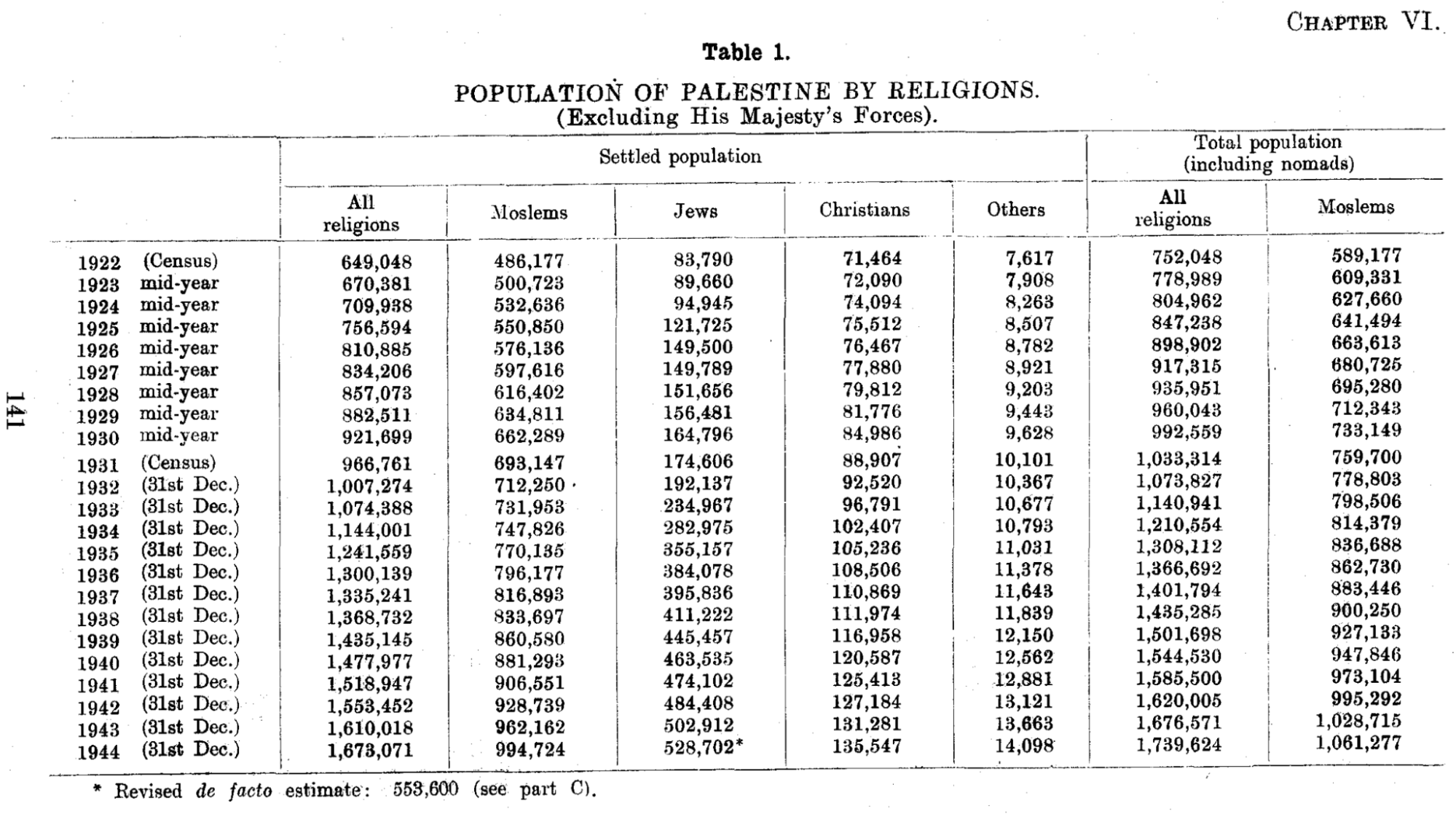
⭐ 1922: The League of Nations incorporates the Balfour Declaration into the British Mandate for Palestine
-
Jewish immigration from Europe continues to increase throughout the 1920s and 1930s. Tens of thousands of Palestinian tenants are displaced from their lands as Zionists buy land from absentee landlords. By the start of WW2, the Jewish population will have expanded by over 400,000.
-
June 3: The Churchill White Paper, sometimes referred to as "British Policy in Palestine", official name “Palestine: Correspondence with the Palestine Arab Delegation and the Zionist Organisation,” was drafted at the request of Winston Churchill, then Secretary of State for the Colonies, partly in response to the 1921 Jaffa Riots. While maintaining Britain's commitment to the Balfour Declaration and its promise of a Jewish national home in Mandatory Palestine, the paper emphasized that the establishment of a national home would not impose a Jewish nationality on the Arab inhabitants of Palestine.
-
July 24: The Mandate is signed, coming into effect formally in September. Although Transjordan had originally been included in the Palestine Mandate, on 16 September 1922, the League of Nations approved a separate administration for it. Consequently, the Mandate thus applied only to Palestine itself, although the area claimed originally for the Jewish national home included parts of neighbouring lands.
-
The Mandate never once uses the term “Arab.” Although the Palestinian Arabs constituted nine-tenths of the population at that time, they continue to be referred to only as the “non-Jewish communities of Palestine.” One writer sardonically likens this formulation to “calling the multitude the non-few.”
-
Despite a common Zionist propaganda talking point, Palestinians did not willingly sell the majority of their land to Zionist settlers, only later to regret it. Detailed land purchase records disprove this claim, showing that at most, Zionists acquired 5.7% of the territory in Mandatory Palestine by 1939, and roughly 7% by 1948. The majority of land was bought from absentee landlords, not local Palestinians, who often did not wish to sell or were misled about the purpose of the sale (source). Nevertheless, the land purchases resulted in visible displacement of Palestinians due to Zionism, facilited primarily by the British and League of Nations as a direct result of the Balfour Declaration’s integration into the Mandate.
-
The Jewish population in Palestine is approximately 83,000 to 88,000.
1923: Republic of Turkey established. Following the signing of the Treaty of Lausanne in July, the Republic of Turkey is formally established on October 29, superseding the Treaty of Sèvres and recognizing the sovereignty of the new Turkish nation-state. This signifies the official dissolution of the Ottoman Empire.
-
Menachem Ussishkin, a Russian Zionist leader, becomes head of the Jewish National Fund at the age of 60, a position he would hold until his death by natural causes in 1941.
-
Betar founded. Vladimir Jabotinsky (who eventually will change his name to Ze’ev) founds the group Betar, short for "Brit Yosef Trumpeldor" (The Covenant of Joseph Trumpeldor), in Riga, Latvia. The group emphasized Jewish self-defense, nationalism, and the aspiration for a Jewish state on both sides of the Jordan River. Betar played a crucial role in the mobilization of young Jews with a strong focus on physical fitness and military training.
-
The Iron Wall. This same year. Jabotinsky publishes an infamous essay in Russian titled “The Iron Wall.” In it, he says, “Zionist colonisation must either stop, or else proceed regardless of the native population. Which means that it can proceed and develop only under the protection of a power that is independent of the native population – behind an iron wall, which the native population cannot breach.”
- Avi Shlaim's 2000 book, The Iron Wall: Israel and the Arab World gives a brief overview of the background and history of Ze'ev Jabotinsky née Vladimir. Shlaim notes Jabotinsky's argument that efforts to establish a Jewish state would require the assistance of European Western powers, and finds that Jabotinsky's followers considered the ideas put forth in the essay to be the basis for Revisionist Zionism. Shlaim emphasizes Jabotinsky's acknowledgement of the Palestinian Arab national idenitity in his essay; and underlines Jabotinsky's belief that a military intervention is the only way to realise a Jewish state.
-
November: Hitler attempts a coup, a complete failure that lands him in prison. NSDAP is banned. He is released in less than a year, having now written Mein Kampf which lays out, among other things, his openly fascist plans to make Germany great again.
1924–1929: Fourth Aliyah. Approximately 82,000 Jews immigrate to Palestine, the majority of them driven by increasing persecution and instability in Poland, the Soviet Union, Romania, and Lithuania. About 12% of these immigrants came from West Asia, primarily Yemen and Iraq, as U.S. immigration quotas restricted Jewish entry. This wave included many middle-class families who settled in growing towns, establishing small businesses and light industries. Of these immigrants, around 23,000 eventually left the country due to various hardships.
1924 June 30: Haganah assassinates antizionist Jewish Dutchman Jacob Israël de Haan. Dutch Jew Jacob Israël de Haan is assassinated by Avraham Tehomi (born Zilberg) on the orders of Haganah leader Yitzhak Ben-Zvi (born Izaak Shimshelevich) for his antizionist political activities and contacts with Arab leaders.
- Jewish population in Palestine reaches approximately 90,000.
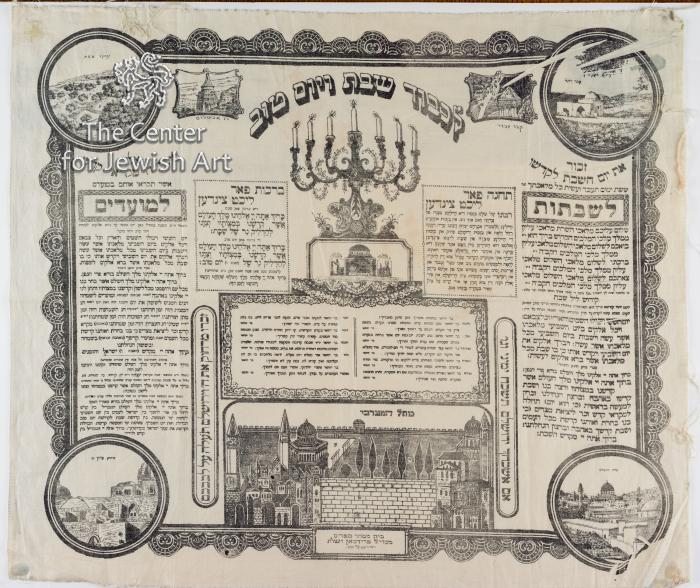
1925: Revisionist Party
-
Far-right Revisionist Party formed by Jabotinsky, who protested the exclusion of Transjordan from British Mandate Palestine. In response, he established the Revisionist Party in 1925, so named because it sought to "revise" the terms of the Mandate, particularly to provide for the re-inclusion of Transjordan in Mandatory Palestine.
- His youth organization, Betar, was already characterized by militaristic, some might say fascist, appearance (dark brown uniforms), activities (parade ground drill) with firearm exercises, slogans, and a militaristic ideology and structure. Jabotinsky admired Mussolini (uniform comparison), and his movement repeatedly sought affiliation with and assistance from Rome. Jabotinsky’s version of Zionism was single-minded, exclusivist, and rigid.
-
Slobodka yeshivah (religious school) established in Hebron. A large number of its Ashkenazi students expressed the will to live in complete separation from the local Arab population as well as from the old Yishuv, those Jews already living in Palestine.
- The local Arab population frequently viewed the newcomers with suspicion, and sometimes with hatred. They were identified as “Zionist immigrants” or “foreign Jews” with no connection to the areas in which they settled. “The immigrants dumped upon the country from different parts of the world,” complained the former mayor of Jerusalem, Mūsā Kāẓim Al-Ḥusaynī (b. 1850) at the beginning of the mandate period, “are ignorant of the language, customs and character of the Arabs and enter Palestine by the might of England against the will of the people.”
-
Brit Shalom (1925–1933) founded, also known as the Covenant of Peace. This organization was founded by a group of Jewish intellectuals and academics in Mandatory Palestine who advocated for a binational state, where Jews and Arabs would coexist with equal rights. The organization sought to promote mutual understanding and cooperation between Jews and Arabs, opposing the more dominant Zionist vision of a Jewish state. Despite its relatively short existence, Brit Shalom's ideas continued to influence discussions on Jewish-Arab relations and the search for a peaceful resolution to the conflict in Palestine.
-
March: English edition of Filastin features a four-page editorial addressed to Lord Balfour criticizing the Balfour Declaration. The editorial begins with "J'Accuse!", in a reference to the outrage at French anti-semitism 27 years previously.
-
Summer: Zionist leader and head of the Jewish National Fund Menachem Ussishkin gives a speech demanding "a Jewish state without compromises and without concessions, from Dan to Be'er Sheva, from the great sea to the desert, including Transjordan." He concluded, "Let us swear that the Jewish people will not rest and will not remain silent until its national home is built on our Mt Moriah," a reference to the Temple Mount.
- Jewish population in Palestine reaches approximately 121,000.

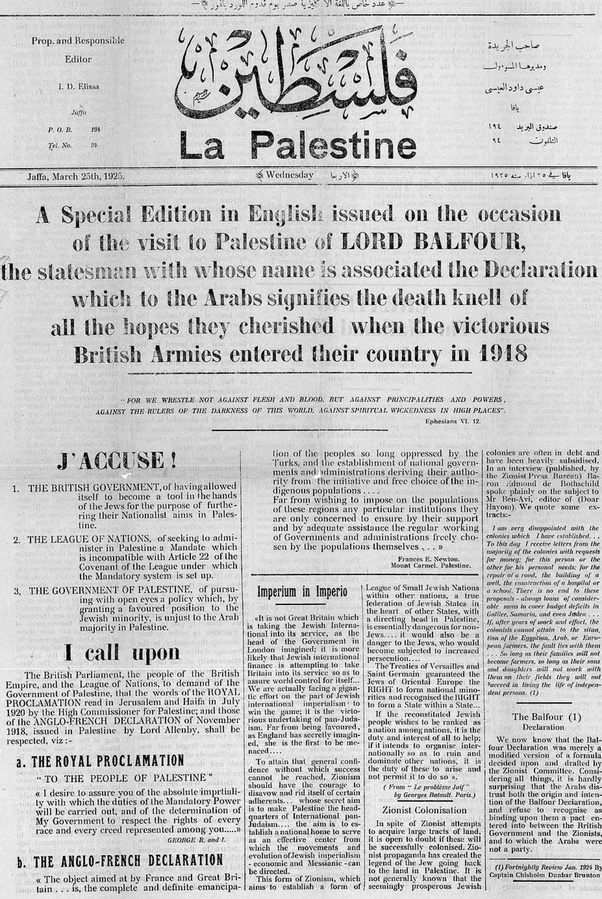
1926 January 26: United States branch of the Jewish National Fund founded.
1927 July 11: Jericho earthquake. A tremendous quake strikes near the Dead Sea town of Jericho, causing widespread damage in Jerusalem, Ramleh, Tiberias, and Transjordan with Nablus being hit hardest. Geological studies estimate that the earthquake reached a magnitude of 6.3. At least 500 were estimated to have been killed. The death toll in Jerusalem included more than 130 people and around 450 were injured. About 300 houses collapsed or were severely damaged to the point of not being usable. The earthquake caused heavy damage to the domes of the Church of the Holy Sepulchre and the al-Aqsa Mosque, the Dome of the Rock being badly damaged. The earthquake was especially severe in Nablus where it destroyed around 300 buildings, including the Mosque of Victory and the historic parts of the Great Mosque of Nablus. The death toll in Nablus included more than 150 people and around 250 were injured. In Jericho, a number of houses collapsed, including several relatively new hotels, in one of which three female tourists from India were killed. Ramla and Tiberias were also heavily damaged.
-
Chaim Weizmann writes. “The Balfour Declaration of 1917 was built on air… every day and every hour of these last 10 years, when opening the newspapers, I thought: Whence will the next blow come? I trembled lest the British Government would call me and ask: ‘Tell us, what is this Zionist Organization? Where are they, your Zionists?’ …The Jews, they knew, were against us: we stood alone on a little island, a tiny group of Jews with a foreign past.”
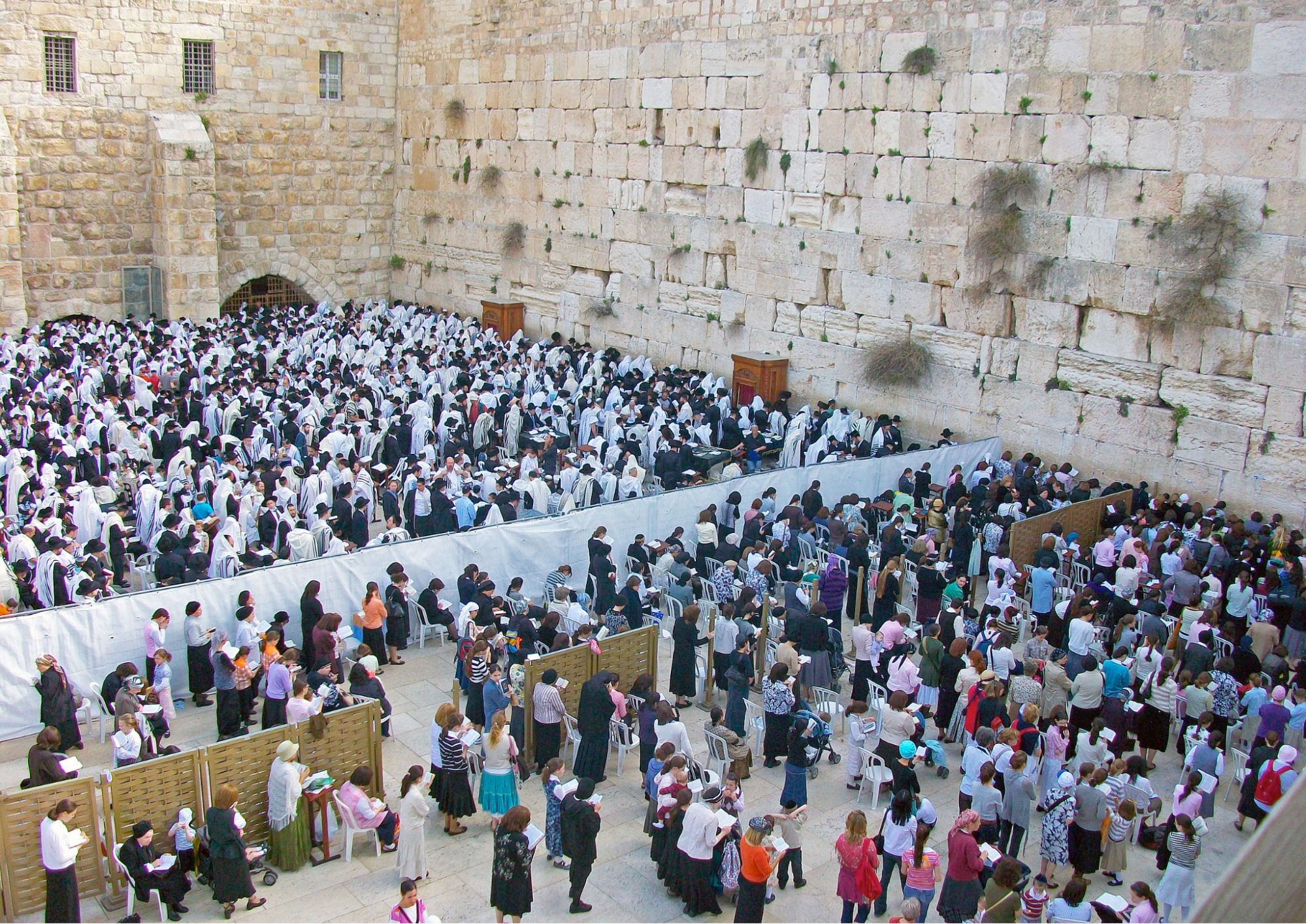
1928 September 23: Screen Incident. On the eve of Yom Kippur, an Ashkenazi shammash brings a larger ark than usual, some mats and lamps, and attaches a mechitza (gender screen) to the pavement in front of the Western Wall in preparation for the religious service the next morning. The Muslims are notified, reportedly by a Sephardi shammash unhappy over the refusal of the Ashkenazi to split a tip with him.
- The mutawalli (guardian) of the Abu Madyan waqf immediately complains to Edward Keith-Roach,
Deputy District Commissioner of Jerusalem, that it violated the Late
Ottoman
status quo forbidding Jews from bringing physical structures, even temporary
furniture, into the area due to Muslim fears of Zionist expropriation of the site.
- The Muslims fears of expropriation had some legal precedent. The worry was that if they acquiesced, the pavement could be claimed as an open synagogue. Under this circumstance, the area could be legally claimed a Jewish possession, and the Jews would then be able to restrict the use of the pavement, not only part of the Haram al-Sharif but for some Muslims the only possible access to their houses.
- The residents also complained that, in any case, the screen blocked the public thoroughfare along the narrow, eleven-foot wide lane used by the Maghribi residents and their donkeys.
- While the commissioner was visiting a synagogue, Attorney General Norman Bentwich had his request to keep the screen until after the fast rejected by the commissioner, who ordered the constable to ensure that it was removed by morning. The shammash assures Keith-Roach he will do so.
- But the next morning the screen is still there, and the mutawalli again complains. The Jewish worshippers claim they cannot remove the screen on the holy day, as it would count as ‘work’.
- When the police proceeded to remove the screen, the Jewish worshippers clung on to it, and a few fought back. The screen was eventually destroyed by the policemen, with no major injuries reported on any side. According to one report, an irate elderly woman hit a police officer several times with her umbrella.
- Many Jewish organizations and individuals, including Rabbi Kook, greatly exaggerate the event, in one case comparing it to deadly pogroms in Russia. The constable’s superiors were initially infuriated due to his apparent use of excessive force, but following an investigation the British government issued a statement defending his actions.
- Rabbi Aaron Menachem Mendel Guterman (1860-1934), the third rebbe of the Radzymin Hasidic dynasty, while visiting Jerusalem from Poland, is described as being the person responsible for erecting the screen. Although Guterman used his own funds to erect the screen, the lack of any prior consultation with the British and Arab authorities resulted in their anger over the event.
- While there had been other attempts by Zionists at adding items to the Wall such as chairs and arks, the screen incident is seen as the beginning of targeted clashes over Western Wall ownership that escalated over the following six months.
-
October: By the following month, the Grand Mufti of Jerusalem had organized various provocations toward the Jews, including new construction next to and above the Wall and a muezzin who performed the Islamic call to prayer at the same time the Jews were conducting their prayers. These in turn resulted in official protests from Jews and greatly increased tensions that festered in the following months.
- November: Pamphlets began to appear in Arabic (auto-translated to English) showcasing various Zionist imagery that depicted various holy sites in Jerusalem surrounded by Jewish symbolism.
1929–1939: Fifth Aliyah. A new wave of 250,000 immigrants arrive largely motivated by the rise of Nazism in Germany. The majority of these, 174,000, arrive between 1933 and 1936, after which increasing restrictions on immigration by the British made immigration clandestine and illegal, called Aliyah Bet. The Fifth Aliyah was again driven almost entirely from Europe, mostly from Central Europe (particularly from Poland, Germany, Austria, and Czechoslovakia), but also from Greece, Turkey, Iran, and Yemen. The Fifth Aliyah contained large numbers of professionals, doctors, lawyers, and professors from Germany.
⭐ 1929: The Western Wall Uprising
-
Also called Al-BuraqUprising (Arabic: ثورة البراق, Thawrat al-Burāq) or the Events of 1929 (Hebrew: מאורעות תרפ"ט, Meora'ot Tarpat, lit. Events of 5689 Anno Mundi)
- A series of demonstrations and riots in late August 1929 after a longstanding dispute between Palestinian Arabs and Jews over the Western Wall in Jerusalem. In total, 133 Jews and 116 Arabs die in the violence, most Arabs during the crackdown by British military and police. Avraham Sela described the riots as “unprecedented in the history of the Arab-Jewish conflict in Palestine, in duration, geographical scope and direct damage to life and property.” The Western Wall is part of the larger retaining walls that support the platform of a sacred site to all Abrahamic religions. Known as the Temple Mount in English, Al-Haram al-Sharif (The Noble Sanctuary) in Arabic, and Har ha'Bayit (The Mount of the House/Temple) in Hebrew, the large, elevated plaza houses significant Islamic structures, including the Al-Aqsa Mosque and the Dome of the Rock. Christianity, Judaism, and Islam all consider the site a vital center of prayer, pilgrimage, and historical significance.
-
Spring: Particularly since the previous year’s “screen incident,” Zionists began making increasing demands for control over the wall, some openly calling for the rebuilding of the Temple. Ben-Gurion claims the wall should be “redeemed,” predicting it could be achieved in as little as “another half a year.” By Spring, Jabotinsky’s Revisionist newspaper runs a long campaign claiming Jewish rights over the wall and its pavement, calling for “insubordination and violence” and pleading that Jews not stop protesting and demonstrating until the Wall is “restored to us.”
-
July 24: Pro–Wailing Wall Committee established by Joseph Klausner, professor of modern Hebrew literature at the Hebrew University of Jerusalem, to promote Jewish access to the Western Wall. The committee created a program of protest, disruption, and political action promoted by a loose coalition of Revisionist Zionists, religious Zionists and youth groups like Beitar. It quickly spawned many branches which held meetings throughout the country.
-
August 6: The Palestine Police Force, the British colonial police service for Mandate Palestine, establishes a post beside the wall.
-
Timeline of Events August 14–30
- August 14: On the eve of the Jewish fast day of Tisha B'Av, the Pro–Wailing Wall Committee, along with Haganah and other factions, helps organize several demonstrations beginning on August 14. Around 6,000 Zionist youth march around the Old City of Jerusalem. They raise the Zionist flag and sing the Zionist anthem "Hatikvah".
- August 15: On Tisha B'Av, several hundred members of Klausner's right-wing group – described by Professor Michael J. Cohen as "brawny youths with staves" – marched to the Western Wall shouting, “The Wall is ours!” They again raised the Jewish national flag and sang Hatikvah. The group included members of Vladimir Jabotinsky's Revisionist Zionism movement Betar youth organization, under the leadership of Jeremiah Halpern.
- August 16: In an incident which "in its origin was of a
personal nature," 17-year-old
Sephardic Jew named
Abraham Mizrachi is stabbed by an Arab causing critical wounds. The stabbing
occurs at the Maccabi grounds near
Mea Shearim and the
Bukharim quarter,
on the outskirts of the village lands of
Lifta, possibly following a
quarrel after he and his friends tried to retrieve their lost
football
from an Arab Palestinian girl after it had rolled into an Arab-owned tomato
field. In retaliation, a Jewish mob first attacks and severely
wounds the policeman arriving to arrest the Arab responsible, and then attacks
and burns the Arab tents and shacks of Lifta residents, wounding many occupants.
The wounded include an Arab Palestinian youth who was chosen
at random to be stabbed in retaliation.
- “Two Hebrew newspapers offered different versions of the incident... but neither reported the raid that followed Mizrahi's injury, when dozens of Jews attacked and burned shacks and tents that Lifta's Arabs had erected on their land near the Bukharan neighborhood, and assaulted the family of one of the Arabs there, 'Ali 'Abdallah Hasan. Hasan had shut himself up in his house, but a band of Jews managed to break in and stabbed him repeatedly. A Jewish neighbor, Shimon, who owned a nearby grocery store, tried to hold the attackers back and was beaten.” Cohen, Michael J. Britain's Moment in Palestine: Retrospect and Perspectives, pp. 89–90. (2014)
- August 17: Minor skirmishes break out in the Old City of Jerusalem. Jewish worshippers and Arab residents clash near the Western Wall. Reports indicate stone-throwing and physical altercations with no recorded fatalities.
- August 18: A Jewish man is attacked by Arabs mob near Jerusalem’s Jaffa Gate. He sustains moderate injuries. The ensuing Jewish mob is dispursed by British police. In the Jewish Quarter of Hebron, Jewish residents report instances of verbal abuse and threats from Arab neighbors, and Arabs make similar claims in the other direction.
- August 19: In the ultra-Orthodox Jewish neighborhood of Mea Shearim in Jerusalem, Jewish residents organize self-defense groups in response to rumors of impending Arab attacks. These groups patrol the area, leading to occasional confrontations with Arab passersby. Jewish and Arab residents in Safed begin to arm themselves as well, leading to more minor clashes with no fatalities. Both sides accuse the other of provocation to British authorities.
- August 20: Mizrachi dies of his wounds. A Jewish man is assaulted near Jerusalem’s Damascus Gate by a group of Arab youths. The incident leads to a brief but intense confrontation between Jewish and Arab residents in the vicinity. British authorities again break up the disturbance, but the atmosphere remains tense.
- August 21: Increased provocations.
- Arab youths harass Jewish worshippers at the Western Wall.
- Simultaneously, Mizrachi’s funeral becomes an anti-Arab demonstration.
- British police again prevent escalations in both circumstances.
- In Hebron, where British police have less presence, Palestinian Arabs gather in the streets unimpeded to chant anti-Jewish slogans.
- A late-night meeting of mostly Jewish leadership, at which acting high commissioner Harry Luke, Jamal al-Husayni, and Yitzhak Ben-Zvi are present, fails to produce a call for an end to the violence.
- The Palestine Zionist Executive telegrams the Zionist Organization describing the general excitement and the Arab fear of the Jews: “Population again very excited and false alarms caused local panics in various quarters but no further incidents course of day. Arabs also excited and afraid Jews. Desirable insist with home Government need of serious measures assuring public security. We are issuing appeal to public keep calm, refrain from demonstrations, and observe discipline, but feel embarrassed by militant attitude. Doar Hayom and also part of youth influenced by Revisionist agitation. Can you speak to Revisionist leaders?”
- August 22: Tensions mount.
- Reports of growing tensions across the majority of Palestine between Arabs and Jews.
- Reports of stone-throwing, physical assaults, and property damage are common.
- Tensions escalate on the border of Jaffa and the Jewish neighborhood Tel Aviv.
- Zionist Organization and Revisionist leaders refuse pleas by Palestine Zionist Executive.
- Haganah increases armed patrols.
- August 23: Widespread violence breaks out.
- Morning: Thousands of Arab villagers enter Jerusalem from the surrounding countryside to pray at the Al-Aqsa Mosque, many armed with sticks and knives. The gathering was reportedly in response to Zionist chants demanding Jewish ownership of the Western Wall during the previous week.
- 9:30 AM: Jewish storekeepers in Jerusalem began closing their shops in anticipation of unrest.
- 11:00: Gunshots were heard on the Temple Mount, seemingly to incite the crowd.
- Midday: Two (or possibly three) Arabs are killed in the Jewish neighborhood of Mea She'arim.
- 12:00 - 12:30: The American consulate documents the killings in Mea She'arim.
- 12:50: The Shaw Report notes that the Arab crowds were agitated and had clear intent on causing harm.
- 13:15: When news of the murder of the two Arabs reaches the Arab Palestinian gathering, violence breaks out as they begin attacking Jews in the Old City of Jerusalem.
- Violence quickly spreads, overwhelming British authorities and police unprepared for an uprising of this scale. The British authorities had fewer than a hundred soldiers, six armored cars, and five or six aircraft in the entire country. Palestine Police had 1,500 men, but the majority were Arab, with a small number of Jews and 175 British officers.
- August 24: Hebron Massacre. The largest-scale massacre takes place in Hebron. Arab mobs attack the Jewish community of over 600 Old Yishuv, killing between 65 and 68 and wounding more than 50. Hundreds of Jews are saved from the mobs by taking shelter in the homes of their Arab neighbors, and some others by sheltering in the British police station at Beit Romano on the outskirts of the city.
- August 25-29: Violence sweeps Palestine. Arab mobs massacre Jews in Safed, Tel Aviv, and dozens of other Jewish settlements, while Jews massacre Arabs in Yafa and destroy the Nebi Akasha Mosque in Jerusalem. British reinforcements begin to arrive, but initially struggle to quell the fighting.
- August 30: British authorities finally gain the upper hand through the use of extreme force. Battleships carrying British troops are deployed to key areas to significantly bolster existing police and military presence.
-
Aftermath
-
Casualties
- During the week of riots, 133 Jews were killed by Arabs, and 339 Jews were injured, most of whom were unarmed. There were 116 Arabs killed and at least 232 wounded, mostly by the Mandate police suppressing the riots. Around 20 Arabs were killed by Jewish attackers and indiscriminate British gunfire.
- The Jewish casualty figures were provided by the Jewish authorities. The Arab casualty figures represented only those actually admitted to hospital and did not include "a considerable number of unrecorded casualties from rifle fire that occurred amongst Arabs.”
- Many of the 116 reported Arab deaths were as a result of police and military activities, although around 20 of the Arabs killed were not involved in attacks on Jews and were killed as a result of lynchings and revenge attacks by Jews or by indiscriminate gunfire by the British police. Prominent Arab figures in Palestine accused authorities of exclusively firing at Arab rioters and not Jewish ones.
- Most Jewish casualties resulted from Arab attacks, although the British authorities noted in the Shaw Report that "possibly some of the Jewish casualties were caused by rifle fire by the police or military forces.”
- 174 Arabs and 109 Jews are charged with murder or attempted murder. Around 40% of Arabs and 3% of Jews are subsequently convicted.
-
The Shaw Commission (excerpts here) finds that the fundamental cause of the violence, “without which in our opinion disturbances either would not have occurred or would have been little more than a local riot, is the Arab feeling of animosity and hostility towards the Jews consequent upon the disappointment of their political and national aspirations and fear for their economic future,” as well as Arab fears of Jewish immigrants "not only as a menace to their livelihood but a possible overlord of the future". With respect to the triggering of the riots, the Commission concludes that the incident that contributed most to the outbreak was "the Jewish demonstration [...] at the Wailing Wall" on August 15.
-
-
Excerpts from The Massacre of Jews in 1929 Hebron is a Microcosm of the Conflict – Middle East Monitor (2021)
- “More than 450 Jewish lives were saved on that day by other Palestinian families who gave them refuge. The massacre is considered by Hillel Cohen as well as several other scholars as the “point-of-no-return” in relations between Arabs and Jews in Palestine. From that moment on, it is often claimed, “Mizrahi Jews” [aka Arab Jews] felt the need to align themselves with Zionism.”
- Arab-Palestinians in Jerusalem were incited to violence by rumours that Jews were planning to appropriate what is known to Muslims as the Noble Sanctuary of Al-Aqsa and destroy the mosques there. The late Israeli historian Haim Gerber pointed out that in numerous documents written by Zionist leaders in the late 1920s they expressed the will to demolish the buildings on the “Temple Mount” to make space for a new Jewish Temple. “It is in this light,” explained Gerber, “that we may understand Amin Husayni’s objection to any compromise with the Zionists over the Buraq [Western] Wall.”
- “Three months after the Hebron massacre, celebrated historian Hans Kohn – active in the Zionist movement from 1909 onwards – wrote the following letter: “I feel that I can no longer remain a leading official within the Zionist Organisation… We pretend to be innocent victims. Of course the Arabs attacked us in August. Since they have no armies, they could not obey the rules of war. They perpetrated all the barbaric acts that are characteristic of a colonial revolt. But we are obliged to look into the deeper cause of this revolt. We have been in Palestine for twelve years [since the start of the British occupation] without having even once made a serious attempt at seeking through negotiations the consent of the indigenous people. We have been relying exclusively upon Great Britain’s military might. We have set ourselves goals which by their very nature had to lead to conflict with Arabs… for twelve years we pretended that the Arabs did not exist and were glad when we were not reminded of their existence.” (Jewish National and University Library 376/224, Kohn to Berthold Feiwel [1875–1937]. Jerusalem, 21 Nov. 1929).”
1930 October 20: Passfield White Paper issued by colonial secretary Lord Passfield (Sidney Webb), a formal statement of British policy in Palestine, which previously had been set by the Churchill White Paper of 1922. Resulting from the Hope Simpson Commission's investigation into the deeper causes of the 1929 Palestine riots, the new white paper limited official Jewish immigration to a much greater degree.
- “Actually the result of the purchase of land in Palestine by the Jewish National Fund has been that land became extra territorial. It ceases to be land from which the Arab can gain any advantage either now or at any time in the future. Not only can he never hope to lease or cultivate it, but, by the stringent provisions of the lease of the Jewish National Fund, he is deprived forever from employment on the land." Hope Simpson Enquiry, p.56
- "The policy of the Jewish Labour Federation is successful in impeding the employment of Arabs in Jewish colonies and in Jewish enterprises of every kind. There is therefore no relief to be anticipated from an extension of Jewish enterprise unless some departure from existing practice is effected." Hope Simpson Enquiry, p.133
- "It is impossible to view with equanimity the extension of an enclave in Palestine from which the Arabs are excluded. The Arab population already regards the transfer of lands to Zionist hands with dismay and alarm. These cannot be dismissed as baseless in light of the Zionist policy described above." Hope Simpson Enquiry p.135
-
The Great Depression is now a global economic crisis, which hits Germany particularly hard. No longer able pay the war debts stipulated in the Versailles Peace Treaty, millions of Germans become unemployed. This contributes to a major political crisis, as cabinets continually fail despite repeated new elections. A stable majority government appears to be an impossibility.
-
Jewish population in Palestine reaches approximately 160,000.
⭐ 1931: Irgun forms
-
February 13: The MacDonald Letter, also known in Arabic as the Black Letter (الورقة السوداء), was a letter from British prime minister Ramsay MacDonald to Chaim Weizmann on 13 February 1931 regarding the passage of the Passfield white paper, which recommended restrictions on Jewish immigration to Palestine, as well as Jewish purchases of land in Palestine.
- Zionist organizations worldwide mounted a vigorous campaign against the document, which culminated in MacDonald's "clarification" of the White Paper, reaffirming British support for the continuation of Jewish immigration and land purchase in Palestine.
- It was considered a withdrawal of the Passfield White Paper, despite the fact that Prime Minister stated in parliament on 11 February 1931 that he was "very unwilling to give the letter the same status as the dominating document" i.e. the Passfield White Paper. The letter itself also claimed the importance of justice for "non-Jewish sections of the community".
- In secret testimony to the Peel Commission, Chaim Weizmann admitted that he was sent a draft of the letter in advance so that he could make necessary amendments.
-
April: Formation of Irgun (Etzel)
- An offshoot of the older and larger Jewish paramilitary organization Haganah. The Irgun is considered terrorist organization, the military wing of Revisionist Zionism founded by Ze'ev Jabotinsky. Two of the operations for which the Irgun is best known are the bombing of the King David Hotel in Jerusalem on 22 July 1946 and the Deir Yassin massacre that killed at least 107 Palestinian Arab villagers, including women and children, carried out together with Lehi on 9 April 1948 during the Nakba.
- Irgun was known as the “National Military Organization" headed first by Avraham Tehomi, who declared that “political violence and terrorism" were “legitimate means in the Jewish national struggle for the land of Israel."
- Jewish population in Palestine reaches approximately 175,000.
1931–1935: The term “sabra” comes into common usage. Derived from the Modern Hebrew word "tzabar" (צבר) which was derived from the Arabic word “sabbar/sabbara” (صبار), “sabra” references the fruit of a desert cactus, the prickly pear, itself originally from the Americas which began to thrive in the Levant some time around the 1600s CE. Used to refer to Jews born in Palestine (as opposed to those who came as settlers i.e. born in diaspora), it is meant to refer to someone with a tough, thorny exterior, but who is soft and sweet on the inside. The implication is that this is an extension of the new, militant, agrarian “Muscle Jew” of Max Nordau, as opposed to the weaker, more feminine Jewry in diaspora.
1932: Yosef Weitz joins the JNF. When Weitz joined the JNF, there were only 91,000 Jews in Palestine (about 10% of the population) who owned just 2% of the land. Weitz oversaw the program to purchase properties from absentee landlords and run the Palestinian tenant farmers off their land. Due to Weitz's role in the expulsion of the Palestinians, he became known as the “Architect of Transfer” - with 'transfer' being a euphemism for the ethnic cleansing. He also became known as the “Father of the Forests” for his work in afforestation, done in large part to cover up the hundreds of destroyed Palestinian villages in the Nakba.
1932–1933: Holodomor. A man-made famine in Ukraine that was part of the broader Soviet Famine, devastated multiple regions beyond Ukraine including Kazakhstan and parts of Russia. It was caused by policies of forced collectivization and grain requisitioning under Joseph Stalin's regime, resulting in widespread suffering and the deaths of between 3 and 7 million Ukrainians.
- By 1933, Stalinist purges have decimated the Jewish Labor Bund's leadership and general membership as the Soviet government targets political groups perceived as potential threats to its totalitarian control. Combined with the later outbreak of WWII, the Bund never again reaches its prior political influence.
1933: Nazi regime seizes power in Germany.
-
January 30: Paul von Hindenburg appoints Adolf Hitler as Chancellor. Despite numerous attempts, he comes to power having never won the majority vote of the German people.
-
February 23: Reichstag Fire. Guards notice flames blazing through the roof of the Reichstag, the German parliament building. They overpower the suspected arsonist, a Dutch communist named Marinus van der Lubbe, who is ultimately executed after a show trial the following year. Van der Lubbe confesses to setting the building ablaze but repeatedly insists that he had acted alone. Hitler pays this little attention, using the opportunity to spread fear of an impending Communist revolt.
-
Nazi leadership is quick to seize the narrative. Göring calls out: ‘This is the beginning of the Communist revolt, they will start their attack now! Not a moment must be lost!' Hitler then added: 'There will be no mercy now! Anyone who stands in our way will be cut down!’
-
President Von Hindenburg promulgates the two Reichstag Fire Decrees the following morning, titled “For the Defense of Nation and State” and “To Combat Treason against the German Nation and Treasonable Activities”. They suspended, until further notice, every part of the Weimar constitution that protected personal freedoms, claiming such measures necessary to protect the nation from the “Communist menace.”
-
Under the pretense of these decrees, the Nazi Party quickly consolidates power. Among many oppressive new laws and precedents are a series of racist legislation designed to marginalize and disenfranchise Jews.
-
The sharp increase in persecution leads many Jews to emmigrate to other parts of Europe, particularly England, the United States, and Palestine. The Nazi regime actively encourages widespread harassment of Jews, including boycotts of Jewish businesses and public humiliation.
-
-
March 3: First Nazi concentration camp, Nohra, is established in Nohra, Thuringia in a school. Many early arrests following the March 5 election end up here.
-
March 5: New elections are held in Germany. NSDAP wins 43.9% of the votes, while left-wing parties KPD and SPD together win about 30%. A nationwide protest breaks out against anti-Jewish excesses, which quickly spreads throughout the world in the form of mass rallies, marches, and a spontaneous anti-German boycott.
-
March 15: Nazis outlaw the Community party.
-
March 19: The Jewish War Veterans establish America's first anti-Nazi boycott group.
-
March 20: An official boycott proclamation by the Jews of Vilna marks the launch of the boycott movement in Europe.
-
March 21: Nazis pass the Malicious Practices Act, making it a crime to speak out against the new government or criticize its leaders. The law made even the smallest expression of dissent a crime. Those who were accused of “gossiping” or “making fun” of government officials could be arrested and sent to prison or a concentration camp.
-
March 24: Dachau established.
- The Reichstag passes what is now called the Enabling Act by a vote of 141 to 94, allowing the chancellor of Germany to punish anyone he considers an “enemy of the state.” The act allowed “laws passed by the government” to override the constitution. The 94 votes against were all Social Democrats, as most of the other deputies who opposed it were in hiding, in exile, or already imprisoned.
- That same day, Nazi leader Heinrich Himmler, then police commissioner for the
city of Munich, held a news conference to announce the opening of the first
concentration camp near Dachau, Germany. According to Himmler, the camp
would have the capacity to hold 5,000 people, including Communist Party members
and Social Democrats “who threaten the security of the state.” Himmler
continued, according to a newspaper report:
- “On Wednesday, 22 March, the concentration camp at the former gunpowder factory received its first allocation of 200 inmates… The occupancy of the camp will gradually increase to 2,500 men and will possibly be expanded to 5,000 men later. A labor service detachment recently prepared the barrack for the first 200 men and secured it for the time being with a barrier of triple barbed-wire. The first job of the camp inmates will be to restore the other stone buildings, which are very run-down… The guard unit will initially consist of a contingent of 100 state police, which are to be further reinforced by SA [storm trooper] auxiliary police guards… No visits are allowed at the Concentration Camp in Dachau.”
-
March 26: Warsaw officially anounces an anti-German boycott. The boycott movement soon spreads to virtually all of Poland, subsequently consolidated by the United Boycott Committee of Poland.
-
April 1: The anti-Nazi boycott movement has spread to France, Romania, and Yugoslavia. Soon after, it reaches the Jewish communities of Egypt, Greece, Latvia, Morocco, Palestine, several Latin American countries, and the United States.
- Two of France's most active boycott groups were the International League against Anti-Semitism, and the Comité de Défense des Juifs Persécutés en Allemagne.
- The Alliance Israélite Universelle, a prominent Zionist group, opposes the boycott.
-
April: Through mutual acquaintance Kurt Tuchler, a German Jew, Zionists invite Nazi SS officer Leopold von Mildenstein to visit Palestine at his request. He spends several months there helping facilitate the Haavara Agreement as a collaborative form of ethnic cleansing, which the Zionists support, and which both parties view as a solution to the “Jewish Question” in Germany.
- May: The American League for the Defense of Jewish Rights (ALDJR) is
founded by Yiddish journalist Abraham Coralnik.
- By now, all trade labor unions in Germany have been dissolved by force. Workers could only belong to a Nazi-approved union called the German Labor Front.
- Hundreds of thousands of Germans, including 63,000 Jews, flee the country, mostly to neighboring countries. The rest of the nation’s 60 million people stayed, by choice or necessity, and tried to adapt to life in the “new Germany.”
- June: The American Jewish Congress (AJC) makes a boycott declaration and subsequently creates a Boycott Committee.
-
June 16: Haim Arlosoroff assassinated. A prominent Zionist leader and the head of the Political Department of the Jewish Agency, Arlosoroff played a significant role in negotiating the Haavara Agreement.
- Arlosoroff was part of the Mapai faction of Zionism, which was at odds with the Revisionists. The rift reached a climax when Mapai showed interest in negotiations with the Nazi government over German Jews' expedited immigration to Palestine. Arlosoroff was in Germany regarding this matter the week before his murder. The Revisionists, especially its secret radical branch, Brit Habiryonim, expressed criticism in Mapai's willingness to confer with the Nazi government over German Jews' expedited emigration to Palestine.
- He was assassinated while walking with his wife on a beach in Tel Aviv. His wife, who witnessed the murder, identified his killers as Avraham Stavsky and Zvi Rosenblatt, both Revisionist Zionists, but both men were acquitted of any wrongdoing, and no one else was ever convicted of the crime.
-
⭐ August: The Haavara Agreement aka “The Transfer Agreement” is signed between Zionists and Nazi Germany
- The trade collaboration is signed on August 25 between Nazi Germany and Zionist German Jews that quickly broke the Jewish boycott of the Nazis.
-
It was negotiated over three months by the Zionist Federation of Germany, the Anglo-Palestine Bank (under the directive of the Jewish Agency), and the economic authorities of Nazi Germany. The agreement played a crucial role in enabling the migration of approximately 60,000 German Jews to British Mandatory Palestine between 1933 and 1939 and involved the transfer of around 140 million Reichsmarks (approximately $40 million) worth of assets.
- The Haavara Agreement was negotiated by Eliezer Hoofein, director of the Anglo-Palestine Bank, and continued until 1939. It provided a substantial export market for German goods in Palestine, and was seen by the Nazi regime as one possible solution to their racist obsession with the so-called “Jewish Question.”
- The Nazi regime had already implemented various anti-Jewish measures, including a nationwide boycott of Jewish businesses and laws excluding Jews from the civil service and imposing quotas on Jews in schools and universities.
- Emigrants sold their assets in Germany, and the proceeds were used to purchase German goods, which were then shipped to Palestine. This facilitated the transfer of Jewish capital to Palestine while also resulting in profit for Nazi Germany, and may have helped break the Jewish anti-Nazi boycott of 1933.
- The agreement was controversial and faced criticism from various quarters. In addition to opposition from some non-Zionist Jews, members of the Nazi Party, and the German public, right-wing Revisionist Zionist leader Ze'ev Jabotinsky was particularly vocal of his opposition. The Revisionists found collaboration with the Nazis morally reprehensible, and were generally opposed to political or economic solutions, preferring intimidation, militancy, and use of force.
- Hanotea Company: Hanotea, a Jewish citrus planting company based in Netanya, Palestine, played a significant role in the early stages of the Haavara Agreement. Established in 1929 by long-established Jewish settlers involved in the Benei Binyamin movement, Hanotea negotiated with the Reich Economics Ministry to transfer funds from blocked German bank accounts. These funds were used to purchase agricultural goods manufactured in Germany, which were then shipped to Palestine.
- The agreement was divisive within both the Nazi party and the Zionist movement. It was opposed by leaders of the World Zionist Congress and the American Jewish Congress, including Rabbi Stephen Wise.
-
October: The American Federation of Labor, a non-Jewish worker's organization, announces its support for the boycott.
-
October: Demonstrations. Arab leaders organize a series of demonstrations to protest against Jewish immigration and land sales, as well as British policies perceived as favoring Zionist interests over indigenous Palestinians. Broader issues like rising facism in Europe and the Haavara agreement also contribute to growing tensions among Palestinians, Zionist settlers, and the British.
- Fearing a repeat of August 1929, British police and security forces respond fiercely to the demonstrations, which quickly escalated into riots.
- Significant violence occurs in several cities, including Jerusalem, Jaffa, and Haifa. All involved sides experience heavy casualties.
- Little is resolved after the British quell the violence, leaving tensions high
among all involved parties.
- Jewish population in Palestine reaches approximately 238,000.
⭐ 1934–1948: Aliyah Bet
- Aliyah Bet (Hebrew: עלייה ב', 'Aliyah 'B'' – bet being the
second letter of the Hebrew alphabet) was the code name for the illegal immigration of
Jews to Mandatory Palestine. Many of these immigrants
were refugees escaping Nazi Germany and later Holocaust survivors, in violation of
several policies including the British White Paper of 1939. This illegal immigration
significantly increased between 1939 and 1948.
- In modern-day Israel, this immigration is also referred to as Ha'apala (Hebrew: הַעְפָּלָה, 'Ascension'). Aliyah Bet is distinguished from Aliyah Aleph ('Aliyah 'A''), which refers to the limited Jewish immigration permitted by British authorities during the same period. The term Aliyah Bet is also a shortened form of Aliyah Bilti Legalit (Hebrew: עלייה בלתי-לגאלית, 'illegal immigration')."
1934: The world reacts to Nazi Germany. Various international parties normalize with the Nazis despite openly authoritarian, racist, and especially antisemitic policies. In Palestine, mainstream Zionism continues to oppose a boycott, preferring a pragmatic approach that bolsters immigration to Palestine. A notable exception to this is the Revisionist stance, which continues to oppose dealings with Nazis on idealistic grounds.
-
January: Poland signs a ten-year nonaggression pact with Hitler, including a precondition requiring cessation of all boycott activities. Poland's premier, Józef Pilsudski, the provision was ignored.
1935: Nuremberg Laws
-
February: The Jewish Labor Committee (JLC) is created representing about 500,000 Jewish workers in America. It immediately initiates an anti-Nazi boycott program.
-
March 24: A mass boycott movement in England begins in the Jewish quarter of London's East End, ending the English-German fur business.
- The boycott groups include the Capt. Weber Boycott Organization, the World Alliance for Combatting Anti-Semitism, the British Anti-War Council, and the Anglo-Jewish Council of Trades and Industries.
- The Board of Deputies of British Jews, a prominent Zionist organization, thoroughly oppose the boycott throughout the 1930s.
-
June: Pilsudski dies. The United Boycott Committee is liquidated soon after, effectively ending Poland’s official boycott of Nazi Germany.
-
September 15: The Nuremberg Laws are passed by the Nazi regime, enacting a set of antisemitic statutes that institutionalize racial discrimination against Jews, having profound and devastating impacts on the Jewish community. It comprised two main statutes:
- The Reich Citizenship Law, which stripped Jews of their German citizenship, relegating them to the status of "subjects" without political rights.
- The Law for the Protection of German Blood and German Honor, which prohibited marriages and extramarital relations between Jews and non-Jews, aiming to preserve the so-called “purity” of the Aryan race.
-
November 20: Izz ad-Din al-Qassam killed by British forces. A prominent revolutionary leader and anti-colonial activist in Palestine, al-Qassam was killed by British forces in a confrontation near Jenin. Originally from Syria, he had become a significant figure in the Palestinian resistance against British rule and Zionist settlement. He organized and led a group of armed fighters advocating for armed struggle as a means to achieve liberation. His death marked a turning point in the Palestinian nationalist movement, galvanizing widespread support and inspiring subsequent brigades and uprisings.
-
The World Zionist Congress formally debates the Haavara Agreement. While there are dissenters in the Zionist movement, particularly among Americans and Revisionists, mainstream Zionism continues to overwhelmingly support the Haavara agreement and oppose the boycott of Nazi Germany, viewing it as useful to their goals of increased immigration to Palestine.
- Jewish population in Palestine reaches approximately 300,000.
⭐ 1936: Arab Revolt in Palestine
-
April 19: The Arab Revolt begins with a general strike initiated by the Arab Higher Committee, led by prominent Palestinian Arab leaders. The strike targets British authorities and Jewish businesses, demanding an end to Jewish immigration and land sales to European Jews.
-
May: The strike escalates into violent clashes. Arab insurgents attack British infrastructure, including railways, roads, and pipelines, as well as Jewish settlements.
-
May 11: To counter the rebellion, the British formed the Special Night Squads, a counter-insurgency force composed of British and Jewish men. Their tactics include curfews, collective punishments, and mass arrests.
-
The Jewish boycott of Nazi Germany continues to grow. The Joint Boycott Council (JBC) is formed by combining the central body for boycott activities of the Jewish Labor Committee and the Congress' Boycott Committee.
- Joseph Tenenbaum, chairman of the Joint Boycott Council, obtains passage of a boycott resolution at the World Jewish Congress (WJC), reaffirming a worldwide boycott resolution adopted by the Second Preliminary Conference in 1933.
- Coralnik and Samuel Untermyer convene a World Jewish Economic Conference in Amsterdam to coordinate the growing international boycott movement. This leads to the creation of the World Jewish Economic Federation, later renamed the "World Non-Sectarian Anti-Nazi Council to Champion Human Rights" by Untermyer.
- Over the next few years, Jewish Veterans and other boycott groups cooperate with or join the Joint Boycott Council and the Non-Sectarian Anti-Nazi League, although attempts to unite the two organizations are unsuccessful. Despite this, the movement achieves success as major department stores like Macy's, Gimbel's, Sears and Roebuck, and Woolworth yield to continued boycott pressure.
- Most Zionist organizations, however, continue to oppose the anti-Nazi
boycott.
- Jewish population in Palestine reaches approximately 370,000.
1937: Peel Commission on the Revolt
-
Rise of unrestrained Jewish militancy. The restrictive British immigration policies and increasing clashes with the local population led to increased militancy among Jewish groups in Palestine. Zionist paramilitary organizations, notably the Irgun, conducted terrorist attacks against British targets to pressure them into allowing more Jewish immigration for the purpose of establishing a Jewish state.
- Zionist political violence - Wikipedia: Irgun, Haganah and Lehi attacks
- List of Irgun attacks - Wikipedia
- Assassinations, Terror Attacks and Even Castration – the Hidden Actions of Israel's Pre-state Militia | Haaretz (2020)
-
⭐ July: The Peel Commission
-
Established by the British government to investigate the causes of unrest among Arabs in Palestine. The commission is the first to propose a partition of Palestine into separate Jewish and Arab states, with a British-controlled corridor from Jerusalem to the coast. The plan is accepted by the Jewish Agency but rejected by Arab leaders.
-
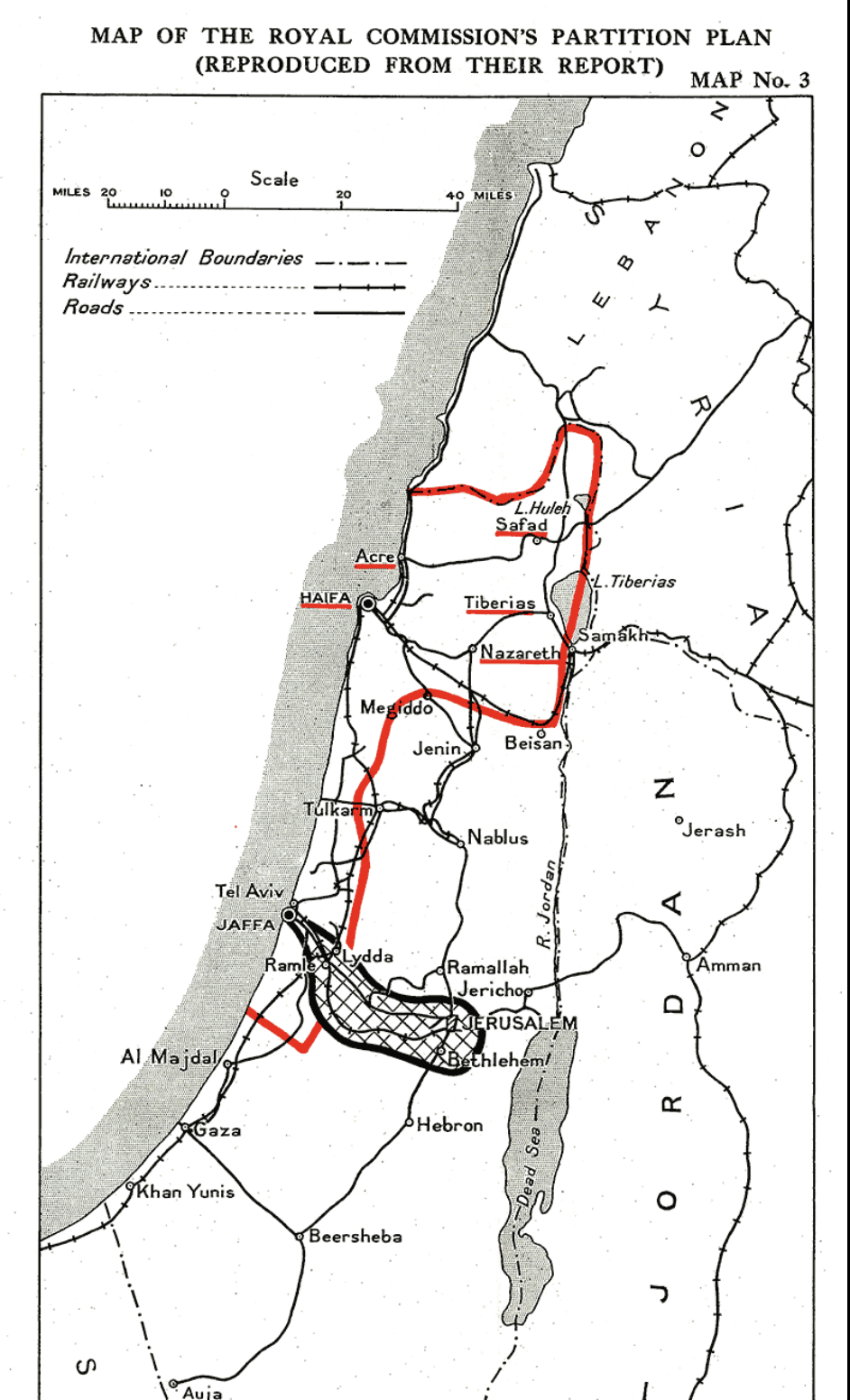
-
September: The Arab Higher Committee is declared illegal by the British authorities. Key Arab leaders are arrested or exiled, further inflaming tensions.
-
October: The second phase of the Arab Revolt begins, characterized by more organized and widespread guerrilla warfare. Arab insurgents target both British forces and Jewish communities.
-
November: Population Transfer Committee formed. On the heels of the Peel Committee recommendations, the Jewish Agency created the Population Transfer Committee with an impressive list of executive members, one of whom was Dr Kurt Mendelson from Holland considered to be “the expert on the question of population transfer,” which was a euphemism for ethnic cleansing. He would divide the Palestinian Arabs into 3 categories to be cleared in the first stage of the Transfer Plan:
- Tenant farmers.
- Landless villagers working as agricultural labourers.
- Farmers who owned less than 3 dunums per capita.
- Ten years later, amorphously renamed or reconstituted as simply the Transfer Committee, this method of transfer will have been totally abandoned in favor of violent forced expulsion (source, source, source) as its method of “transfer.”
- Mossad Le'Aliyah Bet formed. A clandestine organization formed within the Haganah responsible for facilitating illegal Jewish immigration (Aliyah Bet) to Palestine.
1938: Height ofthe Revolt
-
Spring: The revolt reaches its peak. Arab insurgents control large rural areas and continue to attack British and Jewish targets. British forces struggle to maintain control and resort to increasingly harsh measures.
-
Summer: British forces, with the assistance of Zionist militias such as the Haganah, launch a series of counter-insurgency operations. These operations include house demolitions, punitive raids, and the use of special units like the Special Night Squads, which are composed of British and Jewish fighters.
-
October: British forces recapture major towns and strategic locations from the insurgents. The tide begins to turn in favor of the British, but sporadic violence continues.
-
October 1-10: Germany annexes the Sudetenland, a region of Czechoslovakia with a large ethnic German population, under the pretext of protecting German interests in the East.
-
November 6-13: The last free elections in Poland before WW2 see the antizionist Bund take 17 of the 20 Jewish Council seats, while the Zionists obtained only one. Throughout Poland, in conjunction with the Polish Socialist Party, the Bund is victorious. In Germany as well, the Zionists were even more of a fringe minority, constituting no more than 2% of its Jewish population. (Source)
-
November 9: Kristallnacht. Also called “The Night of Broken Glass.” A nationwide pogrom orchestrated by the Nazi regime. Synagogues were burned, Jewish businesses were destroyed, and thousands of Jews were arrested and sent to concentration camps.
-
November 15: Kindertransport. In Germany and Austria, a delegation of British, Jewish, and Quaker leaders appeal, in person, to the Prime Minister of the United Kingdom, Neville Chamberlain. Among other measures, they requested that the British government permit the temporary admission of unaccompanied Jewish children, without their parents. Its approval results in saving the lives of nearly 10,000 Jewish children.
-
December 9: In a speech to Mapai’s Central Committee (Israeli Labor Party), David Ben-Gurion expresses anger at the British Kindertransport operation, because the children were taken to England rather than sending them on the journey to Palestine. The following quote from that speech sums up the mentality of mainstream Zionism regarding the usefulness of Nazi Germany:
-
“If I knew that it would be possible to save all the children in Germany by bringing them over to England, and only half of them by transporting them to Eretz Yisrael, then I would opt for the second alternative. For we must weigh not only the life of these children, but also the history of the People of Israel.”
-
1939: The White Paper
-
Yacov Dori appointed head of the Haganah, who later became the first chief of staff of the Israeli army.
-
Nuri al-Said Proposal. Nuri al-Said, the Prime Minister of Iraq, proposes relocating the Jewish population of Palestine to Iraq as a solution to the escalating tensions in the region. He argues that Iraq's larger land area and resources could better accommodate the Jews, integrating them economically into Iraqi society. The proposal aimed to reduce conflict in Palestine and prevent the establishment of a Jewish state, which Arab leaders viewed as a threat. The plan is largely rejected by the Jewish community and did not gain widespread support among Arab leaders or the British government, which instead issued the White Paper of 1939 to limit Jewish immigration to Palestine.
-
⭐ May: White Paper issued at the London Conference
- The British government, led by Prime Minister Neville Chamberlain, issues the White Paper in response to the 1936–1939 Arab revolt in Palestine. This policy document, formally approved by the House of Commons on 23 May 1939, served as the governing policy for Mandatory Palestine until the British departure in May 1948. Drafted unilaterally by the British government after the failure of the Arab–Zionist London Conference, the White Paper proposed the establishment of a Jewish home within an independent Palestinian state within ten years, rejecting the Peel Commission's earlier recommendation of partitioning Palestine.
- Key provisions included limiting Jewish immigration to 75,000 over the next five years, with any further immigration subject to Arab majority approval, and restricting Jewish land purchases to only 5% of the Mandate territory.
- The proposal failed to satisfy the political demands of Arab representatives and was rejected by Palestinian Arab parties, influenced by Haj Amin Effendi al-Husseini, although the more moderate National Defense Party was willing to accept it. The Arabs did not trust the promise of an independent Palestinian state.
- Zionist groups vehemently opposed the White Paper, initiating a campaign of attacks on government property and calling a general strike on May 18. Despite implementation of some regulations on land transfers and immigration, many provisions were not fully enacted due to the outbreak of World War II.
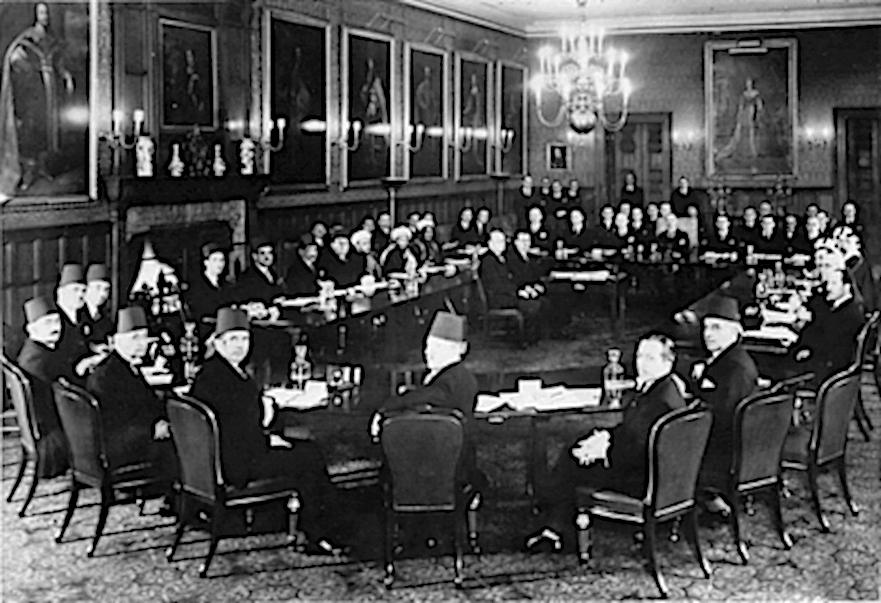
-
Irgun becomes increasingly more active in organizing secret Jewish immigration into Palestine.
-
With the help of Haganah, Britain crushes the Arab Revolt (1936-1939) in Palestine
- At least 2,000 Palestinian homes destroyed
- Approximately 9,000 Palestinians placed into concentration camps, where they are subjected to violent interrogation and torture.
- 200 Palestinian nationalist leaders are deported.
- At least 10% of the Palestinian male population killed, wounded, exiled, or
imprisoned
World War II (1939–1945)
1939 September 1. Germany invades Poland.
-
Piotrków Trybunalski established. It is the first Nazi ghetto established in occupied Poland during World War II, shortly after their initial invasion of the country. This becomes a model for subsequent ghettos, forcibly confining Jews under dire conditions and marking the beginning of systematic segregation and persecution that would escalate into the Holocaust.
-
Jewish population in Palestine reaches approximately 450,000.
1940: World at War
-
Rapid Axis expansion. Nazi Germany’s control spreads across Europe, beginning with the invasion of Denmark and Norway in April, followed by the Blitzkrieg campaigns that led to the fall of France in June. The Battle of Britain commences in July, marking the first major campaign fought entirely by air forces and signaling the resilience of the United Kingdom against German aggression. Meanwhile, in the Pacific, Japan continues its expansionist policies, further destabilizing the region.
-
⭐ August: Formation of Lehi aka Stern Gang
-
Stern Gang splits from Irgun after the latter stopped attacking the British in Palestine during WW2. Lehi’s avowed aim was to evict the British authorities from Palestine by use of violence, allowing unrestricted immigration of Jews and the formation of a Jewish state.
- Stern Gang split from the Irgun militant group to continue fighting the British during World War II. It initially sought an alliance with Fascist Italy and Nazi Germany.
- Initially called the National Military Organization in Israel, renamed Lehi one month later.
- The group referred to its own members as terrorists and boasted of carrying out terrorist attacks.
- Stern rather bizarrely considered himself an anti-imperialist and often equated fighting the native Palestinians as part of fighting the British empire.
- One of their first acts were a series of deadly bank robberies to aquire funds.
- Believing that Nazi Germany was a lesser enemy of the Jews than Britain, Lehi twice attempted to form an alliance with the Nazis, proposing a Jewish state based on "nationalist and totalitarian principles, and linked to the German Reich by an alliance".
-
-
November 16: Warsaw Ghetto sealed off. The Nazis established the Warsaw Ghetto in October, sealing off the Jewish population with a 10-foot high wall by mid-November. Over 400,000 Jews are confined within its boundaries under appalling conditions.
-
November 25: Haganah sinks the Patria. The Patria was an ocean liner being used by the British to deport 1,800 Jews to Mauritius. The Haganah detonated a bomb, claiming the intent was simply to prevent the ship from sailing. However, the ship sank, killing 267 people and injuring 172.
⭐ 1941: The Holocaust begins.
-
Lasting until the end of WWII, Nazi Germany begins systematic murder of at least 10 million people, six million of which are Jews. The remaining four million include Poles, Roma, Soviet POWs, political dissidents, disabled individuals, and homosexuals. Millions are displaced, including hundreds of thousands of European Jews, many of which make for Palestine.
-
Estimated death counts during the Holocaust
- Jews: Following Operation Barbarossa, German forces and local collaborators began the systematic mass shootings of Jews. These operations were carried out by Einsatzgruppen (mobile killing units), resulting in the deaths of approximately 1.5 to 2 million Jews. Over the next five years, Jews from across Europe were deported to concentration and extermination camps, primarily in Poland. Most Jewish victims are of Polish, Soviet, Hungarian, Romanian, and German descent.
- Soviet Prisoners of War: Estimates suggest that between 2.8 million and 3.3 million Soviet POWs were killed through starvation, forced labor, executions, and in concentration camps.
- Polish Non-Jews: Approximately 1.8 to 2 million ethnic Poles were killed by the Nazis, including intellectuals, resistance members, and civilians.
- Romani: It is estimated that around 220,000 to 500,000 Romani were killed. The Nazis targeted them for extermination alongside Jews in their racial policies.
- Disabled people: Approximately 275,000 people living with disabilities were murdered under the T4 Program and other euthanasia operations, aimed at eliminating what the Nazis considered "life unworthy of life."
- Political Dissidents: Communists, Socialists, trade unionists, and other political opponents were targeted by the Nazis, with tens of thousands killed in concentration camps and through other means.
- Homosexual men: An estimated 5,000 to 15,000 gay men were imprisoned in concentration camps, where many died due to maltreatment or were murdered.
- Jehovah's Witnesses: Approximately 1,500 to 2,500 Jehovah's Witnesses who refused to renounce their faith or serve in the German army were killed.
- Serbs in the Independent State of Croatia (NDH): While under the rule of the Ustaše regime, allied with Nazi Germany, an estimated 300,000 to 700,000 Serbs were killed in genocidal campaigns.
- Others: This includes various groups targeted by the Nazis for racial, ideological, or behavioral reasons, such as Afro-Germans, Freemasons, Slovenes, and others deemed undesirable. The numbers vary widely and are often difficult to determine with precision, but estimates range from tens to hundreds of thousands.
-
Haganah during WWII. As WWII intensifies, hundreds of members of the Haganah begin to enlist in the British army to help fight Nazi Germany and its allies.
- Miltary training. In addition to a shared interest in defeating the Axis powers and protecting the Jewish community, this period also provides valuable military training and experience to Haganah members with regards to Zionist militancy. The alliance with the British helps ease tensions between the Zionist movement and British
authorities, despite ongoing disputes over immigration policies and the future of Palestine.
- Palmach (Plugot Maḥatz) formed. The strike force wing of the Haganah
known for its better trained and highly mobile units, which played a crucial role in
various military operations, including sabotage missions
against British infrastructure and the Nakba.
- Shai (Sherut Yediot) formed. The Shai was the intelligence arm of the Haganah, established in 1940. It gathered information on both British authorities and Arab groups, playing a critical role in the Haganah's strategic planning and operations.
-
November 11: Stern Gang signs the “Jerusalem Agreement,” which established an allience between Lehi and fascist Italy. It was agreed that Italy would control the majority of Axis territory, while Stern would control Palestine. It also asserted that Italy would assist in the forcible expulsion of Jewish diaspora to Palestine. Unbeknownst to Avraham Stern, many of his messages had been intercepted by his rivals the Irgun, who used the communique to prove he was a thug and a traitor.
⭐ 1942: Biltmore Programme
-
May: The Biltmore Programme, or Biltmore Conference, is held in New York City, marking a significant shift in Zionist policy. The conference, attended by leading Zionist figures, called for the establishment of a Jewish Commonwealth in Palestine with unlimited immigration and solidified US-Zionist relations.
-
July: The Nazis begin mass deportations from the Warsaw Ghetto to the Treblinka death camp. By mid-September, the number of Jews sent there is over 300,000. Various factions in the ghetto decide to resist future deportations and form battle groups under the central command of 24-year-old Mordecai Anielewicz.
-
Prominent Zionist terrorist leader Menahem Begin arrives in Palestine. Following his arrival in Palestine, Menahem Begin, a Betar leader in Poland, succeeded in rearranging and reforming the ranks of Irgun and declared a revolt against the British mandate regime in Palestine. He then led a series of terrorist attacks against British and Palestinian Arab targets. The British government declared him a wanted individual and announced a prize for his arrest.
- Following the creation of Israel in 1948, Begin at first announced that Israel had come into existence but that "the entire homeland has not been liberated." This was because his project entailed that Greater Israel would include all the lands between the Nile and the Euphrates. He eventually came to an agreement with the Provisional Government in Tel Aviv to disarm the Irgun gang and turn it into a political movement called Herut (Freedom) which, in 1973, participated in the creation of the Likud party.
1943: Warsaw Ghetto Uprising
-
The Warsaw Ghetto Uprising was an act of Jewish resistance in the Warsaw Ghetto in German-occupied Poland during World War II to oppose Nazi Germany's final effort to transport the remaining ghetto population to the gas chambers of the Majdanek and Treblinka extermination camps.
-
January 18: Jewish fighters in the Warsaw Ghetto resist a Nazi deportation attempt, injuring a German officer and temporarily halting the deportations, enraging Nazi leadership.
-
April 19: At 3 a.m., the Nazis surround the ghetto to liquidate it, facing off against 700-750 Jewish fighters armed with limited weaponry.
-
April 22: Fires set by the Germans force Jews out of buildings. The resistance continues under increasingly desperate conditions.
-
May 8: Mordecai Anielewicz and many other fighters killed as the Nazis overrun their bunker.
-
May 16: The uprising ends when the Nazi commander blows up the great Tlomacki Synagogue as a symbol of his victory.
-
-
December: Menachem Begin chosen to lead the Irgun.
1943–1944: Bengali Famine. Though WWII results in many famines, among them the Greek, Dutch, and Soviet famines, death by starvation and related causes is worst in the Bengal region.
- A series of natural disasters caused catastrophic famine in the Bengal region of South Asia, present-day Bangladesh and West Bengal. Malnutrition, population displacement, unsanitary conditions, and lack of health care soon followed. Millions were impoverished as the crisis overwhelmed large segments of the economy and disrupted the entire social fabric of the region.
- Initially caused by a series of natural calamities like cyclones, flooding, and fungal infestations, the disaster was exacerbated by wartime British colonial policies. Specifically, the British government's "denial policy" aimed at preventing Japanese forces from accessing resources resulted in the destruction of rice stocks and boats critical for local transport and trade. The export of rice from Bengal to other parts of the British Empire continued unabated, further depleting local supplies.
- The provincial government never formally declared a state of famine. Its botched attempts to fix the price of rice paddy resulted in hyperinflation from speculation and hoarding after controls were abandoned.
- The first significant increase in aid occurred when the British Indian Army took control of funding in October 1943, but effective relief arrived after a record rice harvest that December. Deaths from starvation began to decline in the early months of 1944, but over half the deaths related to starvation and malnutrition occurred during this time as a result of disease, mostly malaria.
- Due to the initial natural disasters and exacerbating colonial policies of the British Empire, an estimated 2–3.8 million people in the Bengal region died.
1944: The Jewish Brigade
-
February 1: Irgun’s “Proclamation of Revolt,” authored by Begin, was widely distributed by Irgun. It declared war on the British Mandate, and demanded that power be delivered to a Hebrew government of Palestine.
-
June 6: D-Day. Allied forces launch the largest seaborne invasion in history on Normandy's beaches with the objective of liberating Western Europe from Nazi occupation.
-
July 23: Liberation of Majdanek Concentration Camp
- Soviet forces liberated the Majdanek concentration camp, located near Lublin, Poland, the first time a major Nazi concentration camp was liberated by Allied forces.
- As the Red Army advanced into Poland, they discovered the camp largely intact, with extensive documentation and physical evidence of the crimes perpetrated there.
- Majdanek had been used primarily for forced labor and extermination, and it is estimated that between 78,000 and 130,000 people, predominantly Jews, were murdered there.
- The liberation of Majdanek marks a pivotal moment in the global understanding of the Holocaust. Soviet authorities immediately invited journalists and international observers to witness the camp's conditions, leading to widespread media coverage that shocked the world.
-
⭐ Jewish Brigade formed
- August: British Prime Minister Winston Churchill agrees to form a Jewish Brigade, influenced by the slaughter of Polish and Hungarian Jewry and a desire to impress American public opinion.
- September: The British War Office announces the formation of the Jewish Brigade Group, consisting of over 5,000 Jewish volunteers from Mandatory Palestine. The Manchester Guardian writes, "The announcement that a Jewish Brigade will fight with the British Army is welcome, if five years late. One regrets that the British Government has been so slow to seize a great opportunity."
- October: Deployment to Italy. Under Brigadier Ernest F. Benjamin, the brigade is shipped to Italy, joining the British Eighth Army in the Italian Campaign.
-
November: Lehi Assassination of Lord Moyne. On November 6, 1944, members of the Lehi (Stern Gang) assassinate Lord Moyne, the British Minister of State in the Middle East, in Cairo. This assassination was part of the broader campaign against British authorities in Palestine and heightened tensions between the British and Zionist groups.
⭐ 1945: World War II ends
-
September 2: End of World War II, the deadliest 6-year period in human history.
-
An estimated 70-85 million deaths in total, about 3-4% of the world's population at the time.
-
2 in 3 of every death was civilian.
-
Around 1 in 5 military deaths were Soviet, roughly twice German military deaths.
-
Millions more Europeans are displaced, with some estimates as high as 20 million.
-
-
Nazi camps exposed. From January to May of 1945, many major concentration and extermination camps are liberated primarily by Soviet and American troops, including Auschwitz-Birkenau, Buchenwald, Bergen-Belsen, Dachau, and Mauthausen. Video and photographic evidence of the atrocities is quickly disseminated internationally, bringing the full extent of the Holocaust to global attention.
-
Industrialization of genocide. At approximately 10 millions deaths, 6 million of them Jews, the Holocaust becomes the largest genocide in history that is not directly associated with man-made famine, although starvation and malnutrition were involved in Nazi camps and ghettos. This, along with the nuclear bombing of Japan, permanently places the horror of industrialized massacre into the global consciousness.
-
Jewish refugee crisis. Displaced European Jewish survivors of the Holocaust seek refuge, which includes immigration to Palestine. The plight of these survivors increased international pressure on Britain to reconsider its restrictive immigration policies in Palestine.
-
October: United Nations formed. The UN is officially established with the entry into force of its Charter, which had been signed on June 26, 1945, at the United Nations Conference on International Organization in San Francisco. Its stated purpose is to promote international cooperation and prevent future conflicts, succeeding the defunct League of Nations.
-
Returning Haganah members begin training some 60,000 male and female fighters and 700 officers in Mandate Palestine, including members of their elite units, the Palmach. A highly militarized campaign of terrorist operations ensues, targeting British military and Palestinian civilian outposts.
-
Zionist militants begin gathering extensive intelligence on the Arabs of Palestine, drawing maps, collecting demographics of towns and villages, and notable Palestinian places of residence with the explicit intent of an impending widespread assault. This is largely tasked by the Shai (Sherut Yediot) wing of the Haganah.
-
Ben-Gurion after World War II
- Six weeks after the war ended, Ben-Gurion meets a group of wealthy Jews in New York to raise money for arms and equipment for the coming Zionist assault on Palestine. Rudolf Goldschmidt Sonneborn, his host, reassured the guests that the Arabs would be no obstacle to Zionist ambitions, since “the average of that race is inferior even to our average Negro.”
- The meeting results in the the formation of Materials for Israel, aka The
Sonneborn Institute, which funnels money and supplies to the Haganah. Four
months later Begin’s group, the Irgun, bombed Jerusalem’s King David Hotel,
the headquarters of the Mandate administration, killing more than ninety people.
The orders had come from the chief of the Haganah National Command, who told
Begin to ‘carry out that little hotel thing at the earliest opportunity’.
Ben-Gurion issued a statement of protest, distancing himself from the attack,
but, as Segev remarks, it ‘was not particularly vehement’.
- Jewish population in Palestine reaches approximately 600,000.
Impending Nakba (1945–1947)
⭐ 1945 October 30: Night of the Trains begins ongoing targeting of railways
-
Haganah sabotages railway lines across Palestine in a coordinated attack aimed to disrupt British transportation and communication networks and limit Palestinian mobility. Zionist terrorist attacks on railways continue until 1948, with the most frequent targets being key lines from Jaffa to Jerusalem and the train from Cairo–Haifa.
1945-1946: Anglo-American Committee of Inquiry
- In response to growing tensions in Palestine and the plight of Jewish refugees, the British and American governments established the Anglo-American Committee of Inquiry. The committee was tasked with examining the political, economic, and social conditions in Palestine and making recommendations for future policy. Their conclusions were to relax restrictions on Jewish immigration, reject a partition, and focus instead on economics and infrastructure coupled with increased international oversight.
- The ultimate recommendations of the Anglo-American Committee of Inquiry were met with mixed reactions. The Jewish community generally welcomed the proposal to admit 100,000 Jewish refugees, seeing it as a positive step towards addressing the humanitarian crisis. However, the rejection of partition and the continuation of the British Mandate were met with disappointment and criticism from both Jewish and Arab leaders.
1946: former Jewish Brigade members turn their focus to Palestine
-
The Bricha Movement. Former members of the Jewish Brigade form an underground movement known as Bricha dedicated to assisting Holocaust survivors in illegally immigrating to Palestine in defiance of the British White Paper of 1939.
-
Gmul and Tilhas Tizig Gesheften. Former Jewish Brigade members form vigilante groups. These groups engage in the assassination of Nazi war criminals and in smuggling weapons to the Haganah in Palestine with the explicit intent of a nationalist takeover.
- March: Speaking to the Anglo-American commission, Ben-Gurion claims to be unaware of the Sonneborn Institute, which he helped form in July 1945.
-
⭐ July 22: King David Hotel Bombing
-
There are several attacks by Zionist paramilitary groups, but the most significant was orchestrated by Irgun in the bombing of the King David Hotel in Jerusalem, which serves as the British administrative headquarters.
- The orders come from the chief of the Haganah National Command, who tells Begin to “carry out that little hotel thing at the earliest opportunity.”
- Ben-Gurion issues a statement of protest, distancing himself from the attack, but, as historian Tom Segev remarks, it “was not particularly vehement.”
- The attack results in the deaths of 91 people and marks a significant escalation
in the conflict between Jewish militants and British authorities. The bombing is
intended to undermine British control and pressure them to alter
their policies regarding Jewish immigration and the future governance of
Palestine.
-
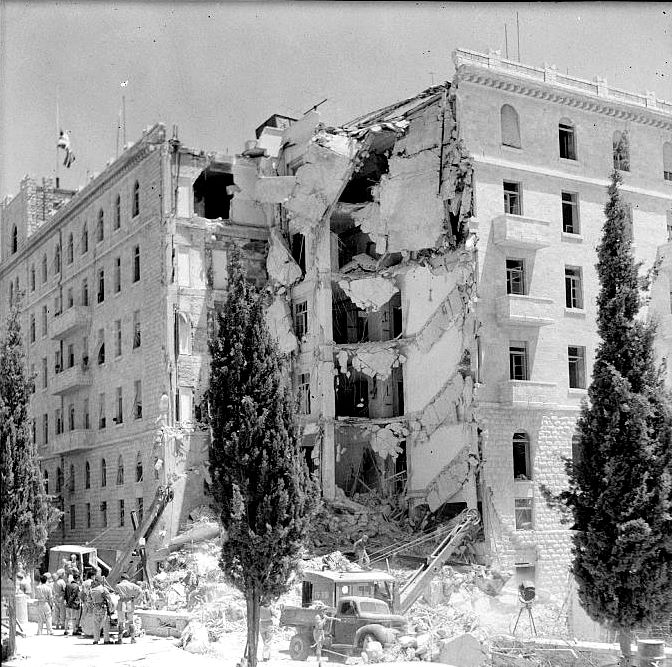
-
October: Ben-Gurion pleads with the British to extend the Mandate.
-
He tells the Colonial Office, “We are the only group in the entire Middle East that wants to be and can be your friends.”
-
He is greeted with some skepticism, like the Labour MP Richard Crossman accusing “the dictator who runs the Jews in Palestine, including the illegal army” of playing a “double game.”
-
The reason for the double game was that the Haganah wasn’t yet ready to defend the Yishuv against an Arab invasion. Ben-Gurion still needed Britain’s army. (Source)
-
⭐ 1947: End of British Mandate announced
-
February: Referral to the United Nations. Faced with escalating violence and unable to find a solution, Britain referred the Palestine problem to the United Nations.
-
August 15: India gains independence from British rule, marking the end of nearly 200 years of colonial governance. The Indian Independence Act of 1947, passed by the British Parliament, partitions British India into two separate states, India and Pakistan, leading to significant demographic shifts and widespread communal violence.
- The independence of India significantly influenced Britain's approach to Palestine. The loss marked a substantial decline in British imperial power, compelling Britain to reassess its global colonial commitments. Faced with post-war economic strain and escalating violence in Palestine, Britain decides to terminate its mandate and defers the issue to the newly formed United Nations.
-
September: Termination of British Mandate announced. Britain announces that it would terminate its mandate for Palestine by May 1948, passing responsibility to the international community.
- Facing rising Zionist terrorist attacks, the British cabinet evacuates Palestine. Shooting and bombing attacks continue to the end of November, killing a number of British soldiers and policemen, including an Irgun bombing of police headquarters in Haifa which drew attention due to the technical sophistication involved.
-
November 11: "Lehi Children" incident. British intelligence are informed of a Lehi firearms course for young members in Ra'anana. They surround the building and open fire, killing five teenagers and injuring two more.
- Lehi retaliates with several terrorist attacks in the following weeks, killing some British police and soldiers and injuring many more civilians.
-
November 19: The Shubaki family assassination. The summary execution of five adult members of the Shubaki family in the village of Arab al-Shubaki by Lehi on suspicions that the men had acted as informants for the British police in the Lehi Children affair.
- The attack followed a period during which Zionist violence was mostly directed at the British presence rather than Palestinians, causing growing concern of an escalation between Zionists and Palestinian Arabs.
-
⭐ November 29: UN Partition Plan
-
United Nations General Assembly adopts Resolution 181, commonly known as the Partition Plan for Palestine. The plan proposed to divide the British Mandate of Palestine into separate Jewish and Arab states, with Jerusalem placed under international administration. The resolution was passed with 33 votes in favor, 13 against, and 10 abstentions. While the Jewish community largely accepted the plan, viewing it as a step toward the establishment of a Jewish state, the Arab community vehemently rejected it, arguing that it was unfair and disregarded the rights and aspirations of the Palestinian Arab majority.
- Palestinians considered the UN Partition Plan unfair for a variety of reasons. Jews in Palestine constituted one third of the population and owned less than six percent of the total land area. Under the UN partition plan, they were allocated 56% of the land, encompassing many of the main cities with Palestinian Arab majorities and most of the vital coastline from Haifa to Yafa. The Arab state would be deprived of key agricultural lands, seaports, and other economic links that had been cultivated by Palestinians for generations, all without regard for their history, traditions, or livelihoods.
-
-
November 30: “From the morning after the UN Partition Resolution was adopted, the 75,000 Palestinians in the city were subjected to a campaign of terror jointly instigated by the Irgun and the Hagana. As they had only arrived in recent decades, the Jewish settlers had built their houses higher up the mountain. Thus, they lived topographically above the Arab neighbourhoods and could easily shell and snipe at them. They had started doing this frequently since early December. They used other methods of intimidation as well: the Jewish troops rolled barrels full of explosives, and huge steel balls, down into the Arab residential areas, and poured oil mixed with fuel down the roads, which they then ignited. The moment panic-stricken Palestinian residents came running out of their homes to try to extinguish these rivers of fire, they were sprayed by machine-gun fire. In areas where the two communities still interacted, the Hagana brought cars to Palestinian garages to be repaired, loaded with explosives and detonating devices, and so wreaked death and chaos. A special unit of the Hagana, Hashahar ('Dawn'), made up of mistarvim-literally Hebrew for 'becoming Arab', that is Jews who disguised themselves as Palestinians - was behind this kind of assault. The mastermind of these operations was someone called Dani Agmon, who headed the 'Dawn' units. On its website, the official historian of the Palmach puts it as follows: 'The Palestinians [in Haifa] were from December onwards under siege and intimidation.'” –Ilan Pappé, The Ethnic Cleansing of Palestine (2006)
- Jewish population in Palestine reaches approximately 630,000.
Al-Nakba, “The Catastrophe” (1947–1949)
Source: Getty Images | Nakba
1948
⭐ 1947 December: The Nakba Begins
-
Though displacement of Palestinians from their lands by the Zionist project was already taking place during the British Mandate, and indeed before then, mass displacement begins when the UN partition plan is passed.
-
Arab Liberation Army forms. The Arab League fascilitates an army of volunteers following the United Nations voted to partition British Mandate Palestine. It was composed of Palestinian and other Arab volunteers and was led by a Lebanese-Iraqi officer, Fawzi al-Qawuqji, and Adib Shishakli, who later became president of Syria.
-
The ALA enters Palestine in January, and from February and May suffer a string of defeats in northern Palestine. Between May and October, the Arab Liberation Army control parts of western Galilee, but by October are completely defeated there as well.
-
-
Waves of methodical, brutal attacks on Palestinian villages begin, mostly based on intelligence gathered by militant groups in the years following WWII.
- The generally deceptive “retaliation” rhetoric is abandoned completely among the Jewish insurgency, now openly engaging in “violent reconnaissance” (“hasiyurha-alim”).
- Haganah and Irgun ramp up ambushes on Arab convoys, focusing on key routes and supply lines. The Palestinian villages of Deir Ayyub and Beit Affa are attacked.
- Lehi intensifies attacks on British military and administrative targets.
- Counterattacks by Arabs escalate in increasingly more severe outbreaks of violence.
-
December 18: Al-Khisas is ethnically cleansed by Haganah. The northern village of Al-Khisas becomes one of the first significant instances of ethnic cleansing during the escalating violence following the UN Partition Plan. The Palmach brigade of the Haganah attacked the village, leading to the massacre of 15 Palestinians , including 5 children and resulting in the expulsion of its Palestinian inhabitants. This is often considered the beginning of the Nakba. Source.
-
December 30: Haifa Oil Refinery Attack. Six Arabs were killed and 42 were wounded after Irgun members threw a number of hand grenades at a crowd of about 100 day-labourers waiting at a bus stop outside the main gate of the then British-owned Haifa Oil Refinery. Arab workers retaliate by killing 29 Jewish refinery workers.
- “The Irgun claimed it was in retaliation for an earlier attack by Arab workers on their Jewish co-workers, a new phenomenon in an industrial site where Arab and Jewish workers had usually joined forces in trying to secure better labour conditions from their British employers. But the UN Partition Resolution seriously dented that class solidarity and tensions grew high. Throwing bombs into Arab crowds was the specialty of the Irgun, who had already done so before 1947. However, this particular attack in the refineries was undertaken in coordination with the Hagana forces as part of the new scheme to terrorise the Palestinians out of Haifa. Within hours, Palestinian workers reacted and rioted, killing a large number of Jewish workers – thirty-nine – in one of the worst but also last Palestinian counterattacks; the last, because there the usual chain of retaliatory skirmishes stopped.” –Ilan Pappé, The Ethnic Cleansing of Palestine (2006)
-
December 31: Balad al-Shaykh massacre. Between 60 and 70 Palestinian Arabs killed by the Haganah in the village of Balad al-Shaykh, one of the largest, and earliest, massacres during the Nakba. It was conducted as a retaliation to the Haifa Oil Refinery massacre. The killings had a significant effect on morale amongst Palestinian civilians in the Haifa region.
1948: Ethnic cleansing of Palestine by Zionist militants
-
Palestine Railways destroyed. By early 1948, the train service was completely disabled and a large truck began to carry passengers and goods to Jerusalem instead. These trucks, too, were subsequently attacked.
-
Violence before May 15 is extensive. In less than six months, Zionist armed groups expel about 440,000 Palestinians from 220 villages. Some of the most infamous massacres were committed prior to May 15, the date of the end of the British Mandate of Palestine:
- Balad al-Sheikh massacre on December 31, 1947, killing up to 70 Palestinians
- Bombing of the Semiramis Hotel on January 5, 1948 in the Arab neighborhood of Katamon in Jerusalem. The explosion completely destroys the hotel, killing more than 20 people, including residents and staff, and injuring many others.
- Sa’sa’ massacre on February 14, 1948, when 16 houses were blown up and 60 people lost their lives.
- Deir Yassin massacre on April 9, 1948, when about 110 Palestinian men, women and children were slaughtered.
-
February: Zionist forces attack the Palestinian village of Qisarya near Haifa. Many villagers are forcibly expelled from their homes, and their properties are destroyed.
-
March 10: Plan Dalet, aka Plan D, officially adopted by Zionist forces. It specified which Palestinian cities and towns would be targeted and gave instructions for how to drive out their inhabitants and destroy their communities.
- “Destruction of villages (setting fire to, blowing up, and planting mines in the debris), especially those population centers which are difficult to control continuously.”
- “Mounting search and control operations according to the following guidelines: encirclement of the village and conducting a search inside it. In the event of resistance, the armed force must be destroyed and the population must be expelled outside the borders of the state.”
- May 13: On the eve of the British Mandate’s end, Jewish population in Palestine reaches approximately 650,000-700,000.
- May 14: British Mandate ends. David Ben-Gurion, head of the Jewish Agency in Palestine, declares the formation of the state of Israel.
-
⭐May 15: Arab-Israeli War begins.
-
Units of the Egyptian, Lebanese, Syrian, Jordanian, and Iraqi armies invade Palestine.
- Count Folke Bernadotte is appointed UN Mediator in Palestine by the UN General Assembly.
-
-
May 22–23: Tantura massacre, where between 40–200 Palestinian Arab villagers are massacred by the Haganah’s Alexandroni Brigade.
-
July: Lydda massacre and ensuing Ramallah death march.
-
September: After only four months as UN Mediator, Lehi assassinates Count Folke Bernadotte.
- Irgun is disbanded and its members join the newly formed IDF.
-
October 29-31: Zionist forces enact a particularly brutal wave of massacres in locations such as Al-Dawayma (Hebron), Saliha, and Eliaboun (Ako/Acre) and force tens of
-
November: According to the UN, by November over 500,000 Palestinians have become refugees due to Zionist attacks.
-
December: UN General Assembly passes resolution 194 calling for refugees to be allowed to return. Jerusalem is to be under international regime. A UN Conciliation Commission for Palestine (UNCCP) is sent to replace the murdered Bernadotte.
⭐ 1949: Arab armies defeated
-
January: The first Israeli elections are held. David Ben-Gurion becomes the first Prime Minister of Israel.
-
February–April: Israel signs armistice agreements with Egypt, Lebanon, and Jordan.
-
April: UN Conciliation Commission convenes Lausanne Conference to reconcile the parties.
-
May: UNGA adopts Resolution 273 (III) admitting Israel as UN member.
-
July 20: Israel signs the final armistice agreement with Syria, marking the official end of the Arab-Israeli War. This agreement establishes the armistice lines, known as the Green Line, which serve as the de facto borders of Israel until 1967.
-
Aftermath. At least 10,000 Palestinians have been murdered by Zionist forces. Between 750,000 and 1 million Palestinians have been forcibly expelled from their homeland.
- Zionist forces have committed at least 223 atrocities, including massacres, sexual assault, bombing of homes, looting, and in some cases the flattening of entire villages.
- Some 150,000 Palestinians remain in the areas of Palestine that became part of the Israeli state. Of the 150,000, some 30,000 to 40,000 were internally displaced.
-
December 8: UNGA Resolution 302 (IV) passes, replacing UNRPR with UNRWA to address Palestinian refugees.
-
December 11: The UN General Assembly passes Resolution 194, calling for the return of Palestinian refugees to their homes and for compensation to those who choose not to return. Israel ignores it.
Nakba Resources
The Nakba | Palestine Campaign
Quick Facts. The Palestinian Nakba (Catastrophe) | IMEU
Palestinian Refugees & The Right of Return Under International Law | IMEU
Nakba Fact Sheet | Jewish Voice for Peace
Al-Nakba | American Muslims for Palestine
The Ongoing Nakba (1948–Present)
It is the general consensus that the Nakba (Arabic for “catastrophe”) beginning at the end of 1947 after the UN Partition plan was announced, never ended. Every event from that moment onward is a continuation of the Zionist goal of ethnically cleansing Palestine. The 76 years that have followed since May 1948, and the consistent policy of subjugation and domination of indigenous Palestinians, is behind every major atrocity perpetrated by the Zionist regime, now known as the apartheid state of Israel.
1950 January 23: Israel moves its capital from Tel Aviv to the western part of Jerusalem, in defiance of UN resolutions, and the West Bank is brought formally under Jordanian control.
1953 October 14-15: Qibya Massacre. Israeli forces led by Ariel Sharon attack the Palestinian village of Qibya in the West Bank, killing at least 69 Palestinians, most of them civilians. The Qibya massacre draws international condemnation and highlights the ongoing violence and reprisals between Israelis and Palestinians.
1956 October 29: Kafr Qasim Massacre. Israeli border police kill 48 Arab citizens of Israel in the village of Kafr Qasim. The massacre occurs on the eve of the Suez Crisis and becomes a symbol of the discrimination and violence faced by Palestinian Arabs living within Israel's borders.
1956 October 29 - November 7: Suez Crisis. Also known as the Tripartite Aggression, occurs in 1956 when Israel, the United Kingdom, and France launch a military operation against Egypt following Egypt's nationalization of the Suez Canal. While the primary focus is on Egypt, the crisis exacerbates regional tensions and impacts Palestinian refugees and the broader Arab-Israeli conflict.
1959: Fatah formed. Yasser Arafat and other Palestinian exiles in Kuwait found Fatah (Harakat al-Tahrir al-Watani al-Filastini), form a Palestinian nationalist movement aiming to liberate Palestine through armed struggle. Fatah later becomes the dominant faction within the Palestine Liberation Organization (PLO).
1964: Palestine Liberation Organization (PLO) founded in Cairo.
1967 Jun 5 - Jun 10: Six-Day War. Israel and several of its Arab neighbors fight the Six-Day War. Beginning with a pre-emptive strike that destroys Egypt’s air force while it sat on the tarmac, Israel wins a decisive victory. It suffers about 700 casualties, while Arabs suffer nearly 20,000. Israel emerges with control of the West Bank and the Gaza Strip, areas inhabited almost entirely by Palestinians. It gains all of East Jerusalem and Syria’s Golan Heights, and finally the Sinai Peninsula in Egypt. Israel will stay in the Sinai Peninsula until April 1982.
- June 8: Israel attacks the USS Liberty. The combined air and sea attack killed 34 crew members, wounded 171 crew members, and severely damaged the ship. The ship was in international waters north of the Sinai Peninsula, about 25.5 nautical miles northwest from the Egyptian city of Arish. Israel apologized, and both the Israeli and United States governments concluded the attack was a mistake due to Israeli confusion about the ship's identity. Others, including survivors of the attack, have rejected these conclusions and maintain that the attack was deliberate.
1960 September 16 – 27: Black September. An armed conflict between Jordan under King Hussein and various Palestinian factions, primarily the PLO under chairman Yasser Arafat. The main phase of the fighting took place between 16 and 27 September, though certain aspects of the conflict continued until 17 July 1971. The confrontation began after a series of hijackings by the Popular Front for the Liberation of Palestine (PFLP) and escalating tensions between the Jordanian government and Palestinian guerrilla groups operating within Jordan. The situation culminated in King Hussein's decision to expel the PLO from Jordan, leading to intense and violent clashes. The conflict resulted in significant casualties, with estimates of thousands of Palestinians killed and many more displaced. By July 1971, the Jordanian military had effectively crushed the Palestinian militant presence in the country, forcing the PLO to relocate its base of operations to Lebanon.
1973 Oct 3: Yom Kippur War. Another Arab-Israeli war, known variously as the Yom Kippur War, the Ramadan War, and the October War, is fought when Egypt and Syria attempt to retake the Israeli-occupied Sinai Peninsula and Golan Heights. Cold War tensions spike as the Soviet Union aids Egypt and Syria and the United States aids Israel. The Organization of the Petroleum Exporting Countries begins an oil embargo on countries that support Israel, and the price of oil skyrockets. The fighting ends after a UN-sponsored cease-fire (negotiated by the United States and the Soviet Union) takes hold. The UN Security Council passes Resolution 338, which calls for implementing UN Security Council Resolution 242.
1978 Sep 1: Camp David Accords. Israel and Egypt sign the Camp David Accords, which establish a basis for a peace treaty between the two countries. The accords also commit the Israeli and Egyptian governments, along with other parties, to negotiate the disposition of the West Bank and the Gaza Strip.
1979 Mar 26: Israel Withdraws From the Sinai Peninsula. Egypt and Israel sign a peace treaty, the first between Israel and one of its Arab neighbors. The treaty commits Israel to withdraw from the Sinai Peninsula and evacuate its settlements there. The termination of the state of war between Egypt and Israel leads to the normalization of diplomatic and commercial relations between the two countries. Israel’s prime minister and Egypt’s president exchange letters reaffirming their commitment—outlined in the Camp David Accords—to negotiate the disposition of the West Bank and the Gaza Strip.
1987 Dec 1: First Intifada. An Israeli driver kills four Palestinians in a car accident that sparks the first intifada, or uprising, against Israeli occupation in the West Bank and Gaza. Over the next six years, roughly 200 Israelis and 1,300 Palestinians are killed. A Palestinian cleric named Sheikh Ahmed Yassin establishes the militant group Hamas as an offshoot of the Muslim Brotherhood. Hamas endorses jihad as a way to regain territory for Muslims; the United States designates Hamas a foreign terrorist organization in 1997.
1988 Jul 31: Jordan Surrenders Claims on the West Bank and East Jerusalem. King Hussein of Jordan relinquishes his country’s claims to the West Bank and East Jerusalem in favor of the claims of the Palestine Liberation Organization (PLO). In December of the same year, PLO Chairman Yasir Arafat denounces violence, recognizes Israel’s right to exist, and acknowledges UN Security Council Resolution 242 and the concept of land for peace. The United States responds to Arafat’s announcement by beginning direct talks with him, though it suspends the talks following a Palestinian terrorist attack against Israel.
1991 Oct 30: The Madrid Peace Conference. The Madrid Peace Conference begins, sponsored jointly by the United States and the Soviet Union. Israeli, Jordanian, Lebanese, Palestinian, and Syrian delegates attend the first negotiations among those parties. The talks proceed along bilateral tracks between Israel and its neighbors, though the Lebanese join the Syrian delegation and the Jordanian team includes Palestinian representatives. A multilateral track includes the wider Arab world and addresses regional issues. The talks last for two years without any breakthroughs.
1993 Sep 13: Oslo Accords. Secret negotiations in Norway result in the Declaration of Principles on Interim Self-Government Arrangements, also known as the Oslo Accords. Before the accords are signed, Israel and the PLO recognize each other in an exchange of letters. Israel and the PLO agree to the creation of the Palestinian Authority to temporarily administer the Gaza Strip and West Bank. Israel also agrees to begin withdrawing from parts of the West Bank. Palestinian leader Arafat, Israeli Prime Minister Yitzhak Rabin, and Israeli Foreign Minister Shimon Peres win the Nobel Peace Prize in 1994 for their efforts on the Oslo Accords. The Accords, however, end up disastrously for the Palestinians, leading to further normalization and apartheid separation.
1994 May 4: Gaza-Jericho Agreement. The Israelis and the Palestinians sign the Gaza-Jericho Agreement, which begins implementation of the Oslo Accords. The agreement provides for an Israeli military withdrawal from Gaza and Jericho, a town in the West Bank, and for a transfer of authority from Israeli administration to the newly formed Palestinian Authority. The agreement also establishes the structure and composition of the Palestinian Authority, its jurisdiction and legislative powers, a Palestinian police force, and relations between Israel and the Palestinian Authority. Arafat returns to the Gaza Strip after a long absence.
1994 Oct 26: Israel and Jordan Sign a Peace Treaty. This marks the end of an ongoing territorial dispute and the beginning of future cooperation in sectors such as trade and tourism. This is Israel’s second peace treaty with an Arab state. It accords special administrative responsibilities for Jerusalem’s Muslim holy places to Jordan.
1995 Sep 28: Oslo II Accord. Israeli and Palestinian negotiators sign the Interim Agreement, sometimes called Oslo II. It gives the Palestinians control over additional areas of the West Bank and defines the security, electoral, public administration, and economic arrangements that will govern those areas until a final peace agreement is reached in 1999.
2000 Jul 11 – Jul 25: Camp David Summit. Hosted by President Bill Clinton, reports indicate that Israeli Prime Minister Ehud Barak is prepared to accept, among other things, Palestinian sovereignty over some 91% of the West Bank and certain parts of Jerusalem. The deal would include a land swap in which some Israeli land would go to the Palestinians in compensation for the remaining 9% of the West Bank, which would go to Israel. Two weeks of intensive discussion, however, fails to produce an agreement. Before leaving office several months later, Clinton lays out proposals for both sides. Talks between them continue, but without success.
2000 Sep 28: Second Intifada. Israeli politicians, including Ariel Sharon, a controversial retired Israeli general, visit the Temple Mount, aka Haram al-Sharif. The Palestinians view the visit as an effort to change the status quo at the holy site. The ensuing demonstrations turn violent, marking the beginning of a second intifada. It will last until 2005 and be markedly more violent than the first intifada. 4,000 Palestinians and 1,000 Israelis die.
2002 Mar 27: Passover Massacre. A terrorist attack kills thirty people at a Passover celebration at a hotel in the Israeli city of Netanya. As a result, the Israeli military reoccupies portions of the West Bank, including the city of Ramallah, where the Palestinian Authority is located and where Arafat has his West Bank headquarters.
2002 Jun 23: West Bank Barrier Construction Begins. Israel begins building a barrier in the West Bank. The barrier, which is a wall in some stretches and a fence in others, cuts deep into West Bank territory. The Palestinians are cut off from Jerusalem, some Palestinian villages are sliced in half, and some Palestinians are unable to get to work or school as a result of the security barrier’s path.
2003 Apr 30: Road Map for Peace. The Quartet, an informal group created to pursue Middle East peace comprising the United States, Russia, the United Nations, and the European Union, puts forth a Road Map for Peace based on the outline President George W. Bush offered in his 2002 speech. The road map lays out a plan for peace based on Palestinian reforms and a cessation of violent resistance in return for an end to illegal Israeli settlements and a new Palestinian state.
2005 Aug 15: Israel Withdraws from Gaza. Israel begins a withdrawal of settlers and military forces from within the Gaza Strip. The Israeli military remains in control of Gaza’s borders, airspace, and coastline.
2006 Jan 29: Hamas in Gaza. Hamas defeats Fatah in Palestinian elections. The United States and other countries suspend their aid to the Palestinian Authority because they consider Hamas to be a terrorist organization. Fatah and Hamas make a deal to govern the West Bank and Gaza Strip together.
2006 Jun 25: Gilad Shalit Taken Hostage. Hamas operatives kidnap an Israeli soldier named Gilad Shalit on Israeli soil near the Gaza Strip. The Israeli military tries and fails to free him. He is held captive in Gaza until Israel—with the help of Egypt and the United States—negotiates his release in 2012.
2007: Hamas expands influence in Gaza as their deal with Fatah collapses. Israel imposes a strict blockade on the Gaza Strip.
- The restrictions on movement and goods in Gaza imposed by Israel date to the early 1990s. After Hamas took over in 2007, Israel significantly intensifie existing movement restrictions and imposed a complete blockade on the movement of goods and people in and out of the Gaza Strip. Egypt began its blockade of Gaza in 2007, shortly after Hamas took control of the territory. The blockade's stated aim is to prevent the smuggling of weapons into Gaza, as well as to intentionally exert economic pressure on Hamas. However, human rights groups have called the blockade illegal and a form of collective punishment, as it restricts the flow of essential goods, contributes to economic hardship, and limits Gazans' freedom of movement. The blockade and its effects have led to the territory being called an “open-air prison”.
- Exit and entry into Gaza by sea or air is prohibited. There are only three crossings in and out of Gaza, two of them controlled by Israel and one by Egypt. Israel heavily regulates Palestinians' movement through Erez, with applications considered only for a small number of laborers (less than 5% of the number considered in 2000) and for limited medical and humanitarian reasons. Israel's military cooperation with Egypt and its control of the population registry (through which it controls who can obtain the necessary travel documents) gives it influence over movement through Rafah. Imports are heavily restricted, with "dual use" items permitted only as part of donor projects. This includes construction material and computer equipment. Exports are also heavily restricted, with the main impediment to economic development in Gaza being Israel's ban on virtually all exports from the Strip.
2008 Dec 27: Operation Cast Lead. A six month long ceasefire between Israel and Hamas ends on 4 November, when the IDF raids Deir al-Balah, central Gaza to destroy a tunnel, killing several Hamas militants. Israel claims the raid was a preemptive strike, because Hamas intended to abduct further Israeli soldiers. Hamas characterizes it as a ceasefire violation. and responds with increased rocket fire into Israel. Israel in turn attacks the Gaza Strip, sparking a three-week armed conflict between Palestinian paramilitary groups and the IDF known as Operation Cast Lead. It results in 1,166–1,417 Palestinian and 13 Israeli deaths. Over 46,000 homes are destroyed in Gaza, displacing more than 100,000 Palestinians.
2013 Jul 28: Kerry Negotiations. Secretary of State John Kerry seeks to restart final status negotiations. The process begins with the Israeli’s agreement to release 104 Palestinian prisoners and the Palestinians’ agreement not to use their new observer state status at the United Nations to advance the cause of statehood. Negotiations between Israel and the Palestinian Authority collapsed in April 2014 over such issues as Israeli settlement growth, the status of a final round of prisoners, and Palestinian attempts to join several international organizations.
2014 Apr 23: Tensions Between the PLO and Hamas. The PLO and Hamas sign an agreement to form a unity government. Tensions between the factions remain, however, and no unity government is formed. Gaza and the West Bank remain disconnected and under the control of rival Palestinian leaderships.
2014 Jul 8 – Aug 26: Operation Protective Edge. After tit-for-tat attacks on Israeli and Palestinian civilians by extremists on both sides, Israel invades the Gaza Strip. The operation, code-named Protective Edge, lasts for fifty days, killing about two thousand Gazans, sixty-six Israeli soldiers, and five Israeli civilians. Unlike the conflicts from 2008 to 2009 and in 2012, Palestinian rocket fire targets major Israeli cities. The war ends after the United States, in consultation with Egypt, Israel, and other regional powers, brokers a cease-fire.
2017 Dec 6: Trump Formally Recognizes Jerusalem as the Capital of Israel. Changing long-standing U.S. policy, U.S. President Donald Trump formally recognizes Jerusalem as the capital of Israel. He also pledges to move the U.S. embassy from Tel Aviv to that city, though the move is not set to occur immediately. Numerous foreign leaders, including those of Egypt, France, Saudi Arabia, Turkey, and the United Kingdom, along with UN Secretary-General António Guterres, criticize the policy change. It also sparks protests and violence throughout East Jerusalem, Gaza, and the West Bank, as well as in Egypt, Iran, Iraq, and Jordan. In January 2018, Palestinian President Mahmoud Abbas declines to meet with U.S. Vice President Mike Pence during Pence’s trip to the region.
2018 March 30 – 2019 December 27: Great March of Return. A series of peaceful demonstrations held each Friday in the Gaza Strip near the border, during which Israeli forces killed a total of 223 Palestinians. The demonstrators demanded the right of Palestinian refugees to return to the lands they were displaced from, which are now part of Israel. They also protested against Israel's land, air, and sea blockade of the Gaza Strip and the United States' recognition of Jerusalem as the capital of Israel.
- The first demonstrations were organized by independent activists but were soon endorsed by Hamas, the rulers of the Gaza Strip, as well as other major factions in Gaza. The activists who planned the Great March of Return initially intended it to last only from March 30, 2018 (Land Day), to May 15 (Nakba Day), but the demonstrations continued for almost 18 months until December 27, 2019, when Hamas announced that they would be postponed indefinitely. 30,000 Palestinians participated in the first demonstration on March 30. Larger protests took place on the following Fridays—April 6, April 13, April 20, April 27, May 4, and May 11—each involving at least 10,000 demonstrators, while smaller numbers attended activities during the week.
- At least 189 Palestinians were killed between March 30 and December 31, 2018. An independent United Nations commission said that at least 29 out of the 189 killed were militants. Other sources claim a higher figure, of at least 40. Israeli soldiers fired tear gas and live ammunition.
- More than 13,000 Palestinians were wounded, mostly severely. No Israelis were physically harmed from March 30 to May 12, until one Israeli soldier was reported as slightly wounded on May 14, the day the protests peaked. On that day, 59 or 60 Palestinians were shot dead at twelve clash points along the border fence. Hamas claimed 50 of them as its militants, and Islamic Jihad claimed 3 of the 62 killed as members of its military wing. Some 35,000 Palestinians protested that day, with thousands approaching the fence.
- Afterward, IDF snipers brag about their deliberate crippling of Palestinian protestors in Gaza, in one infamous interview claming “42 knees in one day.” ( Haaretz)
- Israel's use of deadly force was condemned on June 13, 2018, in a United Nations General Assembly resolution. Condemnations also came from human rights organizations, including Human Rights Watch, B'Tselem, and Amnesty International, as well as United Nations officials.
2019 Mar 25: Trump Recognizes Israeli Sovereignty Over the Golan Heights. The Trump administration recognizes Israeli sovereignty over the Golan Heights, which Israel had formally annexed from Syria in 1981. The United States is the first country other than Israel to recognize Israel’s sovereignty over the territory.
2020 Jan 28: Trump Launches Proposed Peace Plan. Trump unveils his administration’s proposed Israeli-Palestinian peace plan, crafted by U.S. and Israeli diplomats without Palestinian input. The plan calls for a two-state solution with significant economic aid to the Palestinians. Many analysts criticize the plan as being one sided, stipulating impossible requirements for Palestinian statehood and paving the way for Israeli annexation of the West Bank. Palestinian authorities reject the plan immediately. Following the plan’s announcement, Israel’s Prime Minister Benjamin Netanyahu announces Israel’s plan to annex portions of the West Bank as outlined in Trump’s proposal.
2020 Sep 15: Relations between Some Arab Countries and Israel Normalize. Bahrain and the United Arab Emirates agree to normalize diplomatic relations with Israel, becoming the first Arab countries to do so in over twenty-five years. In return, Israel announces the suspension of its plans to annex territory in the West Bank. Morocco and Sudan subsequently also sign on to the agreement and normalize relations with Israel.
2021 May 10 – May 21: Unity Intifada. An outbreak of violence triggered by events starting 6 May, when Palestinians in East Jerusalem began protesting over an anticipated decision of the Supreme Court of Israel on the eviction of six Palestinian families in the East Jerusalem neighborhood of Sheikh Jarrah. On 7 May, Palestinians allegedly threw stones at Israeli police forces, who then stormed the Al-Aqsa Mosque compound using tear gas, rubber bullets, and stun grenades.
- On the afternoon of 10 May, Hamas gave Israel an ultimatum to withdraw its security forces from both the Temple Mount complex and Sheikh Jarrah by 6 p.m. When the ultimatum expired without a response, both Hamas and PIJ launched rockets from the Gaza Strip into Israel; some of these rockets hit Israeli residences and a school. Israel then began a campaign of airstrikes against Gaza.
- By 16 May, some 950 targets had been attacked, demolishing completely or partially 18 buildings, including four high-rise towers, 40 schools and four hospitals, while also striking the al-Shati refugee camp. Additionally, at least 19 medical facilities were damaged or destroyed by the Israeli bombardment. By 17 May, the United Nations estimated that Israeli airstrikes had destroyed 94 buildings in Gaza, comprising 461 housing and commercial units, including the al-Jalaa Highrise; housing offices of the Associated Press, the Al Jazeera Media Network, and other news outlets; and 60 condominiums.
- As a result of the violence, at least 256 Palestinians, including 66 children, were killed. In Israel, at least 13 people were killed, ncluding two children. The Gaza Ministry of Health reported that more than 1,900 Palestinians were injured, and as of 12 May, at least 200 Israelis were reported to have been injured.
- As of 19 May, at least 72,000 Palestinians had been displaced. Around 4,360 Palestinian rockets were fired towards Israel, of which 680 landed within the Gaza Strip, and over 90 percent of rockets bound towards populated areas were intercepted by Israel's Iron Dome, Israel conducted around 1,500 aerial, land, and sea strikes on the Gaza Strip. Calls for a ceasefire were first proposed on 13 May by Hamas, but rejected by Israeli prime minister Benjamin Netanyahu.
- On 18 May, France, along with Egypt and Jordan, announced the filing of a United Nations Security Council resolution for a ceasefire. Egypt mediated a ceasefire between Israel and Hamas, which came into effect on 21 May 2021, ending 11 days of fighting in which both sides claimed victory. On 16 June 2021, incendiary balloons were launched from Gaza into Israel, which the Israeli Air Force responded to with multiple airstrikes in the Gaza Strip, resuming the fighting.
2022 Aug 5 – Aug 7: Operation Breaking Dawn. Israel launches a counterterrorism operation in the West Bank in response to attacks by Palestinians against Jewish Israelis. The operation and resulting resurgence contribute to the deadliest year for both sides since 2005.
- The Israel Defense Forces (IDF) conducted some 147 airstrikes in Gaza and Palestinian militants fired approximately 1,100 rockets towards Israel. The operation, ordered by Prime Minister Yair Lapid and Defense Minister Benny Gantz without prior Cabinet discussion or approval,[15][16] followed a raid in Jenin in the Israeli-occupied West Bank, in which Israeli forces arrested Bassam al-Saadi, a leader of the Palestinian Islamic Jihad (PIJ) in that area.
- On 6 August, Israel arrested 20 people in the West Bank of whom 19 were members of PIJ and a further 20 on 7 August according to an unnamed Israeli official.
- The initial attack included the targeted killing of Tayseer al-Jabari, a military leader of the group. On the second day, the PIJ commander of the Southern area of the Strip, Khaled Mansour, was also targeted and killed. Islamic Jihad stated that the Israeli bombardments were a 'declaration of war' and responded with retaliatory rocket fire towards Israel.
- The clashes resulted in the death of at least 49 Palestinians, including 17 children, according to the Gaza health ministry. The IDF stated that over a dozen of these deaths, including 12 of the children, were caused by failed PIJ rocket launches. This was disputed by the father of one of the victims, while other Gaza residents and journalists state they saw the misfires by PIJ and called for an investigation of the misfires.
2023 Oct 7: Operation Al-Aqsa Flood
- Hamas launches a surprise attack on Israel. Approximately 1,200 Israelis are killed, and over 200 are taken captive. Hamas military leaders justify the attack by citing Israel’s long-running blockade on Gaza, its 10,000+ Palestinian prisoners of which over 3,000 are held without charges, and its occupation of Palestinian lands since the Nakba.
- Within days, Hamas offers to release all civilian hostages in exchange for an IDF agreement to not enter the Gaza Strip, which Israel under Netanyahu rejects.
- Israel launches a deadly counter offensive with the stated aim to eradicate Hamas in Gaza, consisting mostly of aerial bombardment.
- International bodies, including the International Criminal Court and International Court of Justice, eventually issue investigations into both Israeli and Hamas officials for violating international law. Both parties reject these claims.
- Global outrage mounts as Israeli aggression spreads to neighboring countries in the region, and the US continues to send military aid and funding to Israel.
- After some initial releases, one year later over 100 Israeli hostages are still held by Hamas. Multiple offers of a prisoner exchange have been rejected by Israeli officials, who refuse to agree to a permanent ceasefire in such a deal.
- As of October 2024, over 41,000 Palestinian men, women, and children have been confirmed killed in the genocide of Gaza. An estimated 10,000 Palestinians are still under the rubble of destroyed buildings. By some estimates, the number of indirect deaths in Gaza from starvation and disease may already be over 100,000.
Sources, Citations, Further Reading
-
Before Their Diaspora. A Photographic History of the Palestinians 1876-1948 by Walid Khalidi (1984)
- A monumental visual journey into Palestine before 1948. Every important aspect of Palestinian society comes to life in the nearly 500 photographs, carefully selected from thousands available in private and public collections throughout the world. Descriptive, analytical texts, introduce each of the five historical periods into which the book is divided. Carefully researched, captions identify the time, place, personalities and context of each photograph.
- Before Their Diaspora 4th Printing
-
Nakba
-
The Ethnic Cleansing of Palestine by Ilan Pappé (2006)
- A definitive work that reconstructs the Nakba and the events leading up to it. Decisively debunking the myth that the Palestinian population left of their own accord, Pappé offers impressive archival evidence to demonstrate that, from its very inception, a central plank in Israel's founding ideology was the forcible removal of the indigenous population.
- "The Ethnic Cleansing of Palestine" Preface - Ilan Pappe
- Al-Nakba | Al-Jazeera Remix
- Nakba: Palestine, 1948, and the Claims of Memory edited by Ahmad Sa'di & Lila Abu-Lughod (2007)
- The Nakba did not start or end in 1948 | Features | Al Jazeera 2017
- I Vividly Remember the Nakba Hasan Abu Nimah (2022)
- An Oral History of the Palestinian Nakba edited by Nahla Abdo & Nur Masalha (2019)
- The Roots of Zionist Terrorism | Institute for Palestine Studies by Maher Charif (2023)
- Against Erasure: A Photographic Memory of Palestine Before the Nakba edited by Teresa Aranguren and Sandra Barrilaro (2024)
- The Holocaust and the Nakba: A New Grammar of Trauma and History edited by Bashir Bashir & Amos Goldberg (2018)
- Voices of the Nakba: A Living History of Palestine by Rosemary Sayigh, et al (2021)
- Against Erasure: A Photographic Memory of Palestine Before the Nakba edited by Teresa Aranguren & Sandra Barrilaro (2024)
- The Palestine Nakba: Decolonising History, Narrating the Subaltern, Reclaiming Memory by Nur Masalha (2012)
- A Map of Absence: An Anthology of Palestinian Writing on the Nakba by Atef Alshaer (2019)
- Nakba and Survival: The Story of Palestinians Who Remained in Haifa and the Galilee, 1948-1956 Volume 6 (2022)
- Colonizing Palestine: The Zionist Left and the Making of the Palestinian Nakba by Areej Sabbagh-Khoury (2023)
- Palestine in Motion | Ahmad Al-Haaj: A People's Story of Al-Nakba Al-Jazeera Interactive
- Nakba Factsheet | PASSIA Palestinian Academic Society for the Study of International Affairs
-
-
Timelines, etc
- Historical Timeline - Question of Palestine | UN.org
- Interactive timeline/history of the Israeli-Palestinian conflict since 1799 - Palestine Remix
- Timeline of the Palestine region - Wikipedia
- Timeline of the name Palestine - Wikipedia
- Israel-Palestine conflict: A brief history in maps and charts | Al-Jazeera
- The history of the Palestinian-Israeli conflict | PBS (PDF)
- Interactive Encyclopedia of the Palestine Question – PalQuest | Overall Chronology
- A timeline of Israel and Palestine’s complicated history
- The Palestine Question: A Brief History
- The British Army in Palestine
- Menachem Begin and Irgun
- Cairo–Haifa train bombings 1948 - Wikipedia
- Jewish insurgency in Mandatory Palestine - Wikipedia
- Jews and Palestinians in the Late Ottoman Era, 1908-1914: Claiming the Homeland by Louis A. Fishman 2021
- Arabs and Jews in Ottoman Palestine: Two Worlds Collide by Alan Dowty 2021
- The Origins of the term “Palestinian” (“Filasṭīnī”) in late Ottoman Palestine, 1898–1914 | Zachary J Foster and Emanuel Beška 2021 (PDF)
- One Palestine, Complete: Jews and Arabs Under the British Mandate. Segev, Tom. 2001
- Year Zero of the Arab-Israeli Conflict 1929. Cohen, Hillel. 2015
- The Iron Cage: The Story of the Palestinian Struggle for Statehood. Khalidi, Rashid. 2007
- Anti-Nazi Boycotts | Jewish Virtual Library
- A State at Any Cost Tom Segev; Translated from the Hebrew by Haim Watzman (2019)
-
Demographic Sources
- The Population of Palestine: Population History and Statistics of the Late Ottoman Period and the Mandate by Justin McCarthy 1990
- The Population of Israel By Roberto Bachi 1977
- Demographic history of Palestine (region) - Wikipedia
- Timeline of the demographics of Palestine (region) - Wikipedia
- Palestine in Transformation, 1856-1882: Studies in Social, Economic and Political Development 2006
- The New A-Z of the Middle East: Second Edition - Gresh, Alain; Vidal, Dominique 2004
- A SURVEY OF PALESTINE DEC 1945-JAN 1946 VOL I
-
Earthquake Sources
- The earthquake of 1 January 1837 in Southern Lebanon and N orthern Israel | Annals of Geophysics
- And the Land Lurched Forth: Remembering the 1927 Jericho Earthquake | Institute for Palestine Studies
- A Revised Earthquake Catalog of Palestine
- Damage Caused By Landslides During the Earthquakes of 1837 and 1927 in the Galilee Region
- List of earthquakes in the Levant - Wikipedia
“There are now those who are dancing on the graves of our dead, and who consider our Nakba their festival. But the Nakba is not a memory; it is an ongoing uprooting, filling Palestinians with dread for their very existence. The Nakba continues because the occupation continues. And the continued occupation means a continued war. This war that Israel wages against us is not a war to defend its existence, but a war to obliterate ours.” ––Mahmoud Darwish, Welcome (2008)